

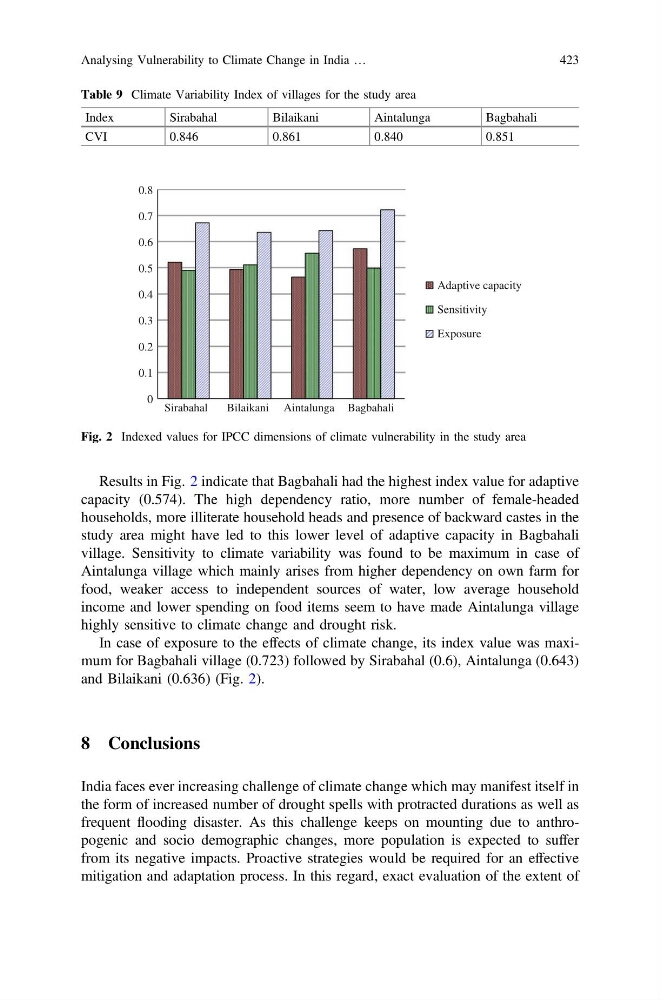
Results in Fig. 2 indicate that Bagbahali had the highest index value for adaptive
capacity (0.574). The high dependency ratio, more number of female-headed
households, more illiterate household heads and presence of backward castes in the
study area might have led to this lower level of adaptive capacity in Bagbahali
village. Sensitivity to climate variability was found to be maximum in case of
Aintalunga village which mainly arises from higher dependency on own farm for
food, weaker access to independent sources of water, low average household
income and lower spending on food items seem to have made Aintalunga village
highly sensitive to climate change and drought risk.
In case of exposure to the effects of climate change, its index value was maximum for Bagbahali village (0.723) followed by Sirabahal (0.6), Aintalunga (0.643)
and Bilaikani (0.636) (Fig. 2).
8 Conclusions
India faces ever increasing challenge of climate change which may manifest itself in
the form of increased number of drought spells with protracted durations as well as
frequent flooding disaster. As this challenge keeps on mounting due to anthropogenic and socio demographic changes, more population is expected to suffer
from its negative impacts. Proactive strategies would be required for an effective
mitigation and adaptation process. In this regard, exact evaluation of the extent of
Table 9 Climate Variability Index of villages for the study area
Index
Sirabahal
Bilaikani
Aintalunga
Bagbahali
CVI
0.846
0.861
0.840
0.851
0
0.1
0.2
0.3
0.4
0.5
0.6
0.7
0.8
Sirabahal
Bilaikani Aintalunga Bagbahali
Adaptive capacity
Sensitivity
Exposure
Fig. 2 Indexed values for IPCC dimensions of climate vulnerability in the study area
Analysing Vulnerability to Climate Change in India …
423
capacity (0.574). The high dependency ratio, more number of female-headed
households, more illiterate household heads and presence of backward castes in the
study area might have led to this lower level of adaptive capacity in Bagbahali
village. Sensitivity to climate variability was found to be maximum in case of
Aintalunga village which mainly arises from higher dependency on own farm for
food, weaker access to independent sources of water, low average household
income and lower spending on food items seem to have made Aintalunga village
highly sensitive to climate change and drought risk.
In case of exposure to the effects of climate change, its index value was maximum for Bagbahali village (0.723) followed by Sirabahal (0.6), Aintalunga (0.643)
and Bilaikani (0.636) (Fig. 2).
8 Conclusions
India faces ever increasing challenge of climate change which may manifest itself in
the form of increased number of drought spells with protracted durations as well as
frequent flooding disaster. As this challenge keeps on mounting due to anthropogenic and socio demographic changes, more population is expected to suffer
from its negative impacts. Proactive strategies would be required for an effective
mitigation and adaptation process. In this regard, exact evaluation of the extent of
Table 9 Climate Variability Index of villages for the study area
Index
Sirabahal
Bilaikani
Aintalunga
Bagbahali
CVI
0.846
0.861
0.840
0.851
0
0.1
0.2
0.3
0.4
0.5
0.6
0.7
0.8
Sirabahal
Bilaikani Aintalunga Bagbahali
Adaptive capacity
Sensitivity
Exposure
Fig. 2 Indexed values for IPCC dimensions of climate vulnerability in the study area
Analysing Vulnerability to Climate Change in India …
423