

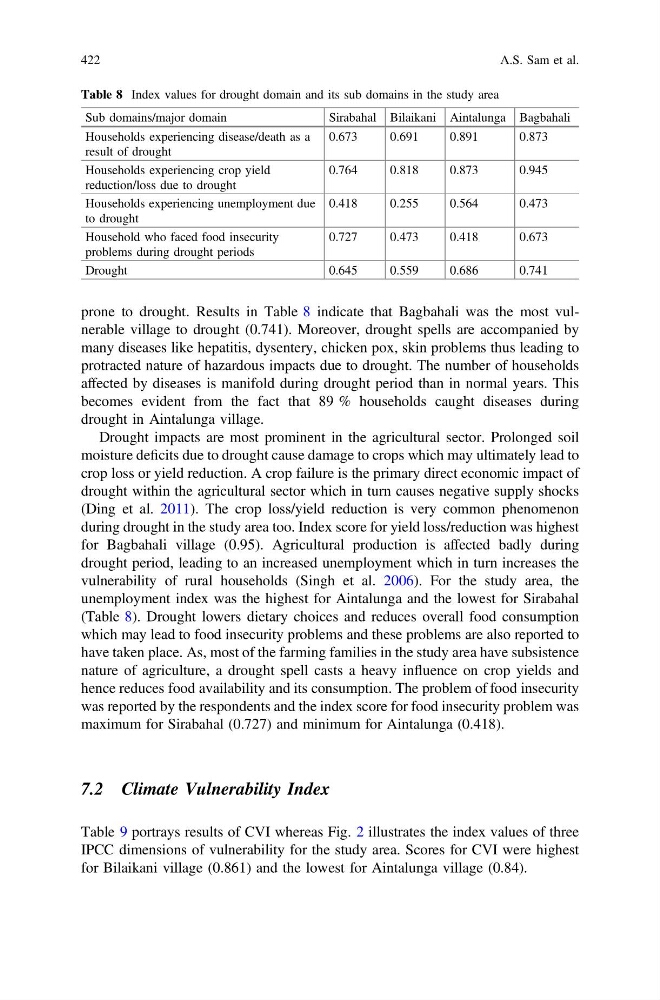
prone to drought. Results in Table 8 indicate that Bagbahali was the most vulnerable village to drought (0.741). Moreover, drought spells are accompanied by
many diseases like hepatitis, dysentery, chicken pox, skin problems thus leading to
protracted nature of hazardous impacts due to drought. The number of households
affected by diseases is manifold during drought period than in normal years. This
becomes evident from the fact that 89 % households caught diseases during
drought in Aintalunga village.
Drought impacts are most prominent in the agricultural sector. Prolonged soil
moisture deficits due to drought cause damage to crops which may ultimately lead to
crop loss or yield reduction. A crop failure is the primary direct economic impact of
drought within the agricultural sector which in turn causes negative supply shocks
(Ding et al. 2011). The crop loss/yield reduction is very common phenomenon
during drought in the study area too. Index score for yield loss/reduction was highest
for Bagbahali village (0.95). Agricultural production is affected badly during
drought period, leading to an increased unemployment which in turn increases the
vulnerability of rural households (Singh et al. 2006). For the study area, the
unemployment index was the highest for Aintalunga and the lowest for Sirabahal
(Table 8). Drought lowers dietary choices and reduces overall food consumption
which may lead to food insecurity problems and these problems are also reported to
have taken place. As, most of the farming families in the study area have subsistence
nature of agriculture, a drought spell casts a heavy influence on crop yields and
hence reduces food availability and its consumption. The problem of food insecurity
was reported by the respondents and the index score for food insecurity problem was
maximum for Sirabahal (0.727) and minimum for Aintalunga (0.418).
7.2 Climate Vulnerability Index
Table 9 portrays results of CVI whereas Fig. 2 illustrates the index values of three
IPCC dimensions of vulnerability for the study area. Scores for CVI were highest
for Bilaikani village (0.861) and the lowest for Aintalunga village (0.84).
Table 8 Index values for drought domain and its sub domains in the study area
Sub domains/major domain
Sirabahal Bilaikani Aintalunga Bagbahali
Households experiencing disease/death as a
result of drought
0.673
0.691
0.891
0.873
Households experiencing crop yield
reduction/loss due to drought
0.764
0.818
0.873
0.945
Households experiencing unemployment due
to drought
0.418
0.255
0.564
0.473
Household who faced food insecurity
problems during drought periods
0.727
0.473
0.418
0.673
Drought
0.645
0.559
0.686
0.741
422
A.S. Sam et al.
many diseases like hepatitis, dysentery, chicken pox, skin problems thus leading to
protracted nature of hazardous impacts due to drought. The number of households
affected by diseases is manifold during drought period than in normal years. This
becomes evident from the fact that 89 % households caught diseases during
drought in Aintalunga village.
Drought impacts are most prominent in the agricultural sector. Prolonged soil
moisture deficits due to drought cause damage to crops which may ultimately lead to
crop loss or yield reduction. A crop failure is the primary direct economic impact of
drought within the agricultural sector which in turn causes negative supply shocks
(Ding et al. 2011). The crop loss/yield reduction is very common phenomenon
during drought in the study area too. Index score for yield loss/reduction was highest
for Bagbahali village (0.95). Agricultural production is affected badly during
drought period, leading to an increased unemployment which in turn increases the
vulnerability of rural households (Singh et al. 2006). For the study area, the
unemployment index was the highest for Aintalunga and the lowest for Sirabahal
(Table 8). Drought lowers dietary choices and reduces overall food consumption
which may lead to food insecurity problems and these problems are also reported to
have taken place. As, most of the farming families in the study area have subsistence
nature of agriculture, a drought spell casts a heavy influence on crop yields and
hence reduces food availability and its consumption. The problem of food insecurity
was reported by the respondents and the index score for food insecurity problem was
maximum for Sirabahal (0.727) and minimum for Aintalunga (0.418).
7.2 Climate Vulnerability Index
Table 9 portrays results of CVI whereas Fig. 2 illustrates the index values of three
IPCC dimensions of vulnerability for the study area. Scores for CVI were highest
for Bilaikani village (0.861) and the lowest for Aintalunga village (0.84).
Table 8 Index values for drought domain and its sub domains in the study area
Sub domains/major domain
Sirabahal Bilaikani Aintalunga Bagbahali
Households experiencing disease/death as a
result of drought
0.673
0.691
0.891
0.873
Households experiencing crop yield
reduction/loss due to drought
0.764
0.818
0.873
0.945
Households experiencing unemployment due
to drought
0.418
0.255
0.564
0.473
Household who faced food insecurity
problems during drought periods
0.727
0.473
0.418
0.673
Drought
0.645
0.559
0.686
0.741
422
A.S. Sam et al.