

the government with assistance from International Fund for Agricultural
Development (IFAD) (www.ifad.org) to increase land under second harvest (Kanjilal
2000). Currently, only 20 % of the total area of the Sunderbans can produce two
harvests. Efforts are on, to increase this proportion as this has proved to be quite
profitable to the farmers (Bairi 2004). This has also made cultivation of certain winter
crops possible. However, Danda (2007) points out that lack of maintenance has turned
most of these canals dry. Since these are considered as government property, the
locals do not have any authority to reconstruct them (Banerjee 1998). The villagers do
not have the resource to re excavate the canals by themselves. They wait for the
government to do the maintenance work, knowing it would be a long wait.
With passage of time, new technologies have come up. Some well to do farmers
have bought diesel or kerosene driven generators which enables them to take water
from the ponds or extract groundwater for a second harvest. But again, not every
farmer in Sunderbans can afford a generator or pay for so much fuel. There are not
many rules followed in regards to groundwater extraction and thus the farmers
extract whatever amount they want, resulting in further depletion of groundwater
aquifers in this ecologically fragile region. At times, the owner of a pond might loan
it to a farmer without a pond, for a season. In return the owner is paid some rent or
in kind by the borrower. At times, in order to make more profits farmers tend to
grow the same crop every season which reduces the soil fertility. Hence, farmers are
encouraged to grow pulses, as they provide nitrogen to the soil. In the Sunderbans,
the soil salinity decreases during and after a good monsoon season and only starts
increasing from December. During summer and winter times it becomes clayey and
hard and hence is difficult to cultivate (Saha 2004). Historically the farmers used the
indigenous Matla and Hamilton paddy variety which were more salt resistant. The
indigenous variety of paddy which are used now, include Pankaj, Shalibon or
Bipasha. But hybrid varieties are used by the majority for higher yield. But the
hybrid ones require more water and fertilizer and are also more expensive. Other
crops include a few vegetables, some fruits and betel leaves. However, their saline
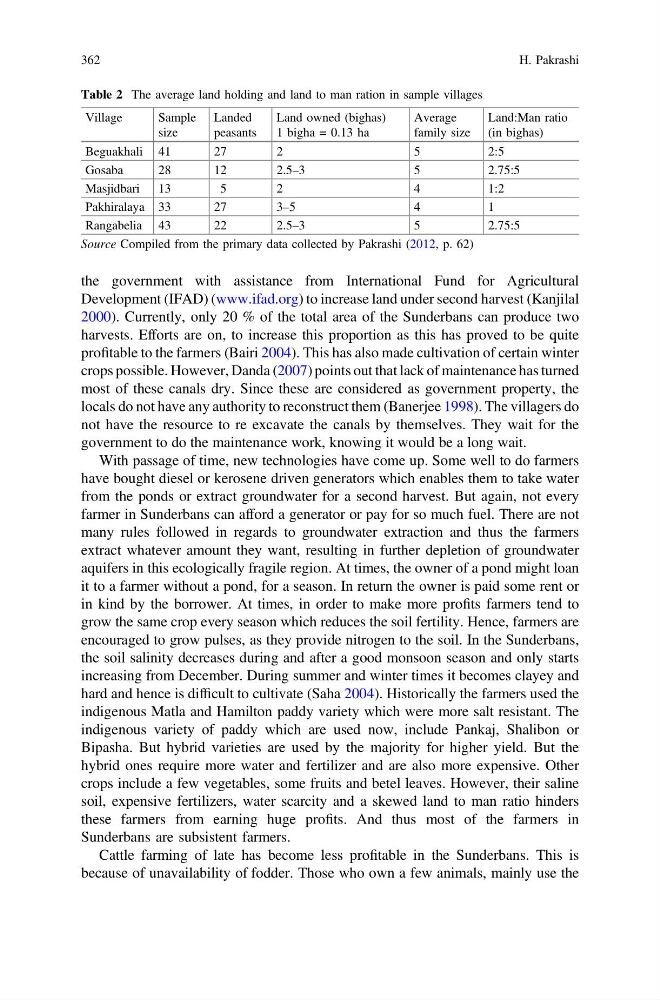
soil, expensive fertilizers, water scarcity and a skewed land to man ratio hinders
these farmers from earning huge profits. And thus most of the farmers in
Sunderbans are subsistent farmers.
Cattle farming of late has become less profitable in the Sunderbans. This is
because of unavailability of fodder. Those who own a few animals, mainly use the
Table 2 The average land holding and land to man ration in sample villages
Village
Sample
size
Landed
peasants
Land owned (bighas)
1 bigha = 0.13 ha
Average
family size
Land:Man ratio
(in bighas)
Beguakhali 41
27
2
5
2:5
Gosaba
28
12
2.5–3
5
2.75:5
Masjidbari 13
5
2
4
1:2
Pakhiralaya 33
27
3–5
4
1
Rangabelia 43
22
2.5–3
5
2.75:5
Source Compiled from the primary data collected by Pakrashi (2012, p. 62)
362
H. Pakrashi
Development (IFAD) (www.ifad.org) to increase land under second harvest (Kanjilal
2000). Currently, only 20 % of the total area of the Sunderbans can produce two
harvests. Efforts are on, to increase this proportion as this has proved to be quite
profitable to the farmers (Bairi 2004). This has also made cultivation of certain winter
crops possible. However, Danda (2007) points out that lack of maintenance has turned
most of these canals dry. Since these are considered as government property, the
locals do not have any authority to reconstruct them (Banerjee 1998). The villagers do
not have the resource to re excavate the canals by themselves. They wait for the
government to do the maintenance work, knowing it would be a long wait.
With passage of time, new technologies have come up. Some well to do farmers
have bought diesel or kerosene driven generators which enables them to take water
from the ponds or extract groundwater for a second harvest. But again, not every
farmer in Sunderbans can afford a generator or pay for so much fuel. There are not
many rules followed in regards to groundwater extraction and thus the farmers
extract whatever amount they want, resulting in further depletion of groundwater
aquifers in this ecologically fragile region. At times, the owner of a pond might loan
it to a farmer without a pond, for a season. In return the owner is paid some rent or
in kind by the borrower. At times, in order to make more profits farmers tend to
grow the same crop every season which reduces the soil fertility. Hence, farmers are
encouraged to grow pulses, as they provide nitrogen to the soil. In the Sunderbans,
the soil salinity decreases during and after a good monsoon season and only starts
increasing from December. During summer and winter times it becomes clayey and
hard and hence is difficult to cultivate (Saha 2004). Historically the farmers used the
indigenous Matla and Hamilton paddy variety which were more salt resistant. The
indigenous variety of paddy which are used now, include Pankaj, Shalibon or
Bipasha. But hybrid varieties are used by the majority for higher yield. But the
hybrid ones require more water and fertilizer and are also more expensive. Other
crops include a few vegetables, some fruits and betel leaves. However, their saline
soil, expensive fertilizers, water scarcity and a skewed land to man ratio hinders
these farmers from earning huge profits. And thus most of the farmers in
Sunderbans are subsistent farmers.
Cattle farming of late has become less profitable in the Sunderbans. This is
because of unavailability of fodder. Those who own a few animals, mainly use the
Table 2 The average land holding and land to man ration in sample villages
Village
Sample
size
Landed
peasants
Land owned (bighas)
1 bigha = 0.13 ha
Average
family size
Land:Man ratio
(in bighas)
Beguakhali 41
27
2
5
2:5
Gosaba
28
12
2.5–3
5
2.75:5
Masjidbari 13
5
2
4
1:2
Pakhiralaya 33
27
3–5
4
1
Rangabelia 43
22
2.5–3
5
2.75:5
Source Compiled from the primary data collected by Pakrashi (2012, p. 62)
362
H. Pakrashi