

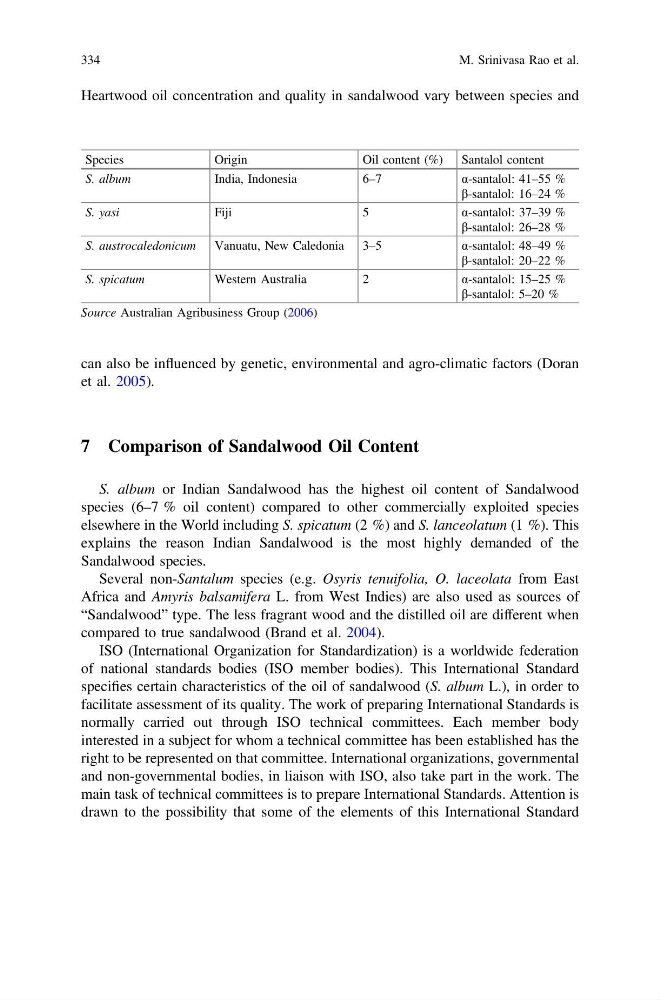
Heartwood oil concentration and quality in sandalwood vary between species and
can also be influenced by genetic, environmental and agro-climatic factors (Doran
et al. 2005).
7 Comparison of Sandalwood Oil Content
S. album or Indian Sandalwood has the highest oil content of Sandalwood
species (6–7 % oil content) compared to other commercially exploited species
elsewhere in the World including S. spicatum (2 %) and S. lanceolatum (1 %). This
explains the reason Indian Sandalwood is the most highly demanded of the
Sandalwood species.
Several non-Santalum species (e.g. Osyris tenuifolia, O. laceolata from East
Africa and Amyris balsamifera L. from West Indies) are also used as sources of
“Sandalwood” type. The less fragrant wood and the distilled oil are different when
compared to true sandalwood (Brand et al. 2004).
ISO (International Organization for Standardization) is a worldwide federation
of national standards bodies (ISO member bodies). This International Standard
specifies certain characteristics of the oil of sandalwood (S. album L.), in order to
facilitate assessment of its quality. The work of preparing International Standards is
normally carried out through ISO technical committees. Each member body
interested in a subject for whom a technical committee has been established has the
right to be represented on that committee. International organizations, governmental
and non-governmental bodies, in liaison with ISO, also take part in the work. The
main task of technical committees is to prepare International Standards. Attention is
drawn to the possibility that some of the elements of this International Standard
Species
Origin
Oil content (%) Santalol content
S. album
India, Indonesia
6–7
α-santalol: 41–55 %
β-santalol: 16–24 %
S. yasi
Fiji
5
α-santalol: 37–39 %
β-santalol: 26–28 %
S. austrocaledonicum Vanuatu, New Caledonia 3–5
α-santalol: 48–49 %
β-santalol: 20–22 %
S. spicatum
Western Australia
2
α-santalol: 15–25 %
β-santalol: 5–20 %
Source Australian Agribusiness Group (2006)
334
M. Srinivasa Rao et al.
can also be influenced by genetic, environmental and agro-climatic factors (Doran
et al. 2005).
7 Comparison of Sandalwood Oil Content
S. album or Indian Sandalwood has the highest oil content of Sandalwood
species (6–7 % oil content) compared to other commercially exploited species
elsewhere in the World including S. spicatum (2 %) and S. lanceolatum (1 %). This
explains the reason Indian Sandalwood is the most highly demanded of the
Sandalwood species.
Several non-Santalum species (e.g. Osyris tenuifolia, O. laceolata from East
Africa and Amyris balsamifera L. from West Indies) are also used as sources of
“Sandalwood” type. The less fragrant wood and the distilled oil are different when
compared to true sandalwood (Brand et al. 2004).
ISO (International Organization for Standardization) is a worldwide federation
of national standards bodies (ISO member bodies). This International Standard
specifies certain characteristics of the oil of sandalwood (S. album L.), in order to
facilitate assessment of its quality. The work of preparing International Standards is
normally carried out through ISO technical committees. Each member body
interested in a subject for whom a technical committee has been established has the
right to be represented on that committee. International organizations, governmental
and non-governmental bodies, in liaison with ISO, also take part in the work. The
main task of technical committees is to prepare International Standards. Attention is
drawn to the possibility that some of the elements of this International Standard
Species
Origin
Oil content (%) Santalol content
S. album
India, Indonesia
6–7
α-santalol: 41–55 %
β-santalol: 16–24 %
S. yasi
Fiji
5
α-santalol: 37–39 %
β-santalol: 26–28 %
S. austrocaledonicum Vanuatu, New Caledonia 3–5
α-santalol: 48–49 %
β-santalol: 20–22 %
S. spicatum
Western Australia
2
α-santalol: 15–25 %
β-santalol: 5–20 %
Source Australian Agribusiness Group (2006)
334
M. Srinivasa Rao et al.