

Many of these are under the threat of extinction due to over exploitation. East
Indian sandalwood, S. album L., is the queen among the species yielding supreme
quality essential oil much required by domestic and international perfume and allied
industries (Ananthapadmanabha 2011).
Sandalwood plants are widely distributed in Southern parts of peninsular India
mainly in the States like, Karnataka, Tamil Nadu, Andhra Pradesh and Kerala. The
value of sandalwood was realized as early as 1792 when Tipu Sultan the then ruler
of Mysore declared it as a “Royal Tree”. Due to this historical reason sandalwood
has ever since remained under government control. It is defined as a “forest produce”, although it does not have any special provisions under “Indian Forest Act”.
Sandalwood resource in India especially wild population is currently threatened
mainly because of illicit felling, forest fire and grazing and to a certain extent spike
disease coupled with heavy domestic and international demand with inadequate
uniform regulation in the Southern states especially in Tamil Nadu, Karnataka and
Kerala. Smuggling of Sandalwood has created socio-economic and law and order
problems in all Sandalwood producing states.
India realised the value of sandalwood trade and took positive steps to protect
the natural population of sandalwood. Measures to sustain this valued bio resources,
took prominence and flaws in policy which endangered the species were amended.
Government of Karnataka promulgated an amendment to Karnataka Forest Act in
2001 to encourage private domestication of sandalwood as a means to conserve and
enhance the status of this resource. The amendment gave landowners full legal right
to trees on their land, made them eligible to receive full value on extraction and
made amendments on the sale of sandalwood through forest department and govt.
departments. Tamil Nadu followed path with the Tamil Nadu Forest (Amendment)
Act in 2002, the landowners were given the right to trees (Dhanya et al. 2010).
Subsequently, Kerala Forest (Amendment) Act in 2010 regulated cutting and
possession of sandalwood.
A need was felt to take sandalwood beyond the burden of forests and farmers
through people’s participation. Karnataka Soaps and Detergents Limited,
Bangalore, which is a State owned Company in India with nearly a 100 year legacy
in the production of natural sandalwood oil and sandalwood oil-based products is
working towards promoting sustainable development of sandalwood for meeting
the needs of society, present and future. Accordingly, the company integrated the
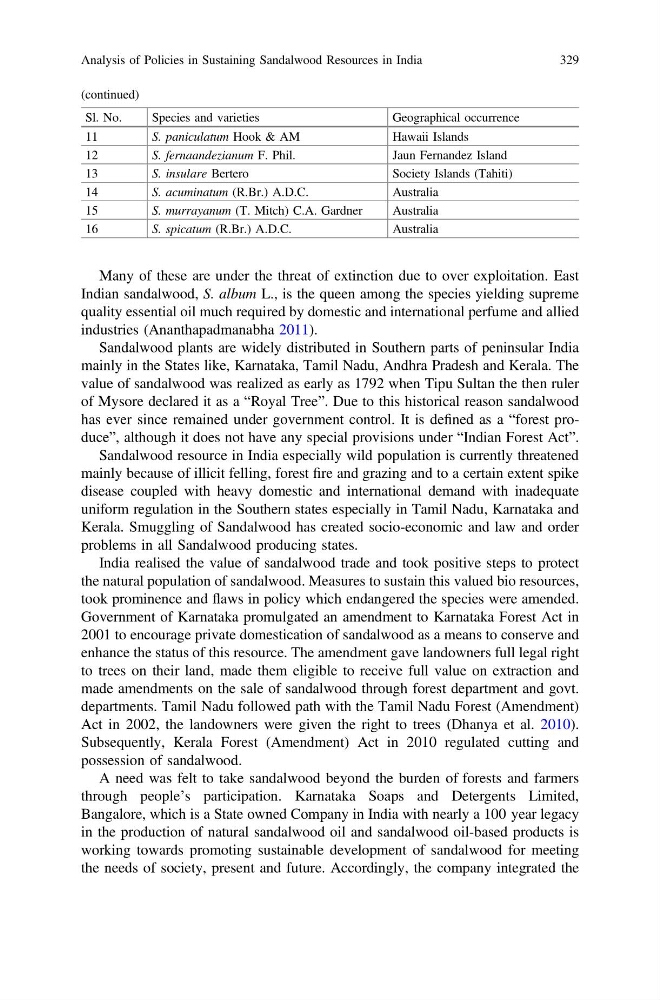
(continued)
Sl. No.
Species and varieties
Geographical occurrence
11
S. paniculatum Hook & AM
Hawaii Islands
12
S. fernaandezianum F. Phil.
Jaun Fernandez Island
13
S. insulare Bertero
Society Islands (Tahiti)
14
S. acuminatum (R.Br.) A.D.C.
Australia
15
S. murrayanum (T. Mitch) C.A. Gardner
Australia
16
S. spicatum (R.Br.) A.D.C.
Australia
Analysis of Policies in Sustaining Sandalwood Resources in India
329
Indian sandalwood, S. album L., is the queen among the species yielding supreme
quality essential oil much required by domestic and international perfume and allied
industries (Ananthapadmanabha 2011).
Sandalwood plants are widely distributed in Southern parts of peninsular India
mainly in the States like, Karnataka, Tamil Nadu, Andhra Pradesh and Kerala. The
value of sandalwood was realized as early as 1792 when Tipu Sultan the then ruler
of Mysore declared it as a “Royal Tree”. Due to this historical reason sandalwood
has ever since remained under government control. It is defined as a “forest produce”, although it does not have any special provisions under “Indian Forest Act”.
Sandalwood resource in India especially wild population is currently threatened
mainly because of illicit felling, forest fire and grazing and to a certain extent spike
disease coupled with heavy domestic and international demand with inadequate
uniform regulation in the Southern states especially in Tamil Nadu, Karnataka and
Kerala. Smuggling of Sandalwood has created socio-economic and law and order
problems in all Sandalwood producing states.
India realised the value of sandalwood trade and took positive steps to protect
the natural population of sandalwood. Measures to sustain this valued bio resources,
took prominence and flaws in policy which endangered the species were amended.
Government of Karnataka promulgated an amendment to Karnataka Forest Act in
2001 to encourage private domestication of sandalwood as a means to conserve and
enhance the status of this resource. The amendment gave landowners full legal right
to trees on their land, made them eligible to receive full value on extraction and
made amendments on the sale of sandalwood through forest department and govt.
departments. Tamil Nadu followed path with the Tamil Nadu Forest (Amendment)
Act in 2002, the landowners were given the right to trees (Dhanya et al. 2010).
Subsequently, Kerala Forest (Amendment) Act in 2010 regulated cutting and
possession of sandalwood.
A need was felt to take sandalwood beyond the burden of forests and farmers
through people’s participation. Karnataka Soaps and Detergents Limited,
Bangalore, which is a State owned Company in India with nearly a 100 year legacy
in the production of natural sandalwood oil and sandalwood oil-based products is
working towards promoting sustainable development of sandalwood for meeting
the needs of society, present and future. Accordingly, the company integrated the
(continued)
Sl. No.
Species and varieties
Geographical occurrence
11
S. paniculatum Hook & AM
Hawaii Islands
12
S. fernaandezianum F. Phil.
Jaun Fernandez Island
13
S. insulare Bertero
Society Islands (Tahiti)
14
S. acuminatum (R.Br.) A.D.C.
Australia
15
S. murrayanum (T. Mitch) C.A. Gardner
Australia
16
S. spicatum (R.Br.) A.D.C.
Australia
Analysis of Policies in Sustaining Sandalwood Resources in India
329