

1 Introduction
Santalum album, the Indian Sandalwood, of the genus Santalum, is a semi-parasitic
woody plant and produces highly aromatic oil, price of which is skyrocketing in the
world market of perfumery. Traditionally, sandalwood oil has unique stability, and
provides perfume with its best fixative property. The heartwood, sandalwood’s
fragrant timber, has long been used traditionally in important religious ceremonies
not only in India but in many parts of the world. Smaller amounts of sandalwood are
also used for decorative carving, craft and smaller furniture pieces. Sandalwood oil
has antipyretic, antiseptic, antiscabietic, and diuretic properties. It is also effective in
the treatment of bronchitis, cystitis, dysuria and diseases of the urinary tract. The oil
has an important place in the indigenous system of medicine. It is considered a cure
against migraine. Markets worldwide are currently facing a serious shortage of this
increasingly expensive, high-quality Indian sandalwood (S. album)—largely as a
result of unsustainable harvesting of the species over a long period of time in its
native environments of India. Indian sandalwood tree is becoming endangered, and
in an attempt to curb its possible extinction increased interest by both forest
departments and private growers towards expansion of plantations has added to the
resource building of this valuable tree (Venkatesha Gowda 2011).
2 Conservation Status of Sandalwood Species
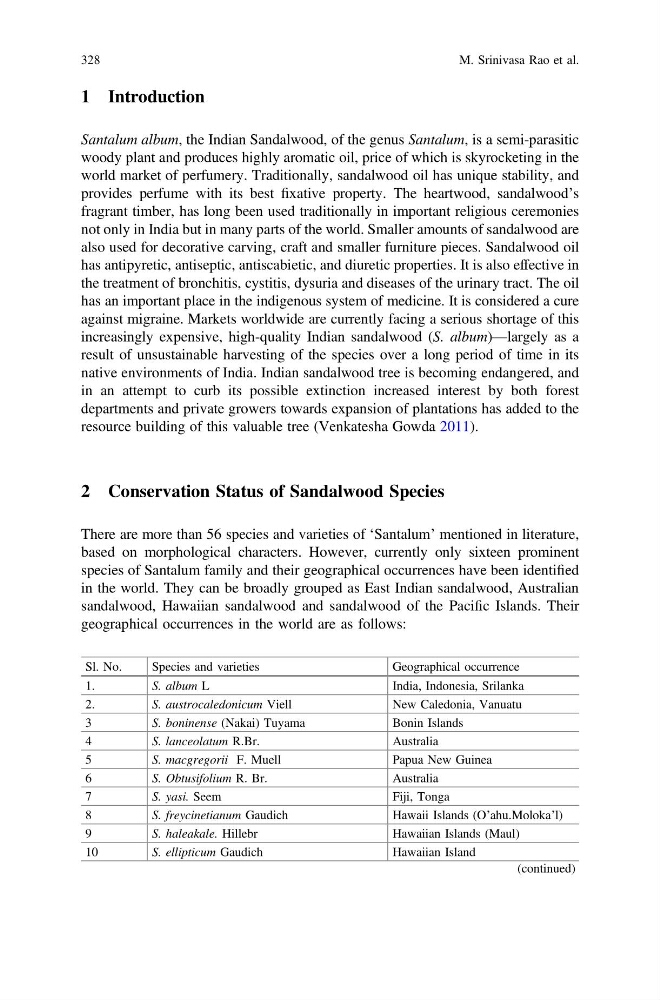
There are more than 56 species and varieties of ‘Santalum’ mentioned in literature,
based on morphological characters. However, currently only sixteen prominent
species of Santalum family and their geographical occurrences have been identified
in the world. They can be broadly grouped as East Indian sandalwood, Australian
sandalwood, Hawaiian sandalwood and sandalwood of the Pacific Islands. Their
geographical occurrences in the world are as follows:
Sl. No.
Species and varieties
Geographical occurrence
1.
S. album L
India, Indonesia, Srilanka
2.
S. austrocaledonicum Viell
New Caledonia, Vanuatu
3
S. boninense (Nakai) Tuyama
Bonin Islands
4
S. lanceolatum R.Br.
Australia
5
S. macgregorii F. Muell
Papua New Guinea
6
S. Obtusifolium R. Br.
Australia
7
S. yasi. Seem
Fiji, Tonga
8
S. freycinetianum Gaudich
Hawaii Islands (O’ahu.Moloka’l)
9
S. haleakale. Hillebr
Hawaiian Islands (Maul)
10
S. ellipticum Gaudich
Hawaiian Island
(continued)
328
M. Srinivasa Rao et al.
Santalum album, the Indian Sandalwood, of the genus Santalum, is a semi-parasitic
woody plant and produces highly aromatic oil, price of which is skyrocketing in the
world market of perfumery. Traditionally, sandalwood oil has unique stability, and
provides perfume with its best fixative property. The heartwood, sandalwood’s
fragrant timber, has long been used traditionally in important religious ceremonies
not only in India but in many parts of the world. Smaller amounts of sandalwood are
also used for decorative carving, craft and smaller furniture pieces. Sandalwood oil
has antipyretic, antiseptic, antiscabietic, and diuretic properties. It is also effective in
the treatment of bronchitis, cystitis, dysuria and diseases of the urinary tract. The oil
has an important place in the indigenous system of medicine. It is considered a cure
against migraine. Markets worldwide are currently facing a serious shortage of this
increasingly expensive, high-quality Indian sandalwood (S. album)—largely as a
result of unsustainable harvesting of the species over a long period of time in its
native environments of India. Indian sandalwood tree is becoming endangered, and
in an attempt to curb its possible extinction increased interest by both forest
departments and private growers towards expansion of plantations has added to the
resource building of this valuable tree (Venkatesha Gowda 2011).
2 Conservation Status of Sandalwood Species
There are more than 56 species and varieties of ‘Santalum’ mentioned in literature,
based on morphological characters. However, currently only sixteen prominent
species of Santalum family and their geographical occurrences have been identified
in the world. They can be broadly grouped as East Indian sandalwood, Australian
sandalwood, Hawaiian sandalwood and sandalwood of the Pacific Islands. Their
geographical occurrences in the world are as follows:
Sl. No.
Species and varieties
Geographical occurrence
1.
S. album L
India, Indonesia, Srilanka
2.
S. austrocaledonicum Viell
New Caledonia, Vanuatu
3
S. boninense (Nakai) Tuyama
Bonin Islands
4
S. lanceolatum R.Br.
Australia
5
S. macgregorii F. Muell
Papua New Guinea
6
S. Obtusifolium R. Br.
Australia
7
S. yasi. Seem
Fiji, Tonga
8
S. freycinetianum Gaudich
Hawaii Islands (O’ahu.Moloka’l)
9
S. haleakale. Hillebr
Hawaiian Islands (Maul)
10
S. ellipticum Gaudich
Hawaiian Island
(continued)
328
M. Srinivasa Rao et al.