

is positive and statistically significant relationship between mitigating expenses and
per capita assets. This might be happening because wealthier individuals do not
hesitate to take mitigating activities if they are suspected to some diseases in
comparison to people who have lesser assets.
Education raises awareness level of individuals with respect to environmental
problems and related health damages and helps in taking informed preventing
activity-related decisions. The coefficient of education is negative, as expected,
though statistically insignificant, depicts that there happens to be a reduction in
mitigation expenditure with the increase in education level. Similarly, the individuals who have to work in agriculture fields where burning of agricultural residue
takes place are thought to be more prone to the adverse effects of pollution in
comparison to their counterparts who are in other occupations such as salaried
individuals. We use dummy variable equal to one for farmers and agricultural wage
earners and zero for the individuals who are in other occupations. We find a positive
association between occupation variable and medical expenditure.
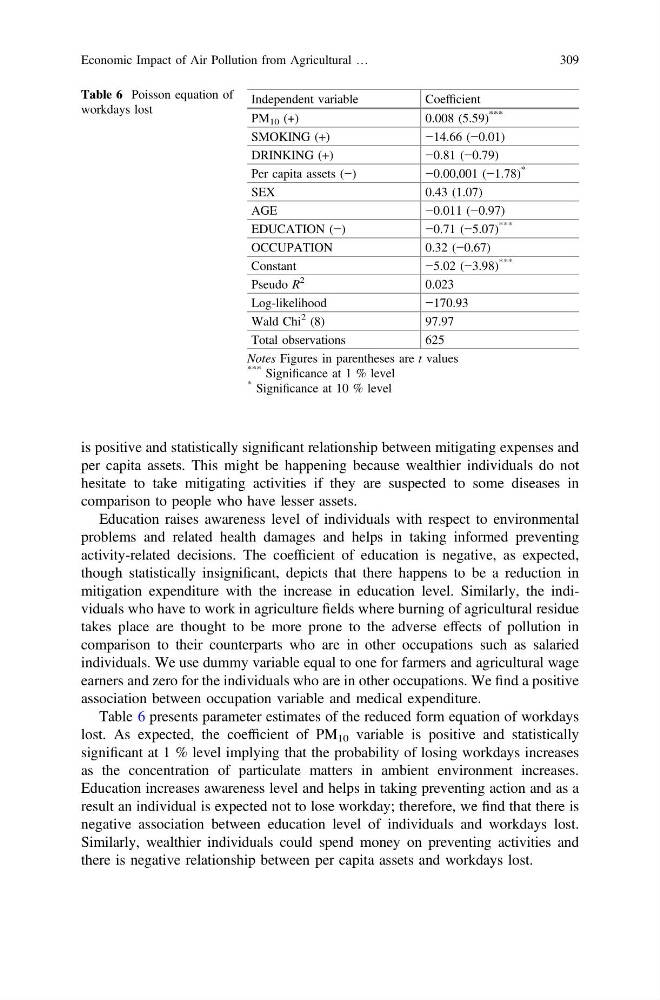
Table 6 presents parameter estimates of the reduced form equation of workdays
lost. As expected, the coefficient of PM 10 variable is positive and statistically
significant at 1 % level implying that the probability of losing workdays increases
as the concentration of particulate matters in ambient environment increases.
Education increases awareness level and helps in taking preventing action and as a
result an individual is expected not to lose workday; therefore, we find that there is
negative association between education level of individuals and workdays lost.
Similarly, wealthier individuals could spend money on preventing activities and
there is negative relationship between per capita assets and workdays lost.
Table 6 Poisson equation of
workdays lost
Independent variable
Coefficient
PM 10 (+)
0.008 (5.59)
***
SMOKING (+)
−14.66 (−0.01)
DRINKING (+)
−0.81 (−0.79)
Per capita assets (−)
−0.00,001 (−1.78)
*
SEX
0.43 (1.07)
AGE
−0.011 (−0.97)
EDUCATION (−)
−0.71 (−5.07)
***
OCCUPATION
0.32 (−0.67)
Constant
−5.02 (−3.98)
***
Pseudo R
2
0.023
Log-likelihood
−170.93
Wald Chi
2 (8)
97.97
Total observations
625
Notes Figures in parentheses are t values
*** Significance at 1 % level
* Significance at 10 % level
Economic Impact of Air Pollution from Agricultural …
309
per capita assets. This might be happening because wealthier individuals do not
hesitate to take mitigating activities if they are suspected to some diseases in
comparison to people who have lesser assets.
Education raises awareness level of individuals with respect to environmental
problems and related health damages and helps in taking informed preventing
activity-related decisions. The coefficient of education is negative, as expected,
though statistically insignificant, depicts that there happens to be a reduction in
mitigation expenditure with the increase in education level. Similarly, the individuals who have to work in agriculture fields where burning of agricultural residue
takes place are thought to be more prone to the adverse effects of pollution in
comparison to their counterparts who are in other occupations such as salaried
individuals. We use dummy variable equal to one for farmers and agricultural wage
earners and zero for the individuals who are in other occupations. We find a positive
association between occupation variable and medical expenditure.
Table 6 presents parameter estimates of the reduced form equation of workdays
lost. As expected, the coefficient of PM 10 variable is positive and statistically
significant at 1 % level implying that the probability of losing workdays increases
as the concentration of particulate matters in ambient environment increases.
Education increases awareness level and helps in taking preventing action and as a
result an individual is expected not to lose workday; therefore, we find that there is
negative association between education level of individuals and workdays lost.
Similarly, wealthier individuals could spend money on preventing activities and
there is negative relationship between per capita assets and workdays lost.
Table 6 Poisson equation of
workdays lost
Independent variable
Coefficient
PM 10 (+)
0.008 (5.59)
***
SMOKING (+)
−14.66 (−0.01)
DRINKING (+)
−0.81 (−0.79)
Per capita assets (−)
−0.00,001 (−1.78)
*
SEX
0.43 (1.07)
AGE
−0.011 (−0.97)
EDUCATION (−)
−0.71 (−5.07)
***
OCCUPATION
0.32 (−0.67)
Constant
−5.02 (−3.98)
***
Pseudo R
2
0.023
Log-likelihood
−170.93
Wald Chi
2 (8)
97.97
Total observations
625
Notes Figures in parentheses are t values
*** Significance at 1 % level
* Significance at 10 % level
Economic Impact of Air Pollution from Agricultural …
309