

completely. Therefore, ‘sick time,’ S, can also be assumed to be the function of
defensive expenditure and contaminated air quality,
S ¼ SðD; PÞ
ð 2Þ
where S D < 0, S P > 0, S DD > 0, S PP > 0
Equation (1) is the maximized subject to the following constraints:
The time constraint is
W þ S ¼ T
ð3Þ
where W is the work time and T is the total time available. The income (resource)
constraint is
I þ wHðD; PÞW ! mS þ D þ X
ð4Þ
where mS is the medical expenses which are assumed proportional to illness, S,
I denotes nonwage income, and w is referred as wage rate.The Lagrangian of the
problem is
P ¼ HðD; PÞUðXÞ þ k½I þ wHðD; PÞðT À SÞ À D À X À mS
ð 5Þ
The first-order optimization conditions are
P X ¼ HðD; PÞU X À k ¼ 0
P D ¼ H D U þ kH D wW À kHwS D À k À kmS D ¼ 0
ð6Þ
Using the envelope theorem, Harrington et al. (1989) obtain the WTP as
WTP ¼ À
H D U
k
þ H D wW
H P
H D
þ HwS D þ mS D
ð
Þ
S P
S D
ð7Þ
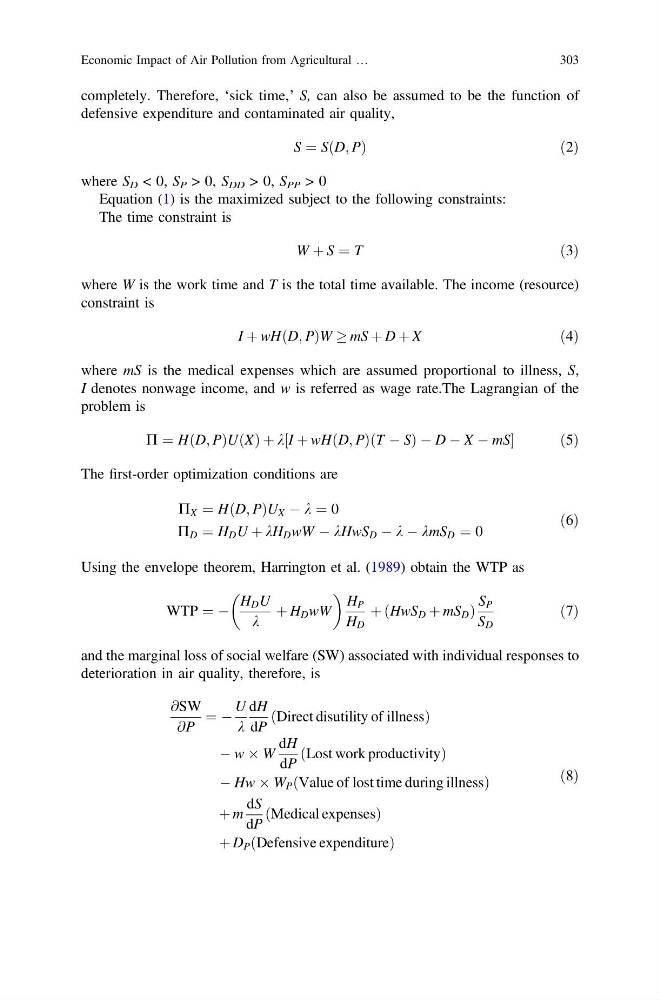
and the marginal loss of social welfare (SW) associated with individual responses to
deterioration in air quality, therefore, is
@SW
@P
¼ À
U
k
dH
dP
Direct disutility of illness
ð
Þ
À w  W
dH
dP
Lost work productivity
ð
Þ
À Hw  W P Value of lost time during illness
ð
Þ
þ m
dS
dP
Medical expenses
ð
Þ
þ D P Defensive expenditure
ð
Þ
ð8Þ
Economic Impact of Air Pollution from Agricultural …
303
defensive expenditure and contaminated air quality,
S ¼ SðD; PÞ
ð 2Þ
where S D < 0, S P > 0, S DD > 0, S PP > 0
Equation (1) is the maximized subject to the following constraints:
The time constraint is
W þ S ¼ T
ð3Þ
where W is the work time and T is the total time available. The income (resource)
constraint is
I þ wHðD; PÞW ! mS þ D þ X
ð4Þ
where mS is the medical expenses which are assumed proportional to illness, S,
I denotes nonwage income, and w is referred as wage rate.The Lagrangian of the
problem is
P ¼ HðD; PÞUðXÞ þ k½I þ wHðD; PÞðT À SÞ À D À X À mS
ð 5Þ
The first-order optimization conditions are
P X ¼ HðD; PÞU X À k ¼ 0
P D ¼ H D U þ kH D wW À kHwS D À k À kmS D ¼ 0
ð6Þ
Using the envelope theorem, Harrington et al. (1989) obtain the WTP as
WTP ¼ À
H D U
k
þ H D wW
H P
H D
þ HwS D þ mS D
ð
Þ
S P
S D
ð7Þ
and the marginal loss of social welfare (SW) associated with individual responses to
deterioration in air quality, therefore, is
@SW
@P
¼ À
U
k
dH
dP
Direct disutility of illness
ð
Þ
À w  W
dH
dP
Lost work productivity
ð
Þ
À Hw  W P Value of lost time during illness
ð
Þ
þ m
dS
dP
Medical expenses
ð
Þ
þ D P Defensive expenditure
ð
Þ
ð8Þ
Economic Impact of Air Pollution from Agricultural …
303