

formal medication such as fee paid to a doctor, expenses on the allopathic
medicines, cost of hospitalization, etc., while the latter section provides information
on expenditure incurred on informal medicines that Indian household generally
takes without consulting any medical professional. Last two sections provide
information on individual habits and households assets. Information on the habits
includes whether an individual is habitual to smoking, alcohol drinking, or/and
taking any other toxicants that affect health in general.
4 Methodology
4.1 Theoretical Model
Air quality affects the utility of individuals and an economic value exists. There are
several ways to capture this economic value, viz., dose-response, revealed preferences, and contingent valuation methods. The dose-response method assumes a
relationship between air quality and morbidity (and/or mortality). It puts a price tag
on air quality without retrieving people’s preferences for the good. But, such type of
mechanical relationship of the dose-response function does not take into account
consumer behavior. The revealed preference methods assume that the consumers
are aware of the costs/benefits of air quality and are able to adjust their behavior to
reveal their preferences. This necessitates the need to have estimates of willingness
to pay (WTP) or willingness to accept (WTA) on the basis of a consumer choice
model aimed at measuring the strength of association between health effects and
contaminated air quality.
Suppose an individual maximizes his/her utility through expenditure on marketed goods and services, X.
4 The utility depends not only on X but also on the state
of health, H, of an individual which is affected by the level of air quality
(non-marketed good). It is further assumed that the contaminated air quality, P, is
beyond the control of individuals, but individuals can at least partially reduce its
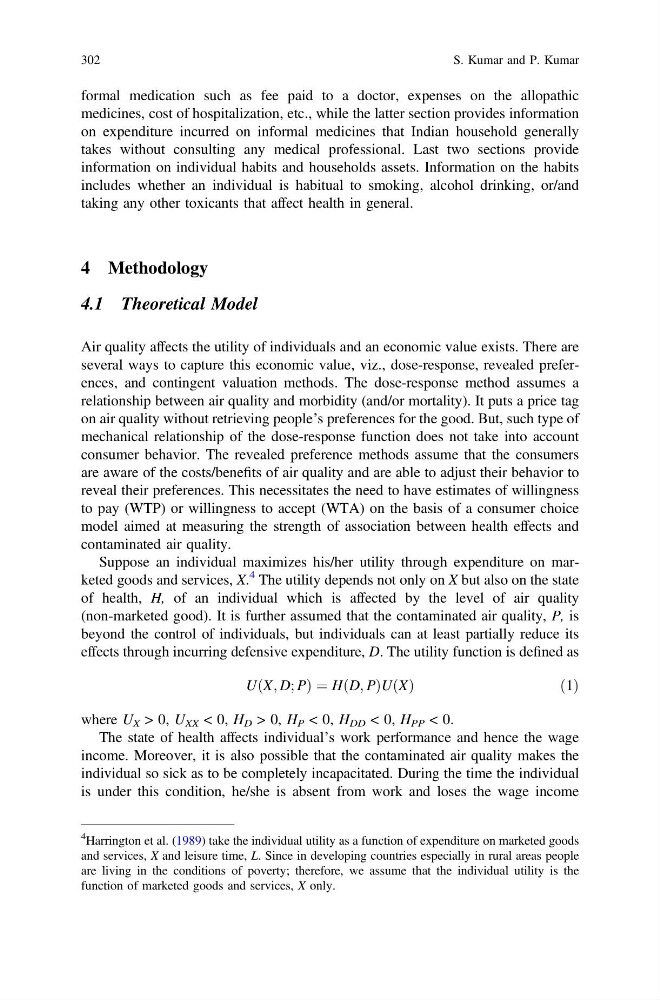
effects through incurring defensive expenditure, D. The utility function is defined as
UðX; D; PÞ ¼ HðD; PÞUðXÞ
ð 1Þ
where U X > 0, U XX < 0, H D > 0, H P < 0, H DD < 0, H PP < 0.
The state of health affects individual’s work performance and hence the wage
income. Moreover, it is also possible that the contaminated air quality makes the
individual so sick as to be completely incapacitated. During the time the individual
is under this condition, he/she is absent from work and loses the wage income
4
Harrington et al. (1989) take the individual utility as a function of expenditure on marketed goods
and services, X and leisure time, L. Since in developing countries especially in rural areas people
are living in the conditions of poverty; therefore, we assume that the individual utility is the
function of marketed goods and services, X only.
302
S. Kumar and P. Kumar
medicines, cost of hospitalization, etc., while the latter section provides information
on expenditure incurred on informal medicines that Indian household generally
takes without consulting any medical professional. Last two sections provide
information on individual habits and households assets. Information on the habits
includes whether an individual is habitual to smoking, alcohol drinking, or/and
taking any other toxicants that affect health in general.
4 Methodology
4.1 Theoretical Model
Air quality affects the utility of individuals and an economic value exists. There are
several ways to capture this economic value, viz., dose-response, revealed preferences, and contingent valuation methods. The dose-response method assumes a
relationship between air quality and morbidity (and/or mortality). It puts a price tag
on air quality without retrieving people’s preferences for the good. But, such type of
mechanical relationship of the dose-response function does not take into account
consumer behavior. The revealed preference methods assume that the consumers
are aware of the costs/benefits of air quality and are able to adjust their behavior to
reveal their preferences. This necessitates the need to have estimates of willingness
to pay (WTP) or willingness to accept (WTA) on the basis of a consumer choice
model aimed at measuring the strength of association between health effects and
contaminated air quality.
Suppose an individual maximizes his/her utility through expenditure on marketed goods and services, X.
4 The utility depends not only on X but also on the state
of health, H, of an individual which is affected by the level of air quality
(non-marketed good). It is further assumed that the contaminated air quality, P, is
beyond the control of individuals, but individuals can at least partially reduce its
effects through incurring defensive expenditure, D. The utility function is defined as
UðX; D; PÞ ¼ HðD; PÞUðXÞ
ð 1Þ
where U X > 0, U XX < 0, H D > 0, H P < 0, H DD < 0, H PP < 0.
The state of health affects individual’s work performance and hence the wage
income. Moreover, it is also possible that the contaminated air quality makes the
individual so sick as to be completely incapacitated. During the time the individual
is under this condition, he/she is absent from work and loses the wage income
4
Harrington et al. (1989) take the individual utility as a function of expenditure on marketed goods
and services, X and leisure time, L. Since in developing countries especially in rural areas people
are living in the conditions of poverty; therefore, we assume that the individual utility is the
function of marketed goods and services, X only.
302
S. Kumar and P. Kumar