

As far as environmental accounts are concerned, one may include other types of
environmental indicators, like waste generation and the depletion of natural
resources other than gas and oil. Furthermore, it may involve the inclusion of stock
data on natural resources and on accumulated pollutants. In addition, attempts
might be made to disaggregate the production and commodity accounts in the
money-metric part of the ESAM in order to show explicitly the production of goods
and services associated with environmental protection and restoration. Also,
attempts to disaggregate the tax account for institutions, in order to make visible
environment-related tax policies, could be mentioned in this connection.
Finally, it seems only logic to recommend the construction of ESAM-based
models and to explore the development of the required algorithms to solve them.
This is only way one can assess the robustness of method, and together with the
extended SAM, to develop CGE models which include the aspects of sustainability.
Appendix 1
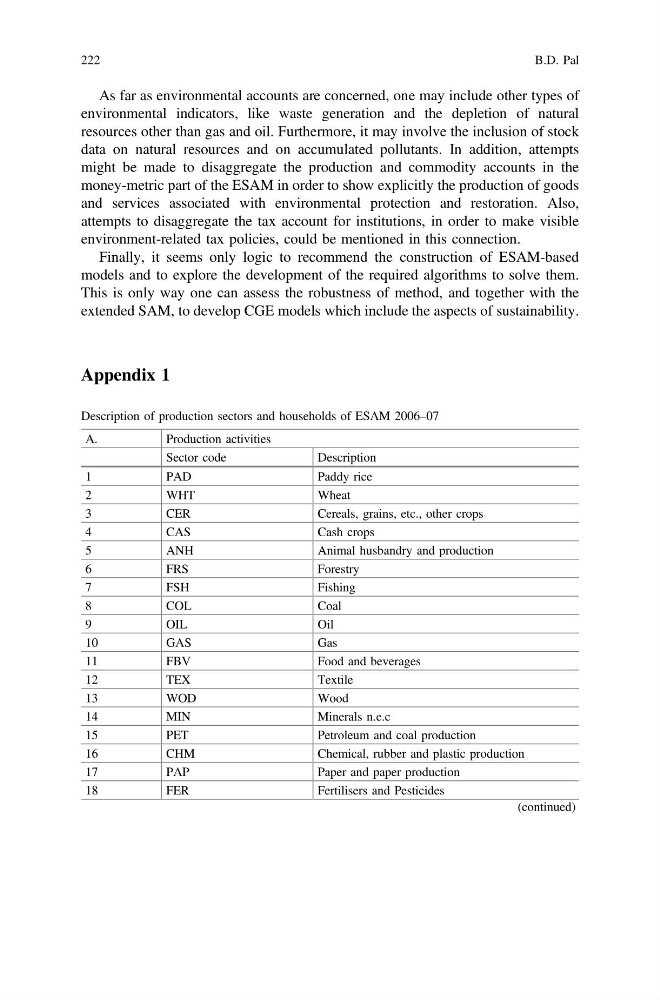
Description of production sectors and households of ESAM 2006–07
A.
Production activities
Sector code
Description
1
PAD
Paddy rice
2
WHT
Wheat
3
CER
Cereals, grains, etc., other crops
4
CAS
Cash crops
5
ANH
Animal husbandry and production
6
FRS
Forestry
7
FSH
Fishing
8
COL
Coal
9
OIL
Oil
10
GAS
Gas
11
FBV
Food and beverages
12
TEX
Textile
13
WOD
Wood
14
MIN
Minerals n.e.c
15
PET
Petroleum and coal production
16
CHM
Chemical, rubber and plastic production
17
PAP
Paper and paper production
18
FER
Fertilisers and Pesticides
(continued)
222
B.D. Pal
environmental indicators, like waste generation and the depletion of natural
resources other than gas and oil. Furthermore, it may involve the inclusion of stock
data on natural resources and on accumulated pollutants. In addition, attempts
might be made to disaggregate the production and commodity accounts in the
money-metric part of the ESAM in order to show explicitly the production of goods
and services associated with environmental protection and restoration. Also,
attempts to disaggregate the tax account for institutions, in order to make visible
environment-related tax policies, could be mentioned in this connection.
Finally, it seems only logic to recommend the construction of ESAM-based
models and to explore the development of the required algorithms to solve them.
This is only way one can assess the robustness of method, and together with the
extended SAM, to develop CGE models which include the aspects of sustainability.
Appendix 1
Description of production sectors and households of ESAM 2006–07
A.
Production activities
Sector code
Description
1
PAD
Paddy rice
2
WHT
Wheat
3
CER
Cereals, grains, etc., other crops
4
CAS
Cash crops
5
ANH
Animal husbandry and production
6
FRS
Forestry
7
FSH
Fishing
8
COL
Coal
9
OIL
Oil
10
GAS
Gas
11
FBV
Food and beverages
12
TEX
Textile
13
WOD
Wood
14
MIN
Minerals n.e.c
15
PET
Petroleum and coal production
16
CHM
Chemical, rubber and plastic production
17
PAP
Paper and paper production
18
FER
Fertilisers and Pesticides
(continued)
222
B.D. Pal