

Similarly, if the income of the UCL class is increased or decreased by Rs. 1 lakh
then total CO 2 emission in India will be increased by 130.57 t. Now the impacts on
environmental pollution for the RAL and UCL household classes are higher due to
their impact on energy use. In Table 5, we have shown the direct, indirect and
induced impacts on energy for every household classes.
The above table describes the issue that impacts on primary energy consumption
due to increase in income of the household income. As shown in the above table,
the indirect and induced effects are higher than the direct effects. This is because of
linkage effects of the households on energy sector and further the linkages of energy
sectors with rest of the sectors in the economy. Quite obviously it is observed from
Table 5 that the commercial primary energy use per unit of income is higher for
urban households than the rural households. But the indirect-induced impacts on
coal are higher for rural households than the urban households. It is again surprising
to see that the direct energy coefficient for Indian household classes is lower for
coal energy than other forms of energy but the indirect and induced effects for coal
are higher than the other energy commodity irrespective of the households’ class.
Therefore, these above-mentioned results again reinforce the statement that Indian
economy has coal-dominated energy basket which is in other way contributing to
the environment in the form of air pollution.
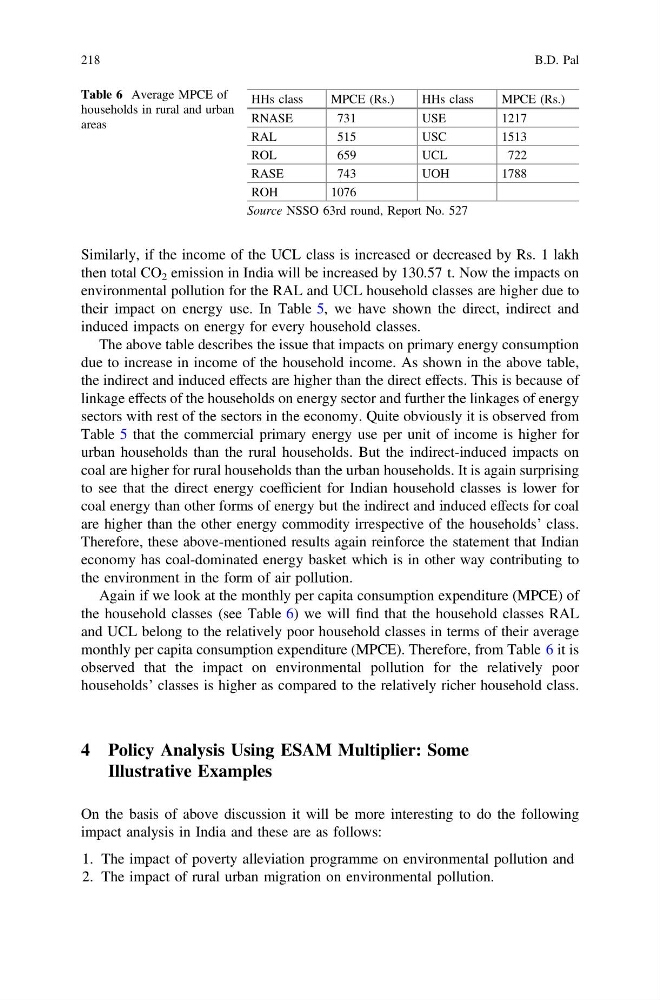
Again if we look at the monthly per capita consumption expenditure (MPCE) of
the household classes (see Table 6) we will find that the household classes RAL
and UCL belong to the relatively poor household classes in terms of their average
monthly per capita consumption expenditure (MPCE). Therefore, from Table 6 it is
observed that the impact on environmental pollution for the relatively poor
households’ classes is higher as compared to the relatively richer household class.
4 Policy Analysis Using ESAM Multiplier: Some
Illustrative Examples
On the basis of above discussion it will be more interesting to do the following
impact analysis in India and these are as follows:
1. The impact of poverty alleviation programme on environmental pollution and
2. The impact of rural urban migration on environmental pollution.
Table 6 Average MPCE of
households in rural and urban
areas
HHs class
MPCE (Rs.)
HHs class
MPCE (Rs.)
RNASE
731
USE
1217
RAL
515
USC
1513
ROL
659
UCL
722
RASE
743
UOH
1788
ROH
1076
Source NSSO 63rd round, Report No. 527
218
B.D. Pal
then total CO 2 emission in India will be increased by 130.57 t. Now the impacts on
environmental pollution for the RAL and UCL household classes are higher due to
their impact on energy use. In Table 5, we have shown the direct, indirect and
induced impacts on energy for every household classes.
The above table describes the issue that impacts on primary energy consumption
due to increase in income of the household income. As shown in the above table,
the indirect and induced effects are higher than the direct effects. This is because of
linkage effects of the households on energy sector and further the linkages of energy
sectors with rest of the sectors in the economy. Quite obviously it is observed from
Table 5 that the commercial primary energy use per unit of income is higher for
urban households than the rural households. But the indirect-induced impacts on
coal are higher for rural households than the urban households. It is again surprising
to see that the direct energy coefficient for Indian household classes is lower for
coal energy than other forms of energy but the indirect and induced effects for coal
are higher than the other energy commodity irrespective of the households’ class.
Therefore, these above-mentioned results again reinforce the statement that Indian
economy has coal-dominated energy basket which is in other way contributing to
the environment in the form of air pollution.
Again if we look at the monthly per capita consumption expenditure (MPCE) of
the household classes (see Table 6) we will find that the household classes RAL
and UCL belong to the relatively poor household classes in terms of their average
monthly per capita consumption expenditure (MPCE). Therefore, from Table 6 it is
observed that the impact on environmental pollution for the relatively poor
households’ classes is higher as compared to the relatively richer household class.
4 Policy Analysis Using ESAM Multiplier: Some
Illustrative Examples
On the basis of above discussion it will be more interesting to do the following
impact analysis in India and these are as follows:
1. The impact of poverty alleviation programme on environmental pollution and
2. The impact of rural urban migration on environmental pollution.
Table 6 Average MPCE of
households in rural and urban
areas
HHs class
MPCE (Rs.)
HHs class
MPCE (Rs.)
RNASE
731
USE
1217
RAL
515
USC
1513
ROL
659
UCL
722
RASE
743
UOH
1788
ROH
1076
Source NSSO 63rd round, Report No. 527
218
B.D. Pal