

But this can be easily remedied by making assumption about the link between gross
output and pollution generation in each production activity. The standard practice in
this regard is to use the direct pollution generation coefficients for each sector and
this is given in Table 5. Now on the basis of Table 5 and the SAM multiplier, we
have tried to estimate the pollution trade-off multiplier for India for the year 2003–
04. In this case the method of estimating pollution trade-off multiplier is described
below.
3.1 Pollution Trade-off Multiplier
These pollution trade-off multipliers measure the direct and indirect impact on
pollution generation level due to exogenous change in sectoral output, household
income, etc. In this study we have estimated two types of pollution trade-off
multipliers: (1) output-pollution multiplier and (2) income-pollution multiplier.
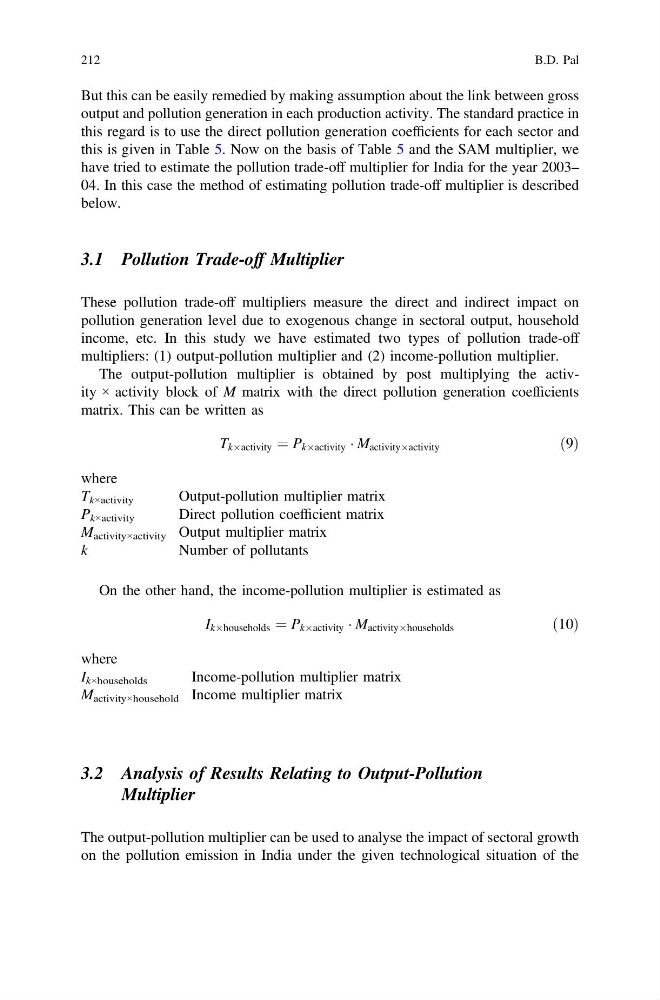
The output-pollution multiplier is obtained by post multiplying the activity × activity block of M matrix with the direct pollution generation coefficients
matrix. This can be written as
T kÂactivity ¼ P kÂactivity Á M activityÂactivity
ð9Þ
where
T k×activity
Output-pollution multiplier matrix
P k×activity
Direct pollution coefficient matrix
M activity×activity Output multiplier matrix
k
Number of pollutants
On the other hand, the income-pollution multiplier is estimated as
I kÂhouseholds ¼ P kÂactivity Á M activityÂhouseholds
ð10Þ
where
I k×households
Income-pollution multiplier matrix
M activity×household Income multiplier matrix
3.2 Analysis of Results Relating to Output-Pollution
Multiplier
The output-pollution multiplier can be used to analyse the impact of sectoral growth
on the pollution emission in India under the given technological situation of the
212
B.D. Pal
output and pollution generation in each production activity. The standard practice in
this regard is to use the direct pollution generation coefficients for each sector and
this is given in Table 5. Now on the basis of Table 5 and the SAM multiplier, we
have tried to estimate the pollution trade-off multiplier for India for the year 2003–
04. In this case the method of estimating pollution trade-off multiplier is described
below.
3.1 Pollution Trade-off Multiplier
These pollution trade-off multipliers measure the direct and indirect impact on
pollution generation level due to exogenous change in sectoral output, household
income, etc. In this study we have estimated two types of pollution trade-off
multipliers: (1) output-pollution multiplier and (2) income-pollution multiplier.
The output-pollution multiplier is obtained by post multiplying the activity × activity block of M matrix with the direct pollution generation coefficients
matrix. This can be written as
T kÂactivity ¼ P kÂactivity Á M activityÂactivity
ð9Þ
where
T k×activity
Output-pollution multiplier matrix
P k×activity
Direct pollution coefficient matrix
M activity×activity Output multiplier matrix
k
Number of pollutants
On the other hand, the income-pollution multiplier is estimated as
I kÂhouseholds ¼ P kÂactivity Á M activityÂhouseholds
ð10Þ
where
I k×households
Income-pollution multiplier matrix
M activity×household Income multiplier matrix
3.2 Analysis of Results Relating to Output-Pollution
Multiplier
The output-pollution multiplier can be used to analyse the impact of sectoral growth
on the pollution emission in India under the given technological situation of the
212
B.D. Pal