

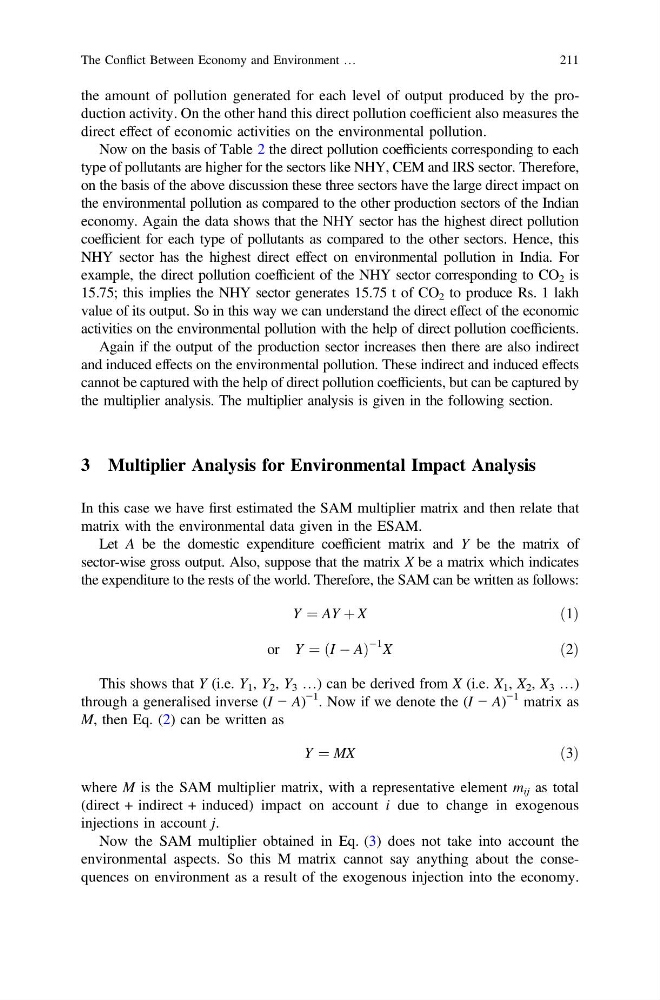
the amount of pollution generated for each level of output produced by the production activity. On the other hand this direct pollution coefficient also measures the
direct effect of economic activities on the environmental pollution.
Now on the basis of Table 2 the direct pollution coefficients corresponding to each
type of pollutants are higher for the sectors like NHY, CEM and IRS sector. Therefore,
on the basis of the above discussion these three sectors have the large direct impact on
the environmental pollution as compared to the other production sectors of the Indian
economy. Again the data shows that the NHY sector has the highest direct pollution
coefficient for each type of pollutants as compared to the other sectors. Hence, this
NHY sector has the highest direct effect on environmental pollution in India. For
example, the direct pollution coefficient of the NHY sector corresponding to CO 2 is
15.75; this implies the NHY sector generates 15.75 t of CO 2 to produce Rs. 1 lakh
value of its output. So in this way we can understand the direct effect of the economic
activities on the environmental pollution with the help of direct pollution coefficients.
Again if the output of the production sector increases then there are also indirect
and induced effects on the environmental pollution. These indirect and induced effects
cannot be captured with the help of direct pollution coefficients, but can be captured by
the multiplier analysis. The multiplier analysis is given in the following section.
3 Multiplier Analysis for Environmental Impact Analysis
In this case we have first estimated the SAM multiplier matrix and then relate that
matrix with the environmental data given in the ESAM.
Let A be the domestic expenditure coefficient matrix and Y be the matrix of
sector-wise gross output. Also, suppose that the matrix X be a matrix which indicates
the expenditure to the rests of the world. Therefore, the SAM can be written as follows:
Y ¼ AY þ X
ð1Þ
or Y ¼ ðI À AÞ
À1 X
ð2Þ
This shows that Y (i.e. Y 1 , Y 2 , Y 3 …) can be derived from X (i.e. X 1 , X 2 , X 3 …)
through a generalised inverse (I − A)
−1 . Now if we denote the (I − A)
−1 matrix as
M, then Eq. (2) can be written as
Y ¼ MX
ð3Þ
where M is the SAM multiplier matrix, with a representative element m ij as total
(direct + indirect + induced) impact on account i due to change in exogenous
injections in account j.
Now the SAM multiplier obtained in Eq. (3) does not take into account the
environmental aspects. So this M matrix cannot say anything about the consequences on environment as a result of the exogenous injection into the economy.
The Conflict Between Economy and Environment …
211
direct effect of economic activities on the environmental pollution.
Now on the basis of Table 2 the direct pollution coefficients corresponding to each
type of pollutants are higher for the sectors like NHY, CEM and IRS sector. Therefore,
on the basis of the above discussion these three sectors have the large direct impact on
the environmental pollution as compared to the other production sectors of the Indian
economy. Again the data shows that the NHY sector has the highest direct pollution
coefficient for each type of pollutants as compared to the other sectors. Hence, this
NHY sector has the highest direct effect on environmental pollution in India. For
example, the direct pollution coefficient of the NHY sector corresponding to CO 2 is
15.75; this implies the NHY sector generates 15.75 t of CO 2 to produce Rs. 1 lakh
value of its output. So in this way we can understand the direct effect of the economic
activities on the environmental pollution with the help of direct pollution coefficients.
Again if the output of the production sector increases then there are also indirect
and induced effects on the environmental pollution. These indirect and induced effects
cannot be captured with the help of direct pollution coefficients, but can be captured by
the multiplier analysis. The multiplier analysis is given in the following section.
3 Multiplier Analysis for Environmental Impact Analysis
In this case we have first estimated the SAM multiplier matrix and then relate that
matrix with the environmental data given in the ESAM.
Let A be the domestic expenditure coefficient matrix and Y be the matrix of
sector-wise gross output. Also, suppose that the matrix X be a matrix which indicates
the expenditure to the rests of the world. Therefore, the SAM can be written as follows:
Y ¼ AY þ X
ð1Þ
or Y ¼ ðI À AÞ
À1 X
ð2Þ
This shows that Y (i.e. Y 1 , Y 2 , Y 3 …) can be derived from X (i.e. X 1 , X 2 , X 3 …)
through a generalised inverse (I − A)
−1 . Now if we denote the (I − A)
−1 matrix as
M, then Eq. (2) can be written as
Y ¼ MX
ð3Þ
where M is the SAM multiplier matrix, with a representative element m ij as total
(direct + indirect + induced) impact on account i due to change in exogenous
injections in account j.
Now the SAM multiplier obtained in Eq. (3) does not take into account the
environmental aspects. So this M matrix cannot say anything about the consequences on environment as a result of the exogenous injection into the economy.
The Conflict Between Economy and Environment …
211