

70
H.-I. Bolle
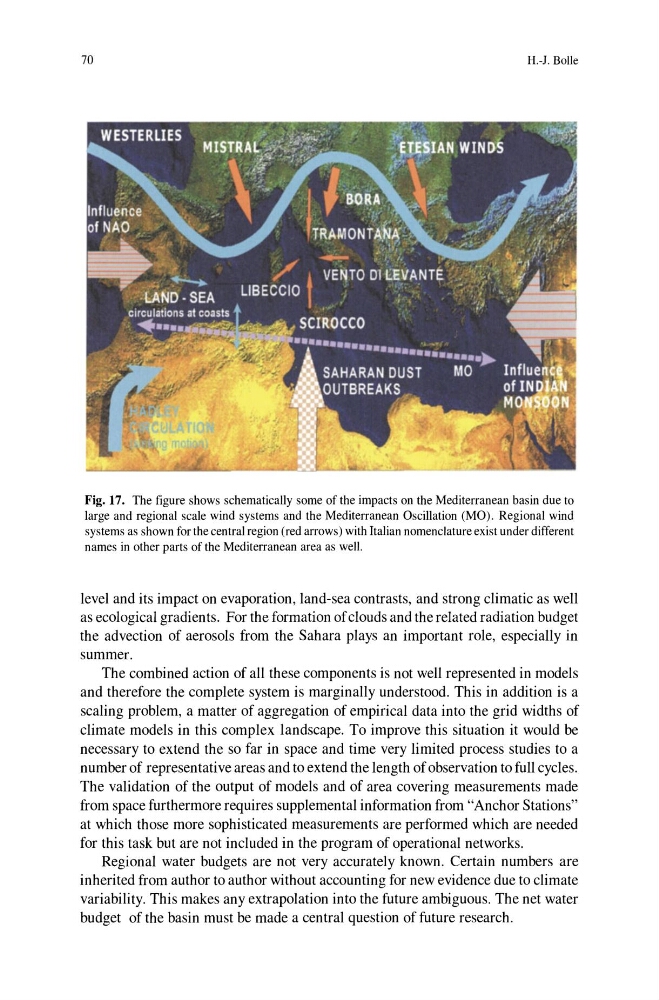
Fig. 17. The figure shows schematically some of the impacts on the Mediterranean basin due to
large and regional scale wind systems and the Mediterranean Oscillation (MO). Regional wind
systems as shown for the central region (red arrows) with Italian nomenclature exist under different
names in other parts of the Mediterranean area as well.
level and its impact on evaporation, land-sea contrasts, and strong climatic as well
as ecological gradients. For the formation of clouds and the related radiation budget
the advection of aerosols from the Sahara plays an important role, especially in
summer.
The combined action of all these components is not well represented in models
and therefore the complete system is marginally understood. This in addition is a
scaling problem, a matter of aggregation of empirical data into the grid widths of
climate models in this complex landscape. To improve this situation it would be
necessary to extend the so far in space and time very limited process studies to a
number of representative areas and to extend the length of observation to full cycles.
The validation of the output of models and of area covering measurements made
from space furthermore requires supplemental information from "Anchor Stations"
at which those more sophisticated measurements are performed which are needed
for this task but are not included in the program of operational networks.
Regional water budgets are not very accurately known. Certain numbers are
inherited from author to author without accounting for new evidence due to climate
variability. This makes any extrapolation into the future ambiguous. The net water
budget of the basin must be made a central question of future research.
H.-I. Bolle
Fig. 17. The figure shows schematically some of the impacts on the Mediterranean basin due to
large and regional scale wind systems and the Mediterranean Oscillation (MO). Regional wind
systems as shown for the central region (red arrows) with Italian nomenclature exist under different
names in other parts of the Mediterranean area as well.
level and its impact on evaporation, land-sea contrasts, and strong climatic as well
as ecological gradients. For the formation of clouds and the related radiation budget
the advection of aerosols from the Sahara plays an important role, especially in
summer.
The combined action of all these components is not well represented in models
and therefore the complete system is marginally understood. This in addition is a
scaling problem, a matter of aggregation of empirical data into the grid widths of
climate models in this complex landscape. To improve this situation it would be
necessary to extend the so far in space and time very limited process studies to a
number of representative areas and to extend the length of observation to full cycles.
The validation of the output of models and of area covering measurements made
from space furthermore requires supplemental information from "Anchor Stations"
at which those more sophisticated measurements are performed which are needed
for this task but are not included in the program of operational networks.
Regional water budgets are not very accurately known. Certain numbers are
inherited from author to author without accounting for new evidence due to climate
variability. This makes any extrapolation into the future ambiguous. The net water
budget of the basin must be made a central question of future research.