

Temperature and Precipitation Variability and Trends in Northern Spain
, .
U'
'4
~ ..
?
~ o.
~ -..
. ,.
Z
~ a t,
,iao
'NO
U
~ '0
~ 0.)
gOA
~ -6,)
~
-'.
z
"2 ~ t.31
, ...
U'
t... '0
,.
:i . , 'lMOb~, ... :o::-~"~';"',m~' ,C.-',_",, ,.-...;,.,,..-..,,..
su ~~ t ~ (, > PC)
...
2°.l
~ OJ> J---.~"""" ...... ~i'1!Ir-+iI!-!-1.,\-1l-W
...
! -O~
~ · 'AI
,.
2 .I ~MO ,., ~toO I'~;; neo •• iCIbo
p
~ "
w
I>
:> .,
~
~ 0'
~
~ ·I "
L
~ - I ~ ,. ,
AUIV .. " ( lsI PC)
S PR INC. (,. , P C)
~ UIU II N (Is Pt)
.,
0 '
~
: ~ . t\ j5:::::?C:;;' ··f-ii.,
~ 'j: t. .- V .. , . " .< , \ ""'"
WI I R (I" PC)
265
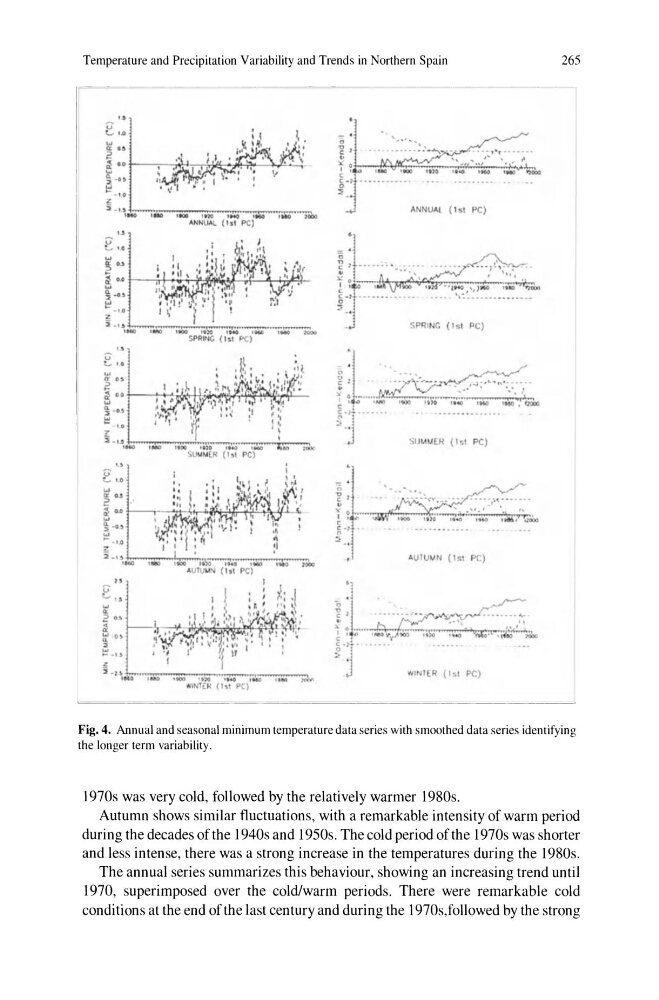
Fig. 4. Annual and seasonal minimum temperature data series with smoothed data series identifying
the longer term variability.
1970s was very cold, followed by the relatively warmer 1980s,
Autumn shows similar fluctuations, with a remarkable intensity of warm period
during the decades of the 1940s and 1950s, The cold period of the 1970s was shorter
and less intense, there was a strong increase in the temperatures during the 1980s.
The annual series summarizes this behaviour, showing an increasing trend until
1970, superimposed over the cold/warm periods. There were remarkable cold
conditions at the end of the last century and during the I 970s,folJowed by the strong
, .
U'
'4
~ ..
?
~ o.
~ -..
. ,.
Z
~ a t,
,iao
'NO
U
~ '0
~ 0.)
gOA
~ -6,)
~
-'.
z
"2 ~ t.31
, ...
U'
t... '0
,.
:i . , 'lMOb~, ... :o::-~"~';"',m~' ,C.-',_",, ,.-...;,.,,..-..,,..
su ~~ t ~ (, > PC)
...
2°.l
~ OJ> J---.~"""" ...... ~i'1!Ir-+iI!-!-1.,\-1l-W
...
! -O~
~ · 'AI
,.
2 .I ~MO ,., ~toO I'~;; neo •• iCIbo
p
~ "
w
I>
:> .,
~
~ 0'
~
~ ·I "
L
~ - I ~ ,. ,
AUIV .. " ( lsI PC)
S PR INC. (,. , P C)
~ UIU II N (Is Pt)
.,
0 '
~
: ~ . t\ j5:::::?C:;;' ··f-ii.,
~ 'j: t. .- V .. , . " .< , \ ""'"
WI I R (I" PC)
265
Fig. 4. Annual and seasonal minimum temperature data series with smoothed data series identifying
the longer term variability.
1970s was very cold, followed by the relatively warmer 1980s,
Autumn shows similar fluctuations, with a remarkable intensity of warm period
during the decades of the 1940s and 1950s, The cold period of the 1970s was shorter
and less intense, there was a strong increase in the temperatures during the 1980s.
The annual series summarizes this behaviour, showing an increasing trend until
1970, superimposed over the cold/warm periods. There were remarkable cold
conditions at the end of the last century and during the I 970s,folJowed by the strong