

418
3 A large scale baroclinic CdV model
The above comments are a motivation to transfer the CdV model to oceanic
stratified conditions where baroclinic Rossby waves are present and a resonance could be build up at the baroclinic Rossby wave speed {3RTnt which is
of order of a few em 8- 1 (the internal Rossby radius Rint is typically 10km
in the Southern Ocean). A baroclinic successor of CdV was constructed
by Charney and Straus (1980) using a two-layer QG model. For the most
part this model defies however analytical treatment and because of the
mismatch in the parameter ranges for atmospheric and oceanic conditions
it cannot readily be transferred to meet our purposes.
3.1 QG planetary scale dynamics
The CdV concept is readily extended to a baroclinic situation and - with
some considerations of planetary scale dynamics - cast into a form which
allows complete analytical treatment. We consider now a stable density
stratification of the fluid given by two homogeneous layers with reduced
gravity g', thicknesses HI + ( - "., and H2 + "., - Band streamfunctions
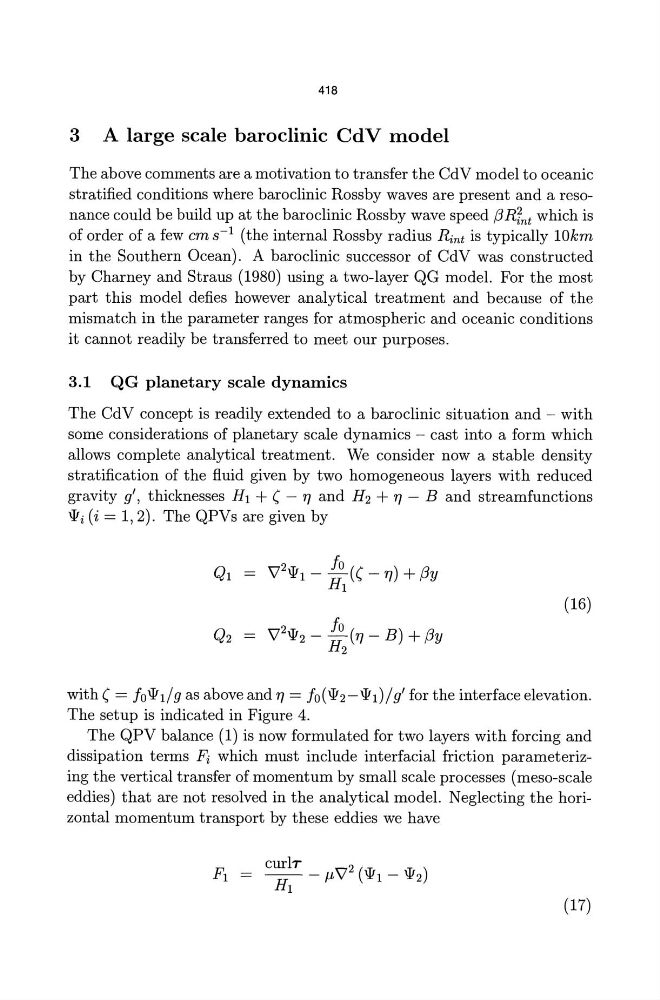
Wi (i = 1,2). The QPVs are given by
(16)
with ( = fowd g as above and"., = fO(W2- Wl)/ g' for the interface elevation.
The setup is indicated in Figure 4.
The QPV balance (1) is now formulated for two layers with forcing and
dissipation terms Fi which must include interfacial friction parameterizing the vertical transfer of momentum by small scale processes (meso-scale
eddies) that are not resolved in the analytical model. Neglecting the horizontal momentum transport by these eddies we have
(17)
3 A large scale baroclinic CdV model
The above comments are a motivation to transfer the CdV model to oceanic
stratified conditions where baroclinic Rossby waves are present and a resonance could be build up at the baroclinic Rossby wave speed {3RTnt which is
of order of a few em 8- 1 (the internal Rossby radius Rint is typically 10km
in the Southern Ocean). A baroclinic successor of CdV was constructed
by Charney and Straus (1980) using a two-layer QG model. For the most
part this model defies however analytical treatment and because of the
mismatch in the parameter ranges for atmospheric and oceanic conditions
it cannot readily be transferred to meet our purposes.
3.1 QG planetary scale dynamics
The CdV concept is readily extended to a baroclinic situation and - with
some considerations of planetary scale dynamics - cast into a form which
allows complete analytical treatment. We consider now a stable density
stratification of the fluid given by two homogeneous layers with reduced
gravity g', thicknesses HI + ( - "., and H2 + "., - Band streamfunctions
Wi (i = 1,2). The QPVs are given by
(16)
with ( = fowd g as above and"., = fO(W2- Wl)/ g' for the interface elevation.
The setup is indicated in Figure 4.
The QPV balance (1) is now formulated for two layers with forcing and
dissipation terms Fi which must include interfacial friction parameterizing the vertical transfer of momentum by small scale processes (meso-scale
eddies) that are not resolved in the analytical model. Neglecting the horizontal momentum transport by these eddies we have
(17)