

381
lOCO~~~--~----~---r--~r---.----r---'----~---r---'----~---r--~
~
i
100
l'
q
. .
';d •
,H
"rl
~l
.g
!e.
~iS
~'Cl
..
~
.~
,0.
"'"
'j .~
.~
q) I· tl)
i' 1.11
~ ~ \l
17 g,
~
(j.~ t;o
';d~
~ . ]
1l
"2 a
H
t
~ .
i
. ~
~'j
.' 1
bf.>
e
.
tl 10
~
1;
&
'"
:~
~ 1!.
~
k
~ 1
0.1
·"0
~~
rl
OCEAN THERMOHALINE RIll.AX.\TION
. . . . ----1 THERMAL RELAXATION - - - - - -
ATMOSPHERE
INERTIAL RElAXATION
..... - - - - - - - - - - - - - - -
THERMAL-CONVECTIVE BUOYANcY
LOGAL TURBUIENCE
Snow/aea-ice
interaction
~
~
'8
A
~
. .
Atmospheric
10;
1
10 2
PEllIOD IN YEARS
10
inertial"
processes
Thermal-convective
Buoyancy
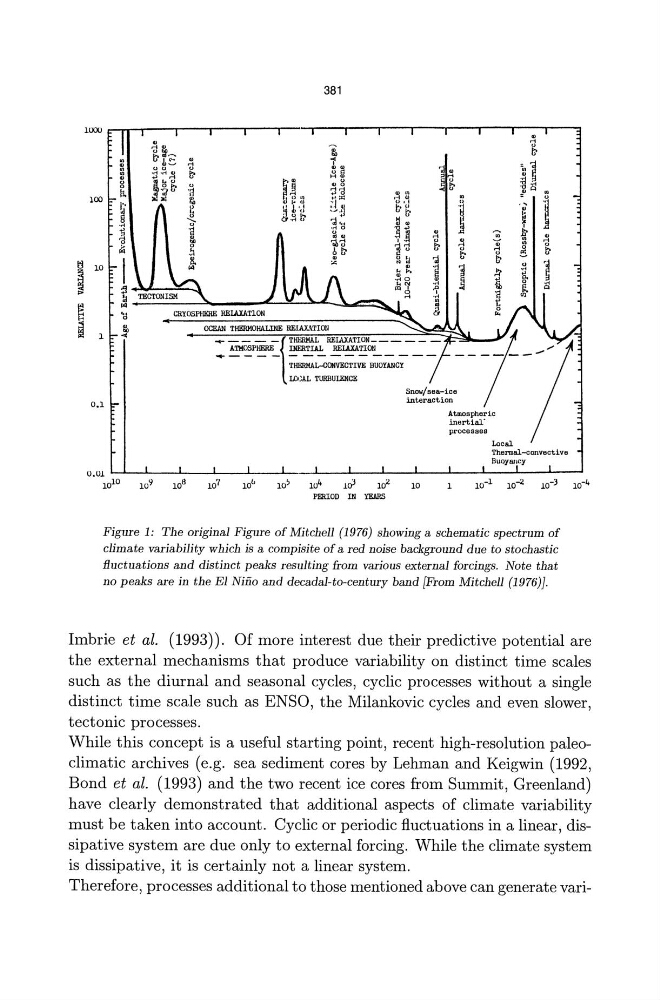
Figure 1: The original Figure of Mitchell (1976) showing a schematic spectrum of
climate variability which is a compisite of a red noise background due to stochastic
fluctuations and distinct peaks resulting from various external forcings. Note that
no peaks are in the El Niiio and decadal-to-century band [From Mitchell (1976)).
Imbrie et al. (1993)). Of more interest due their predictive potential are
the external mechanisms that produce variability on distinct time scales
such as the diurnal and seasonal cycles, cyclic processes without a single
distinct time scale such as ENSO, the Milankovic cycles and even slower,
tectonic processes.
While this concept is a useful starting point, recent high-resolution paleoclimatic archives (e.g. sea sediment cores by Lehman and Keigwin (1992,
Bond et al. (1993) and the two recent ice cores from Summit, Greenland)
have clearly demonstrated that additional aspects of climate variability
must be taken into account. Cyclic or periodic fluctuations in a linear, dissipative system are due only to external forcing. While the climate system
is dissipative, it is certainly not a linear system.
Therefore, processes additional to those mentioned above can generate vari-
lOCO~~~--~----~---r--~r---.----r---'----~---r---'----~---r--~
~
i
100
l'
q
. .
';d •
,H
"rl
~l
.g
!e.
~iS
~'Cl
..
~
.~
,0.
"'"
'j .~
.~
q) I· tl)
i' 1.11
~ ~ \l
17 g,
~
(j.~ t;o
';d~
~ . ]
1l
"2 a
H
t
~ .
i
. ~
~'j
.' 1
bf.>
e
.
tl 10
~
1;
&
'"
:~
~ 1!.
~
k
~ 1
0.1
·"0
~~
rl
OCEAN THERMOHALINE RIll.AX.\TION
. . . . ----1 THERMAL RELAXATION - - - - - -
ATMOSPHERE
INERTIAL RElAXATION
..... - - - - - - - - - - - - - - -
THERMAL-CONVECTIVE BUOYANcY
LOGAL TURBUIENCE
Snow/aea-ice
interaction
~
~
'8
A
~
. .
Atmospheric
10;
1
10 2
PEllIOD IN YEARS
10
inertial"
processes
Thermal-convective
Buoyancy
Figure 1: The original Figure of Mitchell (1976) showing a schematic spectrum of
climate variability which is a compisite of a red noise background due to stochastic
fluctuations and distinct peaks resulting from various external forcings. Note that
no peaks are in the El Niiio and decadal-to-century band [From Mitchell (1976)).
Imbrie et al. (1993)). Of more interest due their predictive potential are
the external mechanisms that produce variability on distinct time scales
such as the diurnal and seasonal cycles, cyclic processes without a single
distinct time scale such as ENSO, the Milankovic cycles and even slower,
tectonic processes.
While this concept is a useful starting point, recent high-resolution paleoclimatic archives (e.g. sea sediment cores by Lehman and Keigwin (1992,
Bond et al. (1993) and the two recent ice cores from Summit, Greenland)
have clearly demonstrated that additional aspects of climate variability
must be taken into account. Cyclic or periodic fluctuations in a linear, dissipative system are due only to external forcing. While the climate system
is dissipative, it is certainly not a linear system.
Therefore, processes additional to those mentioned above can generate vari-