

370
q = kp.
(78)
With fixed differential surface fluxes, HT and Hs, we derive from the
equations for the temperature and salinity gradients, eqs. (29) and (30),
p
v
2Hp - 2klplp
2Hv - 2klplv,
(79)
(80)
with fixed forcing terms. If thermal forcing is stronger than haline forcing,
Hp > 0, and one obtains high-latitude sinking, if> O. Linearization about
the equilibrium leads to
( p' )
( p' ) _ (4kf5 0 ) ( p' )
v' = A v' = =f 2kz; 2kf5
v"
(81)
where the minus sign holds if if > 0, and the plus sign if if < O. The matrix
A does not commute with its transpose. Its eigenvalues and associated
eigenvectors are
>' 1 = -4klf5l,
(1 + z;2jf52)-1 (Z;)f5)'
(82)
( ~ )
(83)
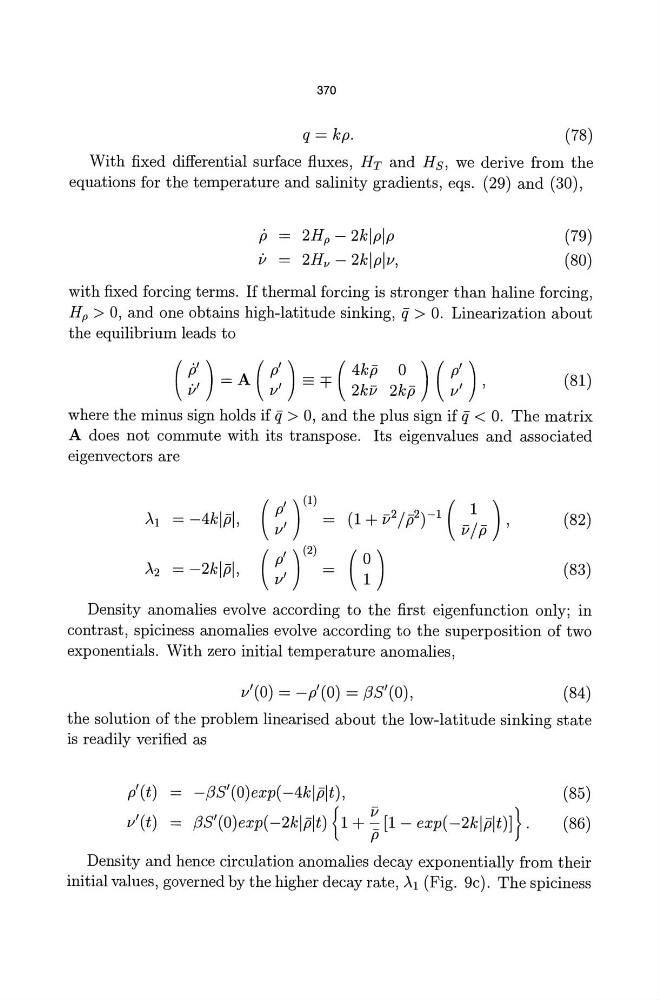
Density anomalies evolve according to the first eigenfunction only; in
contrast, spiciness anomalies evolve according to the superposition of two
exponentials. With zero initial temperature anomalies,
v'(O) = -p'(O) = j3S'(O),
(84)
the solution of the problem linearised about the low-latitude sinking state
is readily verified as
p' (t)
v' (t)
-j3S'(O)exp( -4klf5lt),
j3S'(O)exp( -2klf5lt) {I + ~ [1 - exp( -2klf5lt)]} .
(85)
(86)
Density and hence circulation anomalies decay exponentially from their
initial values, governed by the higher decay rate, >' 1 (Fig. 9c). The spiciness
q = kp.
(78)
With fixed differential surface fluxes, HT and Hs, we derive from the
equations for the temperature and salinity gradients, eqs. (29) and (30),
p
v
2Hp - 2klplp
2Hv - 2klplv,
(79)
(80)
with fixed forcing terms. If thermal forcing is stronger than haline forcing,
Hp > 0, and one obtains high-latitude sinking, if> O. Linearization about
the equilibrium leads to
( p' )
( p' ) _ (4kf5 0 ) ( p' )
v' = A v' = =f 2kz; 2kf5
v"
(81)
where the minus sign holds if if > 0, and the plus sign if if < O. The matrix
A does not commute with its transpose. Its eigenvalues and associated
eigenvectors are
>' 1 = -4klf5l,
(1 + z;2jf52)-1 (Z;)f5)'
(82)
( ~ )
(83)
Density anomalies evolve according to the first eigenfunction only; in
contrast, spiciness anomalies evolve according to the superposition of two
exponentials. With zero initial temperature anomalies,
v'(O) = -p'(O) = j3S'(O),
(84)
the solution of the problem linearised about the low-latitude sinking state
is readily verified as
p' (t)
v' (t)
-j3S'(O)exp( -4klf5lt),
j3S'(O)exp( -2klf5lt) {I + ~ [1 - exp( -2klf5lt)]} .
(85)
(86)
Density and hence circulation anomalies decay exponentially from their
initial values, governed by the higher decay rate, >' 1 (Fig. 9c). The spiciness