

357
4 Land effects
4.1 Basic equations
So far, it has been assumed that the atmosphere completely homogenises
temperature in the zonal direction, so that temperatures over land are identical to the oceanic temperatures at the same latitude. This assumption is
questionable even in the case of only one ocean basin, and this section analyzes the consequences of admitting zonal temperature contrasts. The ratio
of ocean area to total area, E, figures most prominently in the strength of
the Newtonian cooling coefficient, ). [eq. (20)], and we expect modifications
in this dependence when the zonal transport efficiency is finite.
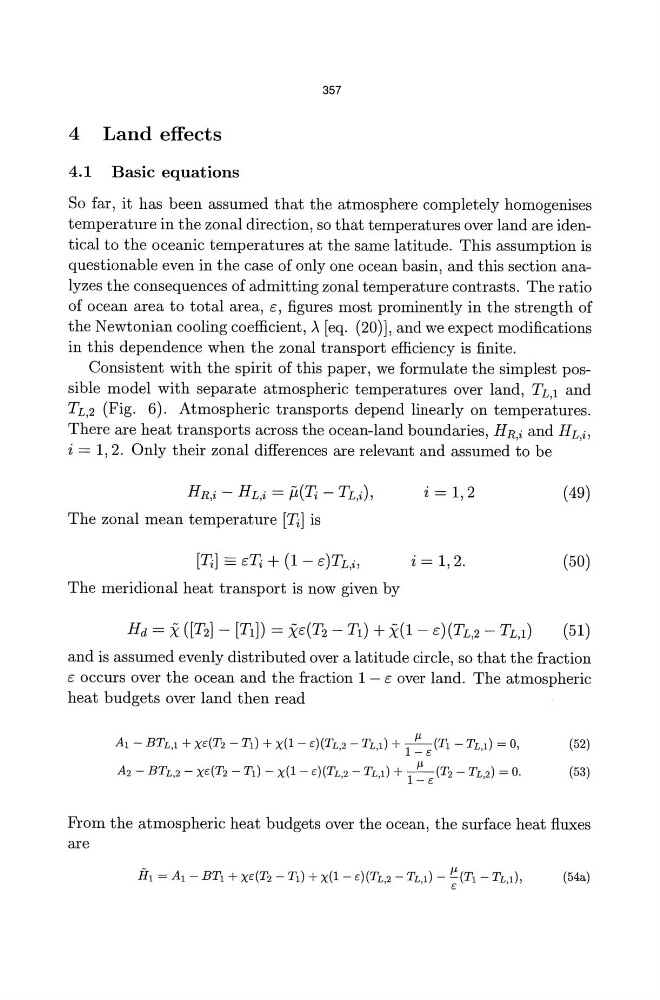
Consistent with the spirit of this paper, we formulate the simplest possible model with separate atmospheric temperatures over land, TL,I and
TL ,2 (Fig. 6). Atmospheric transports depend linearly on temperatures.
There are heat transports across the ocean-land boundaries, HR,i and HL,i,
i = 1,2. Only their zonal differences are relevant and assumed to be
HR . - HL . = iI(T,. - TL .)
,'I,
,'/,,..,..,
't
,'I, ,
i = 1,2
( 49)
The zonal mean temperature ['Ii] is
['Ii] == E'Ii + (1 - E)TL,i,
i = 1,2.
(50)
The meridional heat transport is now given by
Hd = X ([T2]- [TIl) = Xc(T2 - TI) + X(l - E) (TL,2 - TL,I) (51)
and is assumed evenly distributed over a latitude circle, so that the fraction
E occurs over the ocean and the fraction 1 - E over land. The atmospheric
heat budgets over land then read
From the atmospheric heat budgets over the ocean, the surface heat fluxes
are
4 Land effects
4.1 Basic equations
So far, it has been assumed that the atmosphere completely homogenises
temperature in the zonal direction, so that temperatures over land are identical to the oceanic temperatures at the same latitude. This assumption is
questionable even in the case of only one ocean basin, and this section analyzes the consequences of admitting zonal temperature contrasts. The ratio
of ocean area to total area, E, figures most prominently in the strength of
the Newtonian cooling coefficient, ). [eq. (20)], and we expect modifications
in this dependence when the zonal transport efficiency is finite.
Consistent with the spirit of this paper, we formulate the simplest possible model with separate atmospheric temperatures over land, TL,I and
TL ,2 (Fig. 6). Atmospheric transports depend linearly on temperatures.
There are heat transports across the ocean-land boundaries, HR,i and HL,i,
i = 1,2. Only their zonal differences are relevant and assumed to be
HR . - HL . = iI(T,. - TL .)
,'I,
,'/,,..,..,
't
,'I, ,
i = 1,2
( 49)
The zonal mean temperature ['Ii] is
['Ii] == E'Ii + (1 - E)TL,i,
i = 1,2.
(50)
The meridional heat transport is now given by
Hd = X ([T2]- [TIl) = Xc(T2 - TI) + X(l - E) (TL,2 - TL,I) (51)
and is assumed evenly distributed over a latitude circle, so that the fraction
E occurs over the ocean and the fraction 1 - E over land. The atmospheric
heat budgets over land then read
From the atmospheric heat budgets over the ocean, the surface heat fluxes
are