

351
15
_5L---~~============~======d
o
500
1000
Years
1500
2000
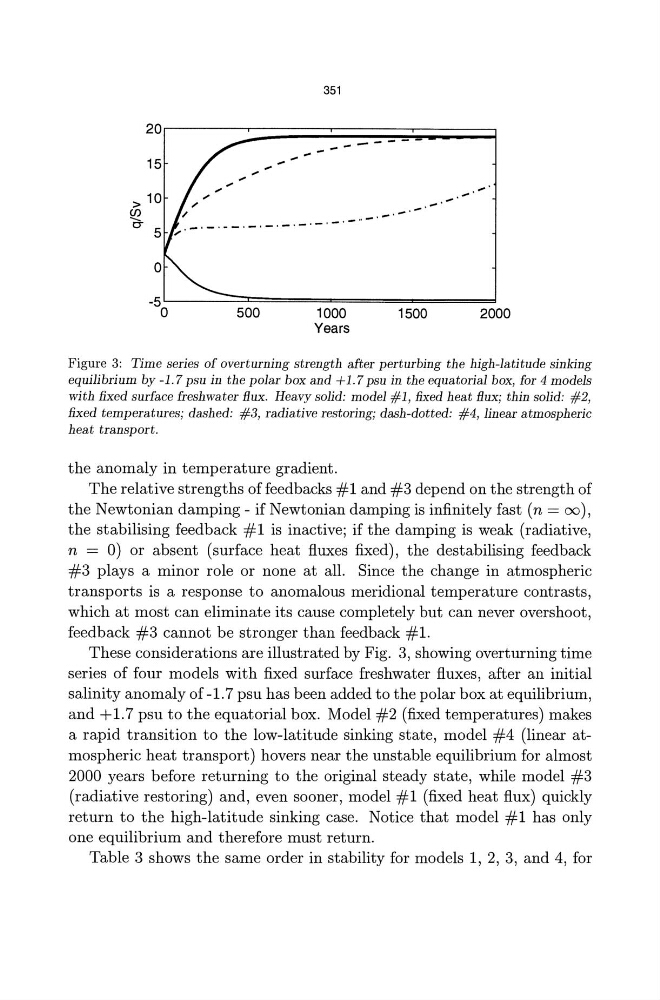
Figure 3: Time series of overturning strength after perturbing the high-latitude sinking
equilibrium by -1.7 psu in the polar box and +1.7 psu in the equatorial box, for 4 models
with fixed surface freshwater flux. Heavy solid: model #1, fixed heat flux; thin solid: #2,
fixed temperatures; dashed: #3, radiative restoring; dash-dotted: #4, linear atmospheric
heat transport.
the anomaly in temperature gradient.
The relative strengths of feedbacks #1 and #3 depend on the strength of
the Newtonian damping - if Newtonian damping is infinitely fast (n = 00),
the stabilising feedback #1 is inactive; if the damping is weak (radiative,
n = 0) or absent (surface heat fluxes fixed), the destabilising feedback
#3 plays a minor role or none at all. Since the change in atmospheric
transports is a response to anomalous meridional temperature contrasts,
which at most can eliminate its cause completely but can never overshoot,
feedback #3 cannot be stronger than feedback #1.
These considerations are illustrated by Fig. 3, showing overturning time
series of four models with fixed surface freshwater fluxes, after an initial
salinity anomaly of -1.7 psu has been added to the polar box at equilibrium,
and +1.7 psu to the equatorial box. Model #2 (fixed temperatures) makes
a rapid transition to the low-latitude sinking state, model #4 (linear atmospheric heat transport) hovers near the unstable equilibrium for almost
2000 years before returning to the original steady state, while model #3
(radiative restoring) and, even sooner, model #1 (fixed heat flux) quickly
return to the high-latitude sinking case. Notice that model #1 has only
one equilibrium and therefore must return.
Table 3 shows the same order in stability for models 1, 2, 3, and 4, for
15
_5L---~~============~======d
o
500
1000
Years
1500
2000
Figure 3: Time series of overturning strength after perturbing the high-latitude sinking
equilibrium by -1.7 psu in the polar box and +1.7 psu in the equatorial box, for 4 models
with fixed surface freshwater flux. Heavy solid: model #1, fixed heat flux; thin solid: #2,
fixed temperatures; dashed: #3, radiative restoring; dash-dotted: #4, linear atmospheric
heat transport.
the anomaly in temperature gradient.
The relative strengths of feedbacks #1 and #3 depend on the strength of
the Newtonian damping - if Newtonian damping is infinitely fast (n = 00),
the stabilising feedback #1 is inactive; if the damping is weak (radiative,
n = 0) or absent (surface heat fluxes fixed), the destabilising feedback
#3 plays a minor role or none at all. Since the change in atmospheric
transports is a response to anomalous meridional temperature contrasts,
which at most can eliminate its cause completely but can never overshoot,
feedback #3 cannot be stronger than feedback #1.
These considerations are illustrated by Fig. 3, showing overturning time
series of four models with fixed surface freshwater fluxes, after an initial
salinity anomaly of -1.7 psu has been added to the polar box at equilibrium,
and +1.7 psu to the equatorial box. Model #2 (fixed temperatures) makes
a rapid transition to the low-latitude sinking state, model #4 (linear atmospheric heat transport) hovers near the unstable equilibrium for almost
2000 years before returning to the original steady state, while model #3
(radiative restoring) and, even sooner, model #1 (fixed heat flux) quickly
return to the high-latitude sinking case. Notice that model #1 has only
one equilibrium and therefore must return.
Table 3 shows the same order in stability for models 1, 2, 3, and 4, for