

342
Quantity
Symbol
Value
High-latitude radiative forcing
Al
-39 Wm-~
Low-latitude radiative forcing
A2
91 Wm-~
Longwave radiation coefficient
B
1.7 Wm -~K-1
Atmospheric heat transport efficiency
X
1.3 Wm -~K-1
Atmospheric moisture transport efficiency
' Y
2.8 x 10 -10 ms -1K ·1
Total high-latitude area
FOl
1.25 x 10 14 m~
Fractional ocean area
E
0.5
Fractional catchment area
EW
0.5
Thermal expansion coefficient
a
1.8 x 10 -q K -1
Haline expansion coefficient
{1
0.8 x 10 -~ psu -1
Hydraulic constant
k
2 x 1O-~s-1
Heat capacity per unit volume of water
POC
4 x 10° Jm -~K -1
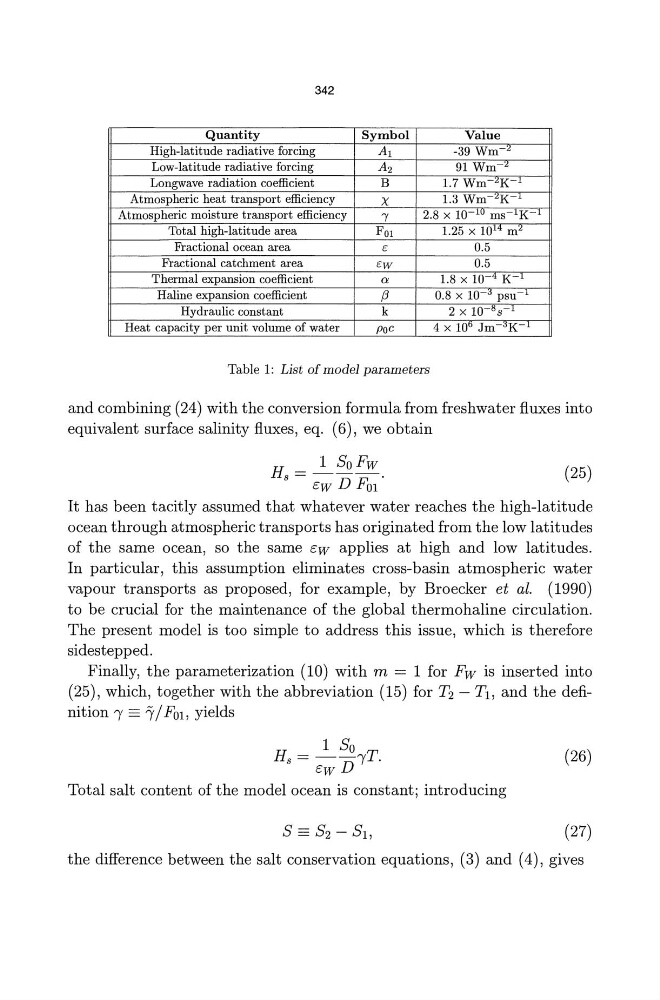
Table 1: List of model parameters
and combining (24) with the conversion formula from freshwater fluxes into
equivalent surface salinity fluxes, eq. (6), we obtain
Hs = ~ SoFw.
lOW D FOl
(25)
It has been tacitly assumed that whatever water reaches the high-latitude
ocean through atmospheric transports has originated from the low latitudes
of the same ocean, so the same lOW applies at high and low latitudes.
In particular, this assumption eliminates cross-basin atmospheric water
vapour transports as proposed, for example, by Broecker et al. (1990)
to be crucial for the maintenance of the global thermohaline circulation.
The present model is too simple to address this issue, which is therefore
sidestepped.
Finally, the parameterization (10) with m = 1 for Fw is inserted into
(25), which, together with the abbreviation (15) for T2 - Tl, and the definition I == ;Y / FOb yields
1 So
Hs = - D 1T.
lOW
Total salt content of the model ocean is constant; introducing
(26)
(27)
the difference between the salt conservation equations, (3) and (4), gives
Quantity
Symbol
Value
High-latitude radiative forcing
Al
-39 Wm-~
Low-latitude radiative forcing
A2
91 Wm-~
Longwave radiation coefficient
B
1.7 Wm -~K-1
Atmospheric heat transport efficiency
X
1.3 Wm -~K-1
Atmospheric moisture transport efficiency
' Y
2.8 x 10 -10 ms -1K ·1
Total high-latitude area
FOl
1.25 x 10 14 m~
Fractional ocean area
E
0.5
Fractional catchment area
EW
0.5
Thermal expansion coefficient
a
1.8 x 10 -q K -1
Haline expansion coefficient
{1
0.8 x 10 -~ psu -1
Hydraulic constant
k
2 x 1O-~s-1
Heat capacity per unit volume of water
POC
4 x 10° Jm -~K -1
Table 1: List of model parameters
and combining (24) with the conversion formula from freshwater fluxes into
equivalent surface salinity fluxes, eq. (6), we obtain
Hs = ~ SoFw.
lOW D FOl
(25)
It has been tacitly assumed that whatever water reaches the high-latitude
ocean through atmospheric transports has originated from the low latitudes
of the same ocean, so the same lOW applies at high and low latitudes.
In particular, this assumption eliminates cross-basin atmospheric water
vapour transports as proposed, for example, by Broecker et al. (1990)
to be crucial for the maintenance of the global thermohaline circulation.
The present model is too simple to address this issue, which is therefore
sidestepped.
Finally, the parameterization (10) with m = 1 for Fw is inserted into
(25), which, together with the abbreviation (15) for T2 - Tl, and the definition I == ;Y / FOb yields
1 So
Hs = - D 1T.
lOW
Total salt content of the model ocean is constant; introducing
(26)
(27)
the difference between the salt conservation equations, (3) and (4), gives