

340
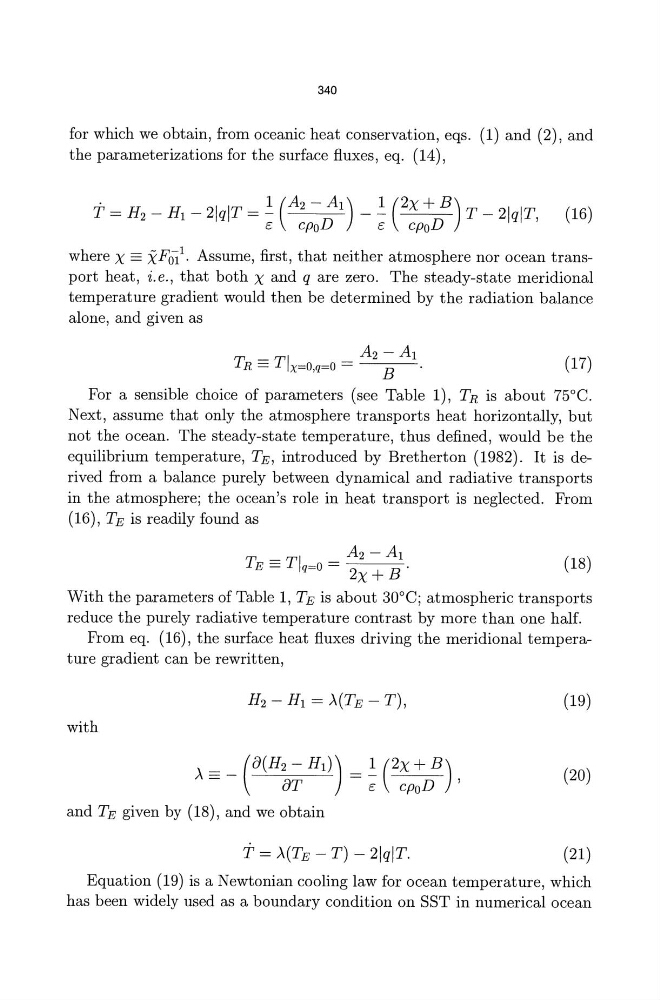
for which we obtain, from oceanic heat conservation, eqs. (1) and (2), and
the parameterizations for the surface fluxes, eq. (14),
T = H2 - HI - 21qlT = ~ (A2 - AI) _ ~ (2X + B) T - 21q1T,
E
cpoD
E
cpoD
(16)
where X == xFO:i I . Assume, first, that neither atmosphere nor ocean transport heat, i.e., that both X and q are zero. The steady-state meridional
temperature gradient would then be determined by the radiation balance
alone, and given as
(17)
For a sensible choice of parameters (see Table 1), TR is about 75°C.
Next, assume that only the atmosphere transports heat horizontally, but
not the ocean. The steady-state temperature, thus defined, would be the
equilibrium temperature, TE , introduced by Bretherton (1982). It is derived from a balance purely between dynamical and radiative transports
in the atmosphere; the ocean's role in heat transport is neglected. From
(16), TE is readily found as
(18)
With the parameters of Table 1, TE is about 30°C; atmospheric transports
reduce the purely radiative temperature contrast by more than one half.
From eq. (16), the surface heat fluxes driving the meridional temperature gradient can be rewritten,
(19)
with
.A. == _ (a(H 2 - HI)) = ~ (2X + B) ,
aT
E
cpoD
(20)
and TE given by (18), and we obtain
(21)
Equation (19) is a Newtonian cooling law for ocean temperature, which
has been widely used as a boundary condition on SST in numerical ocean
for which we obtain, from oceanic heat conservation, eqs. (1) and (2), and
the parameterizations for the surface fluxes, eq. (14),
T = H2 - HI - 21qlT = ~ (A2 - AI) _ ~ (2X + B) T - 21q1T,
E
cpoD
E
cpoD
(16)
where X == xFO:i I . Assume, first, that neither atmosphere nor ocean transport heat, i.e., that both X and q are zero. The steady-state meridional
temperature gradient would then be determined by the radiation balance
alone, and given as
(17)
For a sensible choice of parameters (see Table 1), TR is about 75°C.
Next, assume that only the atmosphere transports heat horizontally, but
not the ocean. The steady-state temperature, thus defined, would be the
equilibrium temperature, TE , introduced by Bretherton (1982). It is derived from a balance purely between dynamical and radiative transports
in the atmosphere; the ocean's role in heat transport is neglected. From
(16), TE is readily found as
(18)
With the parameters of Table 1, TE is about 30°C; atmospheric transports
reduce the purely radiative temperature contrast by more than one half.
From eq. (16), the surface heat fluxes driving the meridional temperature gradient can be rewritten,
(19)
with
.A. == _ (a(H 2 - HI)) = ~ (2X + B) ,
aT
E
cpoD
(20)
and TE given by (18), and we obtain
(21)
Equation (19) is a Newtonian cooling law for ocean temperature, which
has been widely used as a boundary condition on SST in numerical ocean