

338
(8a)
(8b)
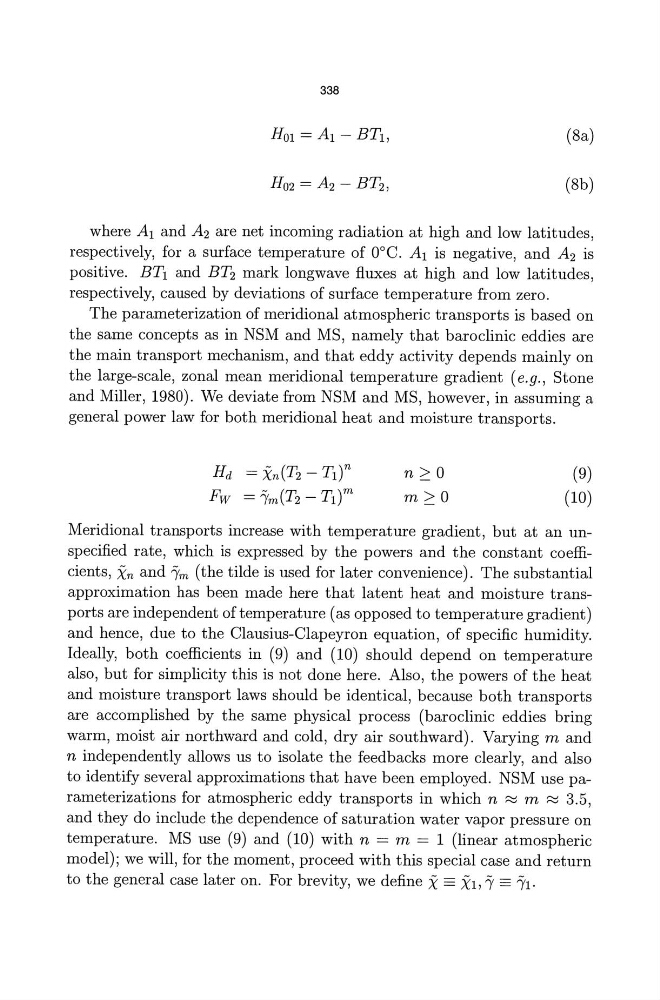
where A1 and A2 are net incoming radiation at high and low latitudes,
respectively, for a surface temperature of O°C. A1 is negative, and A2 is
positive. BTl and BT2 mark longwave fluxes at high and low latitudes,
respectively, caused by deviations of surface temperature from zero.
The parameterization of meridional atmospheric transports is based on
the same concepts as in NSM and MS, namely that baroclinic eddies are
the main transport mechanism, and that eddy activity depends mainly on
the large-scale, zonal mean meridional temperature gradient (e.g., Stone
and Miller, 1980). We deviate from NSM and MS, however, in assuming a
general power law for both meridional heat and moisture transports.
Hd = Xn(T2 - T1t
Fw = "Ym(T2 - Td m
(9)
(10)
Meridional transports increase with temperature gradient, but at an unspecified rate, which is expressed by the powers and the constant coefficients, Xn and "Ym (the tilde is used for later convenience). The substantial
approximation has been made here that latent heat and moisture transports are independent of temperature (as opposed to temperature gradient)
and hence, due to the Clausius-Clapeyron equation, of specific humidity.
Ideally, both coefficients in (9) and (10) should depend on temperature
also, but for simplicity this is not done here. Also, the powers of the heat
and moisture transport laws should be identical, because both transports
are accomplished by the same physical process (baroclinic eddies bring
warm, moist air northward and cold, dry air southward). Varying m and
n independently allows us to isolate the feedbacks more clearly, and also
to identify several approximations that have been employed. NSM use parameterizations for atmospheric eddy transports in which n R:i m R:i 3.5,
and they do include the dependence of saturation water vapor pressure on
temperature. MS use (9) and (10) with n = m = 1 (linear atmospheric
model); we will, for the moment, proceed with this special case and return
to the general case later on. For brevity, we define X == Xl, "Y == "Y1.
(8a)
(8b)
where A1 and A2 are net incoming radiation at high and low latitudes,
respectively, for a surface temperature of O°C. A1 is negative, and A2 is
positive. BTl and BT2 mark longwave fluxes at high and low latitudes,
respectively, caused by deviations of surface temperature from zero.
The parameterization of meridional atmospheric transports is based on
the same concepts as in NSM and MS, namely that baroclinic eddies are
the main transport mechanism, and that eddy activity depends mainly on
the large-scale, zonal mean meridional temperature gradient (e.g., Stone
and Miller, 1980). We deviate from NSM and MS, however, in assuming a
general power law for both meridional heat and moisture transports.
Hd = Xn(T2 - T1t
Fw = "Ym(T2 - Td m
(9)
(10)
Meridional transports increase with temperature gradient, but at an unspecified rate, which is expressed by the powers and the constant coefficients, Xn and "Ym (the tilde is used for later convenience). The substantial
approximation has been made here that latent heat and moisture transports are independent of temperature (as opposed to temperature gradient)
and hence, due to the Clausius-Clapeyron equation, of specific humidity.
Ideally, both coefficients in (9) and (10) should depend on temperature
also, but for simplicity this is not done here. Also, the powers of the heat
and moisture transport laws should be identical, because both transports
are accomplished by the same physical process (baroclinic eddies bring
warm, moist air northward and cold, dry air southward). Varying m and
n independently allows us to isolate the feedbacks more clearly, and also
to identify several approximations that have been employed. NSM use parameterizations for atmospheric eddy transports in which n R:i m R:i 3.5,
and they do include the dependence of saturation water vapor pressure on
temperature. MS use (9) and (10) with n = m = 1 (linear atmospheric
model); we will, for the moment, proceed with this special case and return
to the general case later on. For brevity, we define X == Xl, "Y == "Y1.