

295
The global heat balance
(obserfled)
Reflected Solar
Radiation
101 Wlm 2
Incominf/
Solar
Radiation
341 Wlm 2
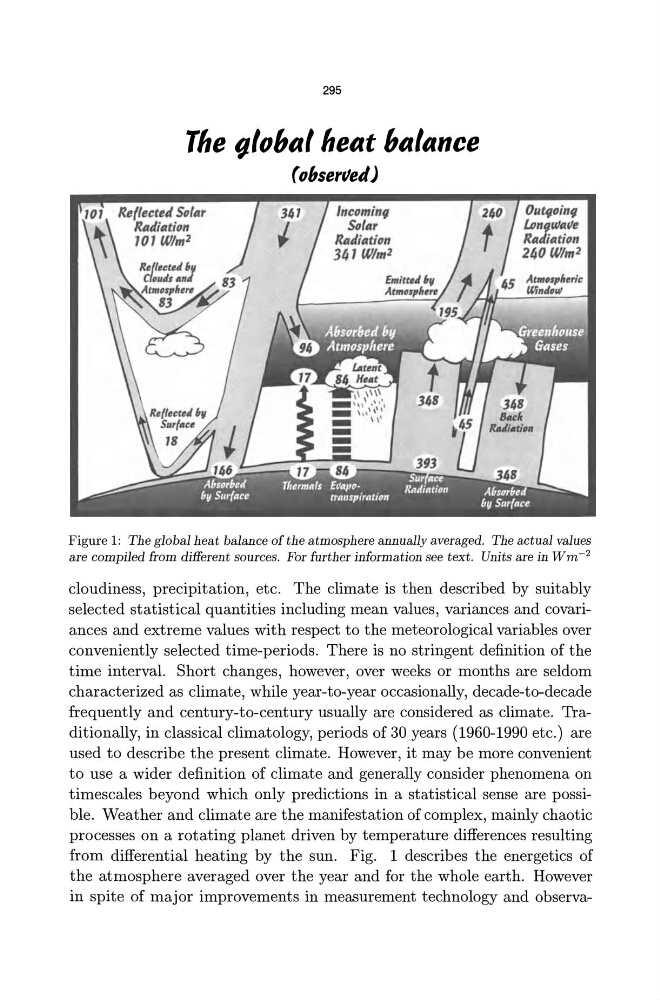
Figure 1: The global heat balance of the atmosphere annually averaged. The actual values
are compiled from different sources. For further information see text. Units are in Wm- 2
cloudiness, precipitation, etc. The climate is then described by suitably
selected statistical quantities including mean values, variances and covariances and extreme values with respect to the meteorological variables over
conveniently selected time-periods. There is no stringent definition of the
time interval. Short changes, however, over weeks or months are seldom
characterized as climate, while year-to-year occasionally, decade-to-decade
frequently and century-to-century usually are considered as climate. Traditionally, in classical climatology, periods of 30 years (1960-1990 etc.) are
used to describe the present climate. However, it may be more convenient
to use a wider definition of climate and generally consider phenomena on
timescales beyond which only predictions in a statistical sense are possible. Weather and climate are the manifestation of complex, mainly chaotic
processes on a rotating planet driven by temperature differences resulting
from differential heating by the sun. Fig. 1 describes the energetics of
the atmosphere averaged over the year and for the whole earth. However
in spite of major improvements in measurement technology and observa-
The global heat balance
(obserfled)
Reflected Solar
Radiation
101 Wlm 2
Incominf/
Solar
Radiation
341 Wlm 2
Figure 1: The global heat balance of the atmosphere annually averaged. The actual values
are compiled from different sources. For further information see text. Units are in Wm- 2
cloudiness, precipitation, etc. The climate is then described by suitably
selected statistical quantities including mean values, variances and covariances and extreme values with respect to the meteorological variables over
conveniently selected time-periods. There is no stringent definition of the
time interval. Short changes, however, over weeks or months are seldom
characterized as climate, while year-to-year occasionally, decade-to-decade
frequently and century-to-century usually are considered as climate. Traditionally, in classical climatology, periods of 30 years (1960-1990 etc.) are
used to describe the present climate. However, it may be more convenient
to use a wider definition of climate and generally consider phenomena on
timescales beyond which only predictions in a statistical sense are possible. Weather and climate are the manifestation of complex, mainly chaotic
processes on a rotating planet driven by temperature differences resulting
from differential heating by the sun. Fig. 1 describes the energetics of
the atmosphere averaged over the year and for the whole earth. However
in spite of major improvements in measurement technology and observa-