

Area
Controls
Greenland Sea 1,2,3,4b,( 4a)
Labrador Sea 1,2,3,4a,4b
257
Convective Status
1960's
Now
I:Max
I:Min
3:Max
4b:Min
(4a:Min)
I:Min
2:Min
4a:Max (GSA)
4b:Max
3:Min
4b:Max
(4a:?(GSA))
I:Max
2:Max
4a:Min
4b:Min
Sargasso Sea
2
2:Max
2:Min
Key to dominant processes:
1: Cyclonic wind stress curl for doming and intnsity of fronts around convective gyre
2: Cold air outbreaks for thermal density increase
3: Brine release during freezing for haline density increase
4: Cross-frontal advection of non-local waters into gyre
a. Capping of gyre by surface freshwater influx
b. Stratifying the gyres interior
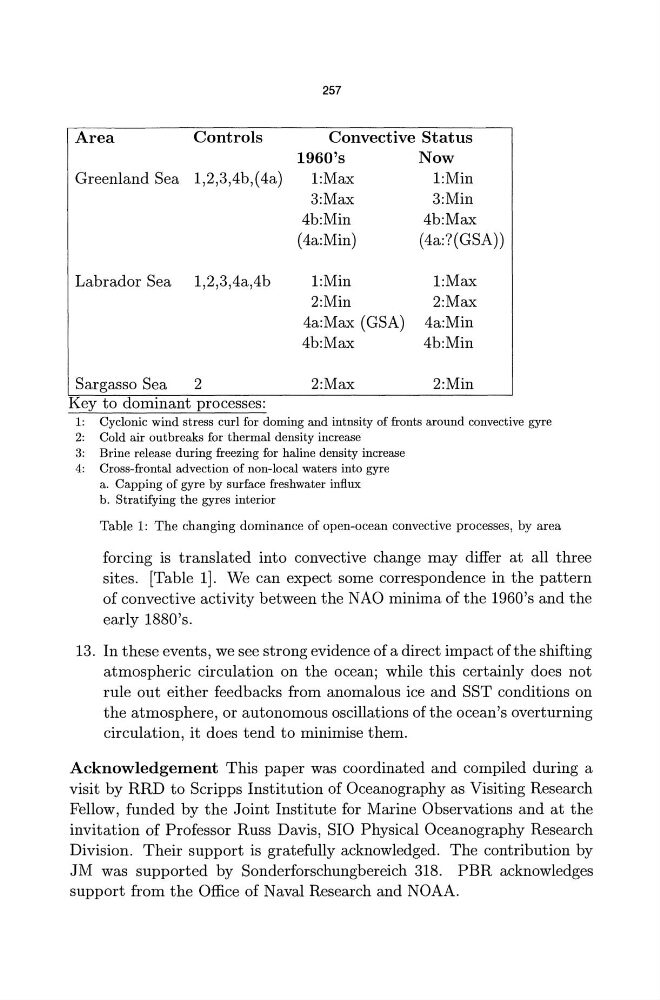
Table 1: The changing dominance of open-ocean convective processes, by area
forcing is translated into convective change may differ at all three
sites. [Table 1]. We can expect some correspondence in the pattern
of convective activity between the NAO minima of the 1960's and the
early 1880's.
13. In these events, we see strong evidence of a direct impact of the shifting
atmospheric circulation on the ocean; while this certainly does not
rule out either feedbacks from anomalous ice and SST conditions on
the atmosphere, or autonomous oscillations of the ocean's overturning
circulation, it does tend to minimise them.
Acknowledgement This paper was coordinated and compiled during a
visit by RRD to Scripps Institution of Oceanography as Visiting Research
Fellow, funded by the Joint Institute for Marine Observations and at the
invitation of Professor Russ Davis, SIO Physical Oceanography Research
Division. Their support is gratefully acknowledged. The contribution by
JM was supported by Sonderforschungbereich 318. PBR acknowledges
support from the Office of Naval Research and NOAA.
Controls
Greenland Sea 1,2,3,4b,( 4a)
Labrador Sea 1,2,3,4a,4b
257
Convective Status
1960's
Now
I:Max
I:Min
3:Max
4b:Min
(4a:Min)
I:Min
2:Min
4a:Max (GSA)
4b:Max
3:Min
4b:Max
(4a:?(GSA))
I:Max
2:Max
4a:Min
4b:Min
Sargasso Sea
2
2:Max
2:Min
Key to dominant processes:
1: Cyclonic wind stress curl for doming and intnsity of fronts around convective gyre
2: Cold air outbreaks for thermal density increase
3: Brine release during freezing for haline density increase
4: Cross-frontal advection of non-local waters into gyre
a. Capping of gyre by surface freshwater influx
b. Stratifying the gyres interior
Table 1: The changing dominance of open-ocean convective processes, by area
forcing is translated into convective change may differ at all three
sites. [Table 1]. We can expect some correspondence in the pattern
of convective activity between the NAO minima of the 1960's and the
early 1880's.
13. In these events, we see strong evidence of a direct impact of the shifting
atmospheric circulation on the ocean; while this certainly does not
rule out either feedbacks from anomalous ice and SST conditions on
the atmosphere, or autonomous oscillations of the ocean's overturning
circulation, it does tend to minimise them.
Acknowledgement This paper was coordinated and compiled during a
visit by RRD to Scripps Institution of Oceanography as Visiting Research
Fellow, funded by the Joint Institute for Marine Observations and at the
invitation of Professor Russ Davis, SIO Physical Oceanography Research
Division. Their support is gratefully acknowledged. The contribution by
JM was supported by Sonderforschungbereich 318. PBR acknowledges
support from the Office of Naval Research and NOAA.