

/
/
/
/
/
/
/
182
y
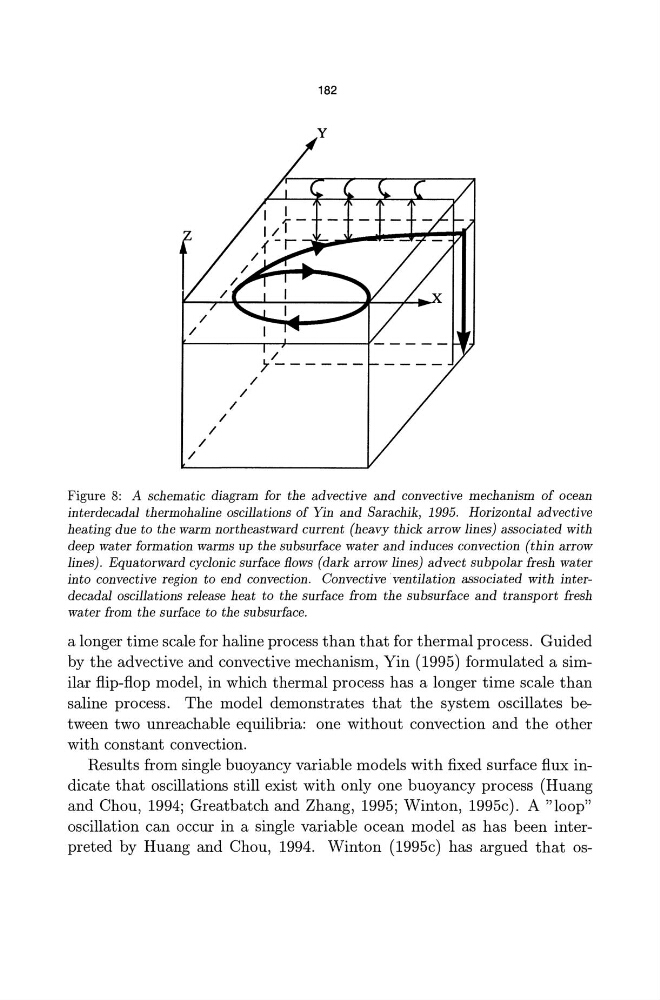
Figure 8: A schematic diagram for the advective and convective mechanism of ocean
interdecadal thermohaline oscillations of Yin and Sarachik, 1995. Horizontal advective
heating due to the warm northeastward current (heavy thick arrow lines) associated with
deep water formation warms up the subsurface water and induces convection (thin arrow
lines). Equatorward cyclonic surface flows (dark arrow lines) advect subpolar fresh water
into convective region to end convection. Convective' ventilation associated with interdecadal oscillations release heat to the surface from the subsurface and transport fresh
water from the surface to the subsurface.
a longer time scale for haline process than that for thermal process. Guided
by the advective and convective mechanism, Yin (1995) formulated a similar flip-flop model, in which thermal process has a longer time scale than
saline process. The model demonstrates that the system oscillates between two unreachable equilibria: one without convection and the other
with constant convection.
Results from single buoyancy variable models with fixed surface flux indicate that oscillations still exist with only one buoyancy process (Huang
and Chou, 1994; Greatbatch and Zhang, 1995; Winton, 1995c). A "loop"
oscillation can occur in a single variable ocean model as has been interpreted by Huang and Chou, 1994. Winton (1995c) has argued that os-
/
/
/
/
/
/
182
y
Figure 8: A schematic diagram for the advective and convective mechanism of ocean
interdecadal thermohaline oscillations of Yin and Sarachik, 1995. Horizontal advective
heating due to the warm northeastward current (heavy thick arrow lines) associated with
deep water formation warms up the subsurface water and induces convection (thin arrow
lines). Equatorward cyclonic surface flows (dark arrow lines) advect subpolar fresh water
into convective region to end convection. Convective' ventilation associated with interdecadal oscillations release heat to the surface from the subsurface and transport fresh
water from the surface to the subsurface.
a longer time scale for haline process than that for thermal process. Guided
by the advective and convective mechanism, Yin (1995) formulated a similar flip-flop model, in which thermal process has a longer time scale than
saline process. The model demonstrates that the system oscillates between two unreachable equilibria: one without convection and the other
with constant convection.
Results from single buoyancy variable models with fixed surface flux indicate that oscillations still exist with only one buoyancy process (Huang
and Chou, 1994; Greatbatch and Zhang, 1995; Winton, 1995c). A "loop"
oscillation can occur in a single variable ocean model as has been interpreted by Huang and Chou, 1994. Winton (1995c) has argued that os-