

CHAPTER 4 . Nutrients and Suspended Matter Behaviour in the Patos Lagoon Estuary (Brazil)
75
6
S
~
3w
4
~
I
Q.
Vl
0
3
I
Q.
2
. . . 1
0
A M J
1990
1991
SACOOA
MANGUEIRA
RIOGRANOE
CHANNEL
SACOOO
MARTINS
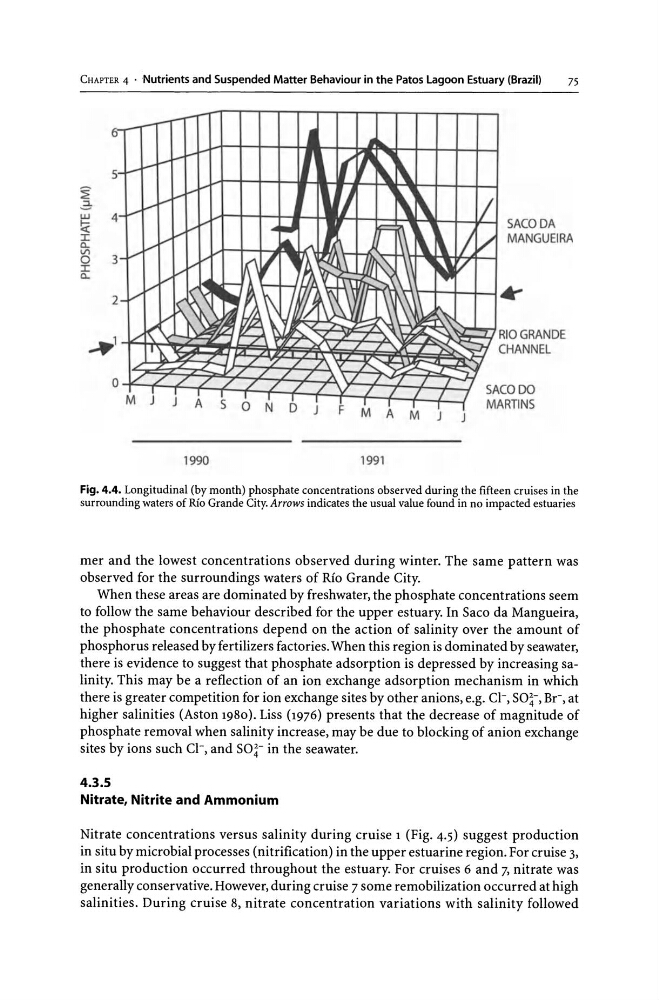
Fig. 4.4. Longitudinal (by month) phosphate concentrations observed during the fifteen cruises in the
surrounding waters of Rio Grande City. Arrows indicates the usual value found in no impacted estuaries
mer and the lowest concentrations observed during winter. The same pattern was
observed for the surroundings waters of Rio Grande City.
When these areas are dominated by freshwater, the phosphate concentrations seem
to follow the same behaviour described for the upper estuary. In Saco da Mangueira,
the phosphate concentrations depend on the action of salinity over the amount of
phosphorus released by fertilizers factories. When this region is dominated by seawater,
there is evidence to suggest that phosphate adsorption is depressed by increasing salinity. This may be a reflection of an ion exchange adsorption mechanism in which
there is greater competition for ion exchange sites by other anions, e.g. Cl-, SO~-, Br-, at
higher salinities (Aston 1980). Liss (1976) presents that the decrease of magnitude of
phosphate removal when salinity increase, may be due to blocking of anion exchange
sites by ions such Cl-, and SO~- in the seawater.
4.3.5
Nitrate, Nitrite and Ammonium
Nitrate concentrations versus salinity during cruise 1 (Fig. 4.5) suggest production
in situ by microbial processes (nitrification) in the upper estuarine region. For cruise 3,
in situ production occurred throughout the estuary. For cruises 6 and 7, nitrate was
generally conservative. However, during cruise 7 some remobilization occurred at high
salinities. During cruise 8, nitrate concentration variations with salinity followed
75
6
S
~
3w
4
~
I
Q.
Vl
0
3
I
Q.
2
. . . 1
0
A M J
1990
1991
SACOOA
MANGUEIRA
RIOGRANOE
CHANNEL
SACOOO
MARTINS
Fig. 4.4. Longitudinal (by month) phosphate concentrations observed during the fifteen cruises in the
surrounding waters of Rio Grande City. Arrows indicates the usual value found in no impacted estuaries
mer and the lowest concentrations observed during winter. The same pattern was
observed for the surroundings waters of Rio Grande City.
When these areas are dominated by freshwater, the phosphate concentrations seem
to follow the same behaviour described for the upper estuary. In Saco da Mangueira,
the phosphate concentrations depend on the action of salinity over the amount of
phosphorus released by fertilizers factories. When this region is dominated by seawater,
there is evidence to suggest that phosphate adsorption is depressed by increasing salinity. This may be a reflection of an ion exchange adsorption mechanism in which
there is greater competition for ion exchange sites by other anions, e.g. Cl-, SO~-, Br-, at
higher salinities (Aston 1980). Liss (1976) presents that the decrease of magnitude of
phosphate removal when salinity increase, may be due to blocking of anion exchange
sites by ions such Cl-, and SO~- in the seawater.
4.3.5
Nitrate, Nitrite and Ammonium
Nitrate concentrations versus salinity during cruise 1 (Fig. 4.5) suggest production
in situ by microbial processes (nitrification) in the upper estuarine region. For cruise 3,
in situ production occurred throughout the estuary. For cruises 6 and 7, nitrate was
generally conservative. However, during cruise 7 some remobilization occurred at high
salinities. During cruise 8, nitrate concentration variations with salinity followed