

CHAPTER 4 . Nutrients and Suspended Matter Behaviour in the Patos Lagoon Estuary (Brazil)
73
S
4
2
3
JUN 89
AUG 89
6
2
6f~
6
'iZl. l!I
6«,
,.~
0
6
5
4
3
4
3
MAY 90
JUN 90
~
2
.36
Q,.
V
6
vvV(,
~
w
6
V
!:i: 0
I
0S
VI
0
5
6
I
4
03
AUG 01 ,90
AUG 30,90
2
6
0
6
<7~4.~
c ..
§-~ Q,.
0
S
4
7
8
3
DEC 90
APR 91
2iY
1 ~~~
<7
0
vv"'\
~9 iflI'Iv~
0
5
10 15 20 25 30 35
0
5
10 15 20 25 30 35
SALINITY
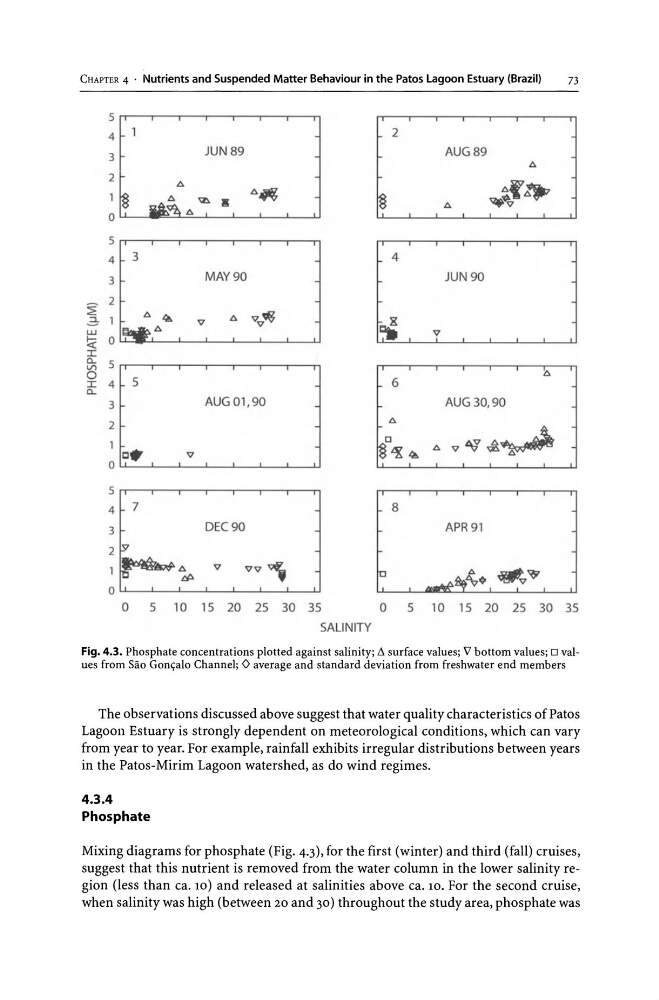
Fig. 4.3. Phosphate concentrations plotted against salinity; L1 surface values; V bottom values; 0 values from Sao Gon~alo Channel; 0 average and standard deviation from freshwater end members
The observations discussed above suggest that water quality characteristics of Patos
Lagoon Estuary is strongly dependent on meteorological conditions, which can vary
from year to year. For example, rainfall exhibits irregular distributions between years
in the Patos-Mirim Lagoon watershed, as do wind regimes.
4.3.4
Phosphate
Mixing diagrams for phosphate (Fig. 4.3), for the first (winter) and third (fall) cruises,
suggest that this nutrient is removed from the water column in the lower salinity region (less than ca. 10) and released at salinities above ca. 10. For the second cruise,
when salinity was high (between 20 and 30) throughout the study area, phosphate was
73
S
4
2
3
JUN 89
AUG 89
6
2
6f~
6
'iZl. l!I
6«,
,.~
0
6
5
4
3
4
3
MAY 90
JUN 90
~
2
.36
Q,.
V
6
vvV(,
~
w
6
V
!:i: 0
I
0S
VI
0
5
6
I
4
03
AUG 01 ,90
AUG 30,90
2
6
0
6
<7~4.~
c ..
§-~ Q,.
0
S
4
7
8
3
DEC 90
APR 91
2iY
1 ~~~
<7
0
vv"'\
~9 iflI'Iv~
0
5
10 15 20 25 30 35
0
5
10 15 20 25 30 35
SALINITY
Fig. 4.3. Phosphate concentrations plotted against salinity; L1 surface values; V bottom values; 0 values from Sao Gon~alo Channel; 0 average and standard deviation from freshwater end members
The observations discussed above suggest that water quality characteristics of Patos
Lagoon Estuary is strongly dependent on meteorological conditions, which can vary
from year to year. For example, rainfall exhibits irregular distributions between years
in the Patos-Mirim Lagoon watershed, as do wind regimes.
4.3.4
Phosphate
Mixing diagrams for phosphate (Fig. 4.3), for the first (winter) and third (fall) cruises,
suggest that this nutrient is removed from the water column in the lower salinity region (less than ca. 10) and released at salinities above ca. 10. For the second cruise,
when salinity was high (between 20 and 30) throughout the study area, phosphate was