

CHAPTER 3 . Coastal Lagoons of Southeastern Brazil
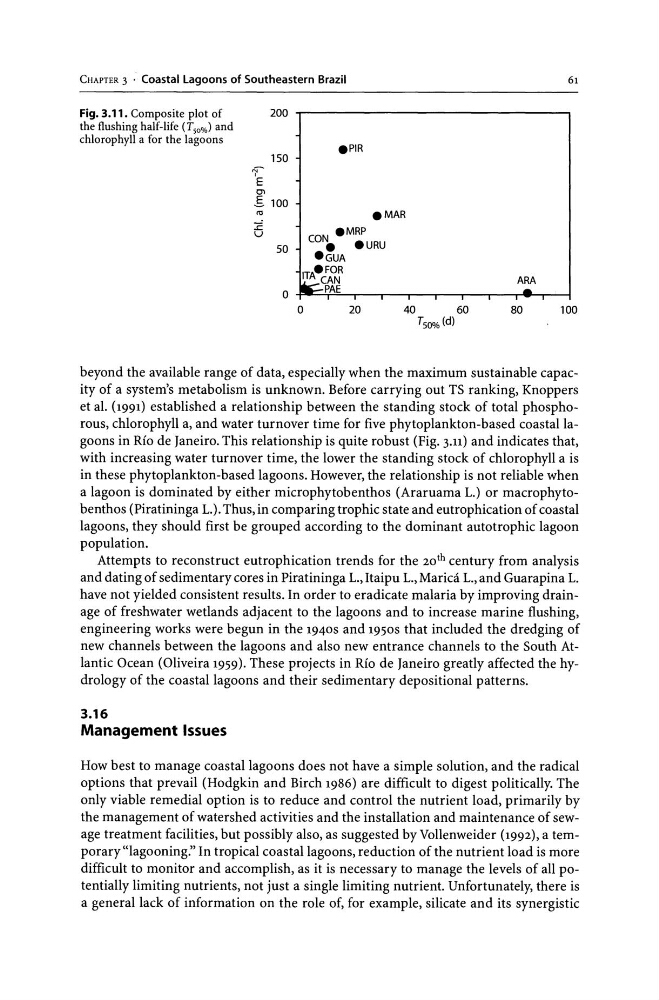
Fig. 3.11. Composite plot of
the flushing half-life (Tso%) and
chlorophyll a for the lagoons
'"I
E
Ol
.5
'"
:;:
u
200
150
100
50
0
ePIR
eMAR
eMRP
CONe
eURU
eGUA
ITA eFOR
~CAN
..... PAE
o
20
40
60
TSO%(d)
61
ARA
-
80
100
beyond the available range of data, especially when the maximum sustainable capacity of a system's metabolism is unknown. Before carrying out TS ranking, Knoppers
et al. (1991) established a relationship between the standing stock of total phosphorous, chlorophyll a, and water turnover time for five phytoplankton-based coastal lagoons in Rio de Janeiro. This relationship is quite robust (Fig. 3.n) and indicates that,
with increasing water turnover time, the lower the standing stock of chlorophyll a is
in these phytoplankton-based lagoons. However, the relationship is not reliable when
a lagoon is dominated by either microphytobenthos (Araruama L.) or macrophytobenthos (Piratininga L.). Thus, in comparing trophic state and eutrophication of coastal
lagoons, they should first be grouped according to the dominant autotrophic lagoon
population.
Attempts to reconstruct eutrophication trends for the 20 th century from analysis
and dating of sedimentary cores in Piratininga L., Itaipu L., Marica L., and Guarapina L.
have not yielded consistent results. In order to eradicate malaria by improving drainage of freshwater wetlands adjacent to the lagoons and to increase marine flushing,
engineering works were begun in the 1940S and 1950S that included the dredging of
new channels between the lagoons and also new entrance channels to the South Atlantic Ocean (Oliveira 1959). These projects in Rio de Janeiro greatly affected the hydrology of the coastal lagoons and their sedimentary depositional patterns.
3.16
Management Issues
How best to manage coastal lagoons does not have a simple solution, and the radical
options that prevail (Hodgkin and Birch 1986) are difficult to digest politically. The
only viable remedial option is to reduce and control the nutrient load, primarily by
the management of watershed activities and the installation and maintenance of sewage treatment facilities, but possibly also, as suggested by Vollenweider (1992), a temporary "lagooning." In tropical coastal lagoons, reduction of the nutrient load is more
difficult to monitor and accomplish, as it is necessary to manage the levels of all potentially limiting nutrients, not just a single limiting nutrient. Unfortunately, there is
a general lack of information on the role of, for example, silicate and its synergistic
Fig. 3.11. Composite plot of
the flushing half-life (Tso%) and
chlorophyll a for the lagoons
'"I
E
Ol
.5
'"
:;:
u
200
150
100
50
0
ePIR
eMAR
eMRP
CONe
eURU
eGUA
ITA eFOR
~CAN
..... PAE
o
20
40
60
TSO%(d)
61
ARA
-
80
100
beyond the available range of data, especially when the maximum sustainable capacity of a system's metabolism is unknown. Before carrying out TS ranking, Knoppers
et al. (1991) established a relationship between the standing stock of total phosphorous, chlorophyll a, and water turnover time for five phytoplankton-based coastal lagoons in Rio de Janeiro. This relationship is quite robust (Fig. 3.n) and indicates that,
with increasing water turnover time, the lower the standing stock of chlorophyll a is
in these phytoplankton-based lagoons. However, the relationship is not reliable when
a lagoon is dominated by either microphytobenthos (Araruama L.) or macrophytobenthos (Piratininga L.). Thus, in comparing trophic state and eutrophication of coastal
lagoons, they should first be grouped according to the dominant autotrophic lagoon
population.
Attempts to reconstruct eutrophication trends for the 20 th century from analysis
and dating of sedimentary cores in Piratininga L., Itaipu L., Marica L., and Guarapina L.
have not yielded consistent results. In order to eradicate malaria by improving drainage of freshwater wetlands adjacent to the lagoons and to increase marine flushing,
engineering works were begun in the 1940S and 1950S that included the dredging of
new channels between the lagoons and also new entrance channels to the South Atlantic Ocean (Oliveira 1959). These projects in Rio de Janeiro greatly affected the hydrology of the coastal lagoons and their sedimentary depositional patterns.
3.16
Management Issues
How best to manage coastal lagoons does not have a simple solution, and the radical
options that prevail (Hodgkin and Birch 1986) are difficult to digest politically. The
only viable remedial option is to reduce and control the nutrient load, primarily by
the management of watershed activities and the installation and maintenance of sewage treatment facilities, but possibly also, as suggested by Vollenweider (1992), a temporary "lagooning." In tropical coastal lagoons, reduction of the nutrient load is more
difficult to monitor and accomplish, as it is necessary to manage the levels of all potentially limiting nutrients, not just a single limiting nutrient. Unfortunately, there is
a general lack of information on the role of, for example, silicate and its synergistic