

Bastiaan Knoppers . Bjorn Kjerfve
compared to the Rio de Janeiro lagoons. Nixon and Pilson (1983) and Knoppers (1994)
showed that the fluvial supply of dissolved inorganic nutrients to most estuaries and
lagoons, subject to only moderate cultural eutrophication, sustains 10-30% of the average annual primary production. Higher contributions are found in individual lagoon cells and during some stages of the annual cycle. They are related to the diversity and locality of point and non-point sources and also meteorological events, as in
the case of Araruama L. and other lagoons, such as Nichupte in Mexico, Venice in Italy,
the Peel-Harvey in western Australia, and Ebrie in Ivory Coast (Hodgkin and Birch
1982,1986; Carmouze and Caumette 1985; Sfrizo et al. 1988).
In phytoplankton-based coastal lagoons, the benthic supply and release of DIN
generally sustains 10-30%, and release of DIP (orthophosphate) 5-30%, of the annual
demand by pelagic primary production (Knoppers 1994). In some estuaries and lagoons, benthic release may supply 50%, and sometimes 100% at certain stages of the
annual cycle (Nixon 1982; Zeitzschel1980). In general, the DIN: DIP release rate from
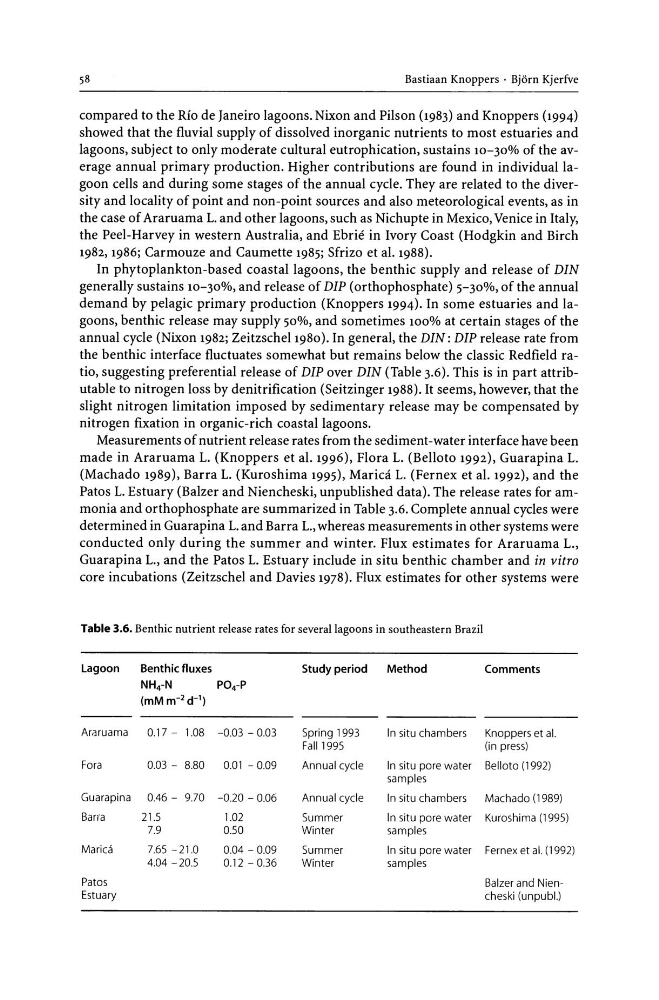
the benthic interface fluctuates somewhat but remains below the classic Redfield ratio, suggesting preferential release of DIP over DIN (Table 3.6). This is in part attributable to nitrogen loss by denitrification (Seitzinger 1988). It seems, however, that the
slight nitrogen limitation imposed by sedimentary release may be compensated by
nitrogen fixation in organic-rich coastal lagoons.
Measurements of nutrient release rates from the sediment-water interface have been
made in Araruama L. (Knoppers et al. 1996), Flora L. (Belloto 1992), Guarapina 1.
(Machado 1989), Barra 1. (Kuroshima 1995), Marica L. (Fernex et al. 1992), and the
Patos L. Estuary (Balzer and Niencheski, unpublished data). The release rates for ammonia and orthophosphate are summarized in Table 3.6. Complete annual cycles were
determined in Guarapina L. and Barra L., whereas measurements in other systems were
conducted only during the summer and winter. Flux estimates for Araruama 1.,
Guarapina L., and the Patos L. Estuary include in situ benthic chamber and in vitro
core incubations (Zeitzschel and Davies 1978). Flux estimates for other systems were
Table 3.6. Benthic nutrient release rates for several lagoons in southeastern Brazil
Lagoon
Benthic fluxes
Study period
Method
Comments
NH4-N
P04-P
(mM m- 2 d-')
Araruama
0.17 - 1.08 -0.03 - 0.03
Spring 1993
In situ chambers
Knoppers et al.
Fall 1995
(in press)
Fora
0.03 - 8.80
0.01 - 0.09
Annual cycle
In situ pore water Belloto (1992)
samples
Guarapina
0.46 - 9.70 -0.20 - 0.06
Annual cycle
In situ chambers
Machado (1989)
Bana
21.5
1.02
Summer
In situ pore water Kuroshima (1995)
7.9
0.50
Winter
samples
Marie]
7.65 -21.0
0.04 - 0.09
Summer
In situ pore water Fernex et al. (1992)
4.04 -20.5
0.12 - 0.36
Winter
samples
Patos
Balzer and NienEstuary
cheski (unpubl.)
compared to the Rio de Janeiro lagoons. Nixon and Pilson (1983) and Knoppers (1994)
showed that the fluvial supply of dissolved inorganic nutrients to most estuaries and
lagoons, subject to only moderate cultural eutrophication, sustains 10-30% of the average annual primary production. Higher contributions are found in individual lagoon cells and during some stages of the annual cycle. They are related to the diversity and locality of point and non-point sources and also meteorological events, as in
the case of Araruama L. and other lagoons, such as Nichupte in Mexico, Venice in Italy,
the Peel-Harvey in western Australia, and Ebrie in Ivory Coast (Hodgkin and Birch
1982,1986; Carmouze and Caumette 1985; Sfrizo et al. 1988).
In phytoplankton-based coastal lagoons, the benthic supply and release of DIN
generally sustains 10-30%, and release of DIP (orthophosphate) 5-30%, of the annual
demand by pelagic primary production (Knoppers 1994). In some estuaries and lagoons, benthic release may supply 50%, and sometimes 100% at certain stages of the
annual cycle (Nixon 1982; Zeitzschel1980). In general, the DIN: DIP release rate from
the benthic interface fluctuates somewhat but remains below the classic Redfield ratio, suggesting preferential release of DIP over DIN (Table 3.6). This is in part attributable to nitrogen loss by denitrification (Seitzinger 1988). It seems, however, that the
slight nitrogen limitation imposed by sedimentary release may be compensated by
nitrogen fixation in organic-rich coastal lagoons.
Measurements of nutrient release rates from the sediment-water interface have been
made in Araruama L. (Knoppers et al. 1996), Flora L. (Belloto 1992), Guarapina 1.
(Machado 1989), Barra 1. (Kuroshima 1995), Marica L. (Fernex et al. 1992), and the
Patos L. Estuary (Balzer and Niencheski, unpublished data). The release rates for ammonia and orthophosphate are summarized in Table 3.6. Complete annual cycles were
determined in Guarapina L. and Barra L., whereas measurements in other systems were
conducted only during the summer and winter. Flux estimates for Araruama 1.,
Guarapina L., and the Patos L. Estuary include in situ benthic chamber and in vitro
core incubations (Zeitzschel and Davies 1978). Flux estimates for other systems were
Table 3.6. Benthic nutrient release rates for several lagoons in southeastern Brazil
Lagoon
Benthic fluxes
Study period
Method
Comments
NH4-N
P04-P
(mM m- 2 d-')
Araruama
0.17 - 1.08 -0.03 - 0.03
Spring 1993
In situ chambers
Knoppers et al.
Fall 1995
(in press)
Fora
0.03 - 8.80
0.01 - 0.09
Annual cycle
In situ pore water Belloto (1992)
samples
Guarapina
0.46 - 9.70 -0.20 - 0.06
Annual cycle
In situ chambers
Machado (1989)
Bana
21.5
1.02
Summer
In situ pore water Kuroshima (1995)
7.9
0.50
Winter
samples
Marie]
7.65 -21.0
0.04 - 0.09
Summer
In situ pore water Fernex et al. (1992)
4.04 -20.5
0.12 - 0.36
Winter
samples
Patos
Balzer and NienEstuary
cheski (unpubl.)