

CHAPTER 3 .. Coastal Lagoons of Southeastern Brazil
57
Complete mass balance studies, including all sources and sinks, are still lacking for
coastal lagoons (Smith and Atkinson 1994), including the lagoons of southeastern
Brazil. In some lagoons, however, nutrient loading from rivers and nutrient release
rates from the sediments have been measured, although information on the riverine
load is available mainly for the dissolved inorganic fractions. To what extent the load
of the dissolved and particulate organic fraction after oxidation within the lagoons
represents a significant new nutrient source for the sustenance of primary production has yet to be established.
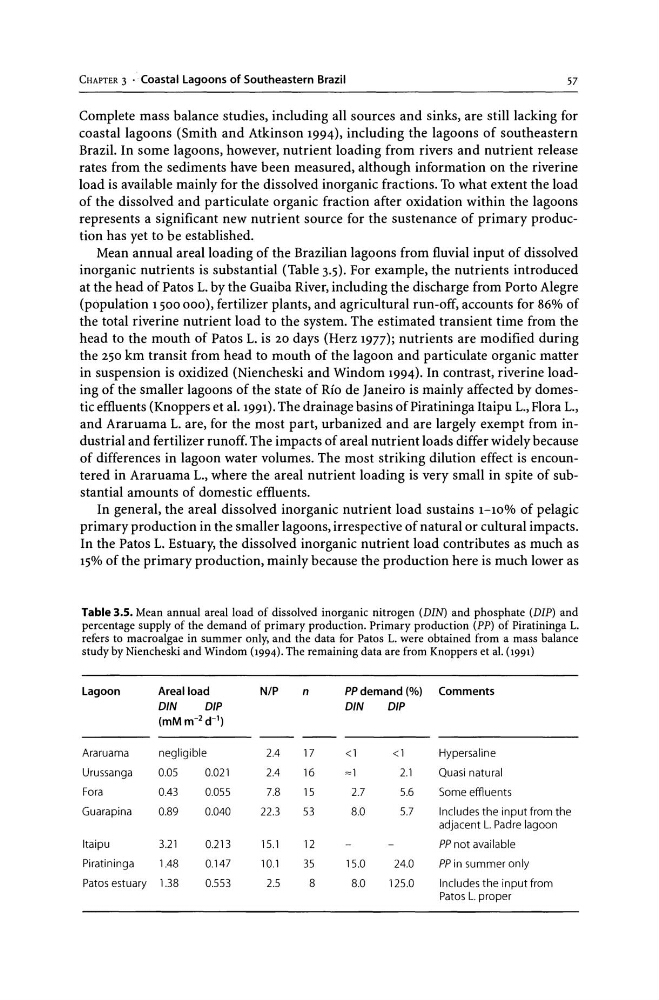
Mean annual areal loading of the Brazilian lagoons from fluvial input of dissolved
inorganic nutrients is substantial (Table 3.5). For example, the nutrients introduced
at the head of Patos L. by the Guaiba River, including the discharge from Porto Alegre
(population 1500000), fertilizer plants, and agricultural run-off, accounts for 86% of
the total riverine nutrient load to the system. The estimated transient time from the
head to the mouth of Patos L. is 20 days (Herz 1977); nutrients are modified during
the 250 km transit from head to mouth of the lagoon and particulate organic matter
in suspension is oxidized (Niencheski and Windom 1994). In contrast, riverine loading of the smaller lagoons of the state of Rio de Janeiro is mainly affected by domestic effluents (Knoppers et al. 1991). The drainage basins ofPiratininga Itaipu L., Flora L.,
and Araruama L. are, for the most part, urbanized and are largely exempt from industrial and fertilizer runoff. The impacts of areal nutrient loads differ widely because
of differences in lagoon water volumes. The most striking dilution effect is encountered in Araruama L., where the areal nutrient loading is very small in spite of substantial amounts of domestic effluents.
In general, the areal dissolved inorganic nutrient load sustains 1-10% of pelagic
primary production in the smaller lagoons, irrespective of natural or cultural impacts.
In the Patos L. Estuary, the dissolved inorganic nutrient load contributes as much as
15% of the primary production, mainly because the production here is much lower as
Table 3.5. Mean annual areal load of dissolved inorganic nitrogen (DIN) and phosphate (DIP) and
percentage supply of the demand of primary production. Primary production (PP) of Piratininga 1.
refers to macro algae in summer only, and the data for Patos 1. were obtained from a mass balance
study by Niencheski and Windom (1994). The remaining data are from Knoppers et al. (1991)
Lagoon
Areal load
NIP
n
PP demand (%) Comments
DIN
DIP
DIN
DIP
(mMm- 2 d-1)
Araruama
negligible
2.4
17
<1
<1
Hypersaline
Urussanga
0.05
0.021
2.4
16
~1
2.1
Quasi natural
Fora
0.43
0.055
7.8
15
2.7
5.6
Some effluents
Guarapina
0.89
0.040
22.3
53
8.0
5.7
Includes the input from the
adjacent L. Padre lagoon
Itaipu
3.21
0.213
15.1
12
PP not available
Piratininga
1.48
0.147
10.1
35
15.0
24.0
PP in summer only
Patos estuary 1.38
0.553
2.5
8
8.0
125.0
Includes the input from
Patos L. proper
57
Complete mass balance studies, including all sources and sinks, are still lacking for
coastal lagoons (Smith and Atkinson 1994), including the lagoons of southeastern
Brazil. In some lagoons, however, nutrient loading from rivers and nutrient release
rates from the sediments have been measured, although information on the riverine
load is available mainly for the dissolved inorganic fractions. To what extent the load
of the dissolved and particulate organic fraction after oxidation within the lagoons
represents a significant new nutrient source for the sustenance of primary production has yet to be established.
Mean annual areal loading of the Brazilian lagoons from fluvial input of dissolved
inorganic nutrients is substantial (Table 3.5). For example, the nutrients introduced
at the head of Patos L. by the Guaiba River, including the discharge from Porto Alegre
(population 1500000), fertilizer plants, and agricultural run-off, accounts for 86% of
the total riverine nutrient load to the system. The estimated transient time from the
head to the mouth of Patos L. is 20 days (Herz 1977); nutrients are modified during
the 250 km transit from head to mouth of the lagoon and particulate organic matter
in suspension is oxidized (Niencheski and Windom 1994). In contrast, riverine loading of the smaller lagoons of the state of Rio de Janeiro is mainly affected by domestic effluents (Knoppers et al. 1991). The drainage basins ofPiratininga Itaipu L., Flora L.,
and Araruama L. are, for the most part, urbanized and are largely exempt from industrial and fertilizer runoff. The impacts of areal nutrient loads differ widely because
of differences in lagoon water volumes. The most striking dilution effect is encountered in Araruama L., where the areal nutrient loading is very small in spite of substantial amounts of domestic effluents.
In general, the areal dissolved inorganic nutrient load sustains 1-10% of pelagic
primary production in the smaller lagoons, irrespective of natural or cultural impacts.
In the Patos L. Estuary, the dissolved inorganic nutrient load contributes as much as
15% of the primary production, mainly because the production here is much lower as
Table 3.5. Mean annual areal load of dissolved inorganic nitrogen (DIN) and phosphate (DIP) and
percentage supply of the demand of primary production. Primary production (PP) of Piratininga 1.
refers to macro algae in summer only, and the data for Patos 1. were obtained from a mass balance
study by Niencheski and Windom (1994). The remaining data are from Knoppers et al. (1991)
Lagoon
Areal load
NIP
n
PP demand (%) Comments
DIN
DIP
DIN
DIP
(mMm- 2 d-1)
Araruama
negligible
2.4
17
<1
<1
Hypersaline
Urussanga
0.05
0.021
2.4
16
~1
2.1
Quasi natural
Fora
0.43
0.055
7.8
15
2.7
5.6
Some effluents
Guarapina
0.89
0.040
22.3
53
8.0
5.7
Includes the input from the
adjacent L. Padre lagoon
Itaipu
3.21
0.213
15.1
12
PP not available
Piratininga
1.48
0.147
10.1
35
15.0
24.0
PP in summer only
Patos estuary 1.38
0.553
2.5
8
8.0
125.0
Includes the input from
Patos L. proper