

CHAPTER 3 . Coastal Lagoons of Southeastern Brazil
47
Kjerfve et al. 1996). The flushing half-life (T 50 0/0), or the time that it takes to replace
half of the lagoon water volume, is one such measure (Pritchard 1961; Knoppers
et al. 1991; Kjerfve et al. 1996). Assuming steady state and complete mixing occurring
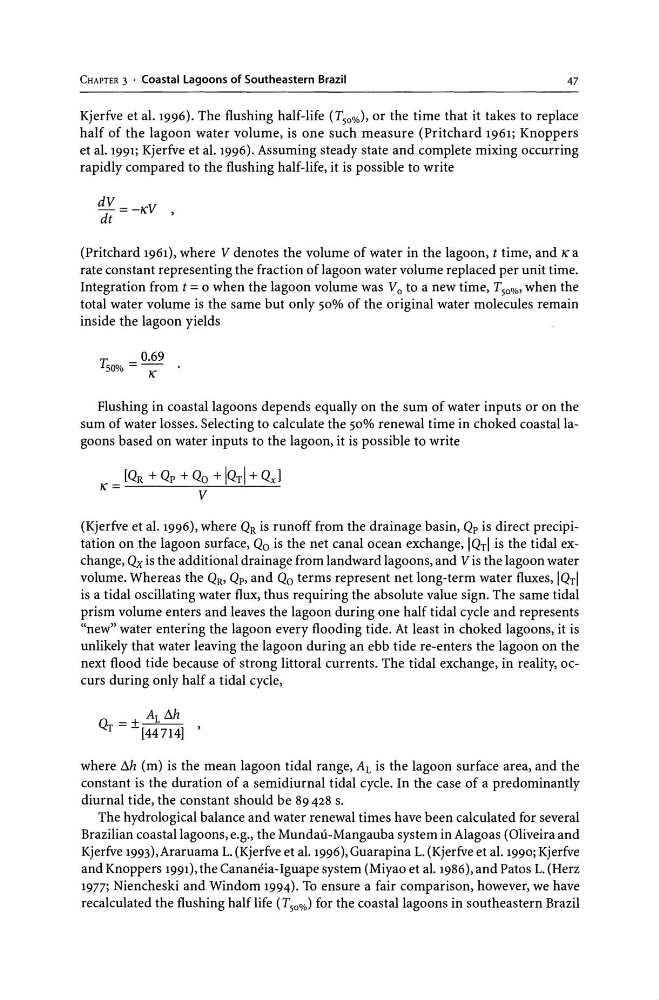
rapidly compared to the flushing half-life, it is possible to write
dV = -KV ,
dt
(Pritchard 1961), where V denotes the volume of water in the lagoon, t time, and K: a
rate constant representing the fraction of lagoon water volume replaced per unit time.
Integration from t = 0 when the lagoon volume was Vo to a new time, T 50 0/0' when the
total water volume is the same but only 50% of the original water molecules remain
inside the lagoon yields
'T'
0.69
150% = -
K:
Flushing in coastal lagoons depends equally on the sum of water inputs or on the
sum of water losses. Selecting to calculate the 50% renewal time in choked coastal lagoons based on water inputs to the lagoon, it is possible to write
(Kjerfve et al. 1996), where QR is runoff from the drainage basin, Qp is direct precipitation on the lagoon surface, Qo is the net canal ocean exchange, IQrl is the tidal exchange, Ox: is the additional drainage from landward lagoons, and V is the lagoon water
volume. Whereas the QR' Qp, and Qo terms represent net long-term water fluxes, IQTI
is a tidal oscillating water flux, thus requiring the absolute value sign. The same tidal
prism volume enters and leaves the lagoon during one half tidal cycle and represents
"new" water entering the lagoon every flooding tide. At least in choked lagoons, it is
unlikely that water leaving the lagoon during an ebb tide re-enters the lagoon on the
next flood tide because of strong littoral currents. The tidal exchange, in reality, occurs during only half a tidal cycle,
= + AL'~h
Q r - [44 714] ,
where I1h (m) is the mean lagoon tidal range, AL is the lagoon surface area, and the
constant is the duration of a semidiurnal tidal cycle. In the case of a predominantly
diurnal tide, the constant should be 89428 s.
The hydrological balance and water renewal times have been calculated for several
Brazilian coastal lagoons, e.g., the Mundau-Mangauba system in Alagoas (Oliveira and
Kjerfve 1993), Araruama L. (Kjerfve et al. 1996), Guarapina L. (Kjerfve et al. 1990; Kjerfve
and Knoppers 1991), the Cananeia-Iguape system (Miyao et al. 1986), and Patos L. (Herz
1977; Niencheski and Windom 1994). To ensure a fair comparison, however, we have
recalculated the flushing half life (T 50 0/0) for the coastal lagoons in southeastern Brazil
47
Kjerfve et al. 1996). The flushing half-life (T 50 0/0), or the time that it takes to replace
half of the lagoon water volume, is one such measure (Pritchard 1961; Knoppers
et al. 1991; Kjerfve et al. 1996). Assuming steady state and complete mixing occurring
rapidly compared to the flushing half-life, it is possible to write
dV = -KV ,
dt
(Pritchard 1961), where V denotes the volume of water in the lagoon, t time, and K: a
rate constant representing the fraction of lagoon water volume replaced per unit time.
Integration from t = 0 when the lagoon volume was Vo to a new time, T 50 0/0' when the
total water volume is the same but only 50% of the original water molecules remain
inside the lagoon yields
'T'
0.69
150% = -
K:
Flushing in coastal lagoons depends equally on the sum of water inputs or on the
sum of water losses. Selecting to calculate the 50% renewal time in choked coastal lagoons based on water inputs to the lagoon, it is possible to write
(Kjerfve et al. 1996), where QR is runoff from the drainage basin, Qp is direct precipitation on the lagoon surface, Qo is the net canal ocean exchange, IQrl is the tidal exchange, Ox: is the additional drainage from landward lagoons, and V is the lagoon water
volume. Whereas the QR' Qp, and Qo terms represent net long-term water fluxes, IQTI
is a tidal oscillating water flux, thus requiring the absolute value sign. The same tidal
prism volume enters and leaves the lagoon during one half tidal cycle and represents
"new" water entering the lagoon every flooding tide. At least in choked lagoons, it is
unlikely that water leaving the lagoon during an ebb tide re-enters the lagoon on the
next flood tide because of strong littoral currents. The tidal exchange, in reality, occurs during only half a tidal cycle,
= + AL'~h
Q r - [44 714] ,
where I1h (m) is the mean lagoon tidal range, AL is the lagoon surface area, and the
constant is the duration of a semidiurnal tidal cycle. In the case of a predominantly
diurnal tide, the constant should be 89428 s.
The hydrological balance and water renewal times have been calculated for several
Brazilian coastal lagoons, e.g., the Mundau-Mangauba system in Alagoas (Oliveira and
Kjerfve 1993), Araruama L. (Kjerfve et al. 1996), Guarapina L. (Kjerfve et al. 1990; Kjerfve
and Knoppers 1991), the Cananeia-Iguape system (Miyao et al. 1986), and Patos L. (Herz
1977; Niencheski and Windom 1994). To ensure a fair comparison, however, we have
recalculated the flushing half life (T 50 0/0) for the coastal lagoons in southeastern Brazil