

38
Bastiaan Knoppers ' Bjorn Kjerfve
48· 30'
48·00'
47"30'
47"00'
46· 30' W
23· 45'
24· 00' S
?
State of
Sao Paulo
24· 15'
24· 30'
24· 45'
r:P
25· 00'
0"' ' 1;
~'"
~(§'
~
~'S'
25· 15'
'-,0
25· 30'
,/
Trapande
Bay
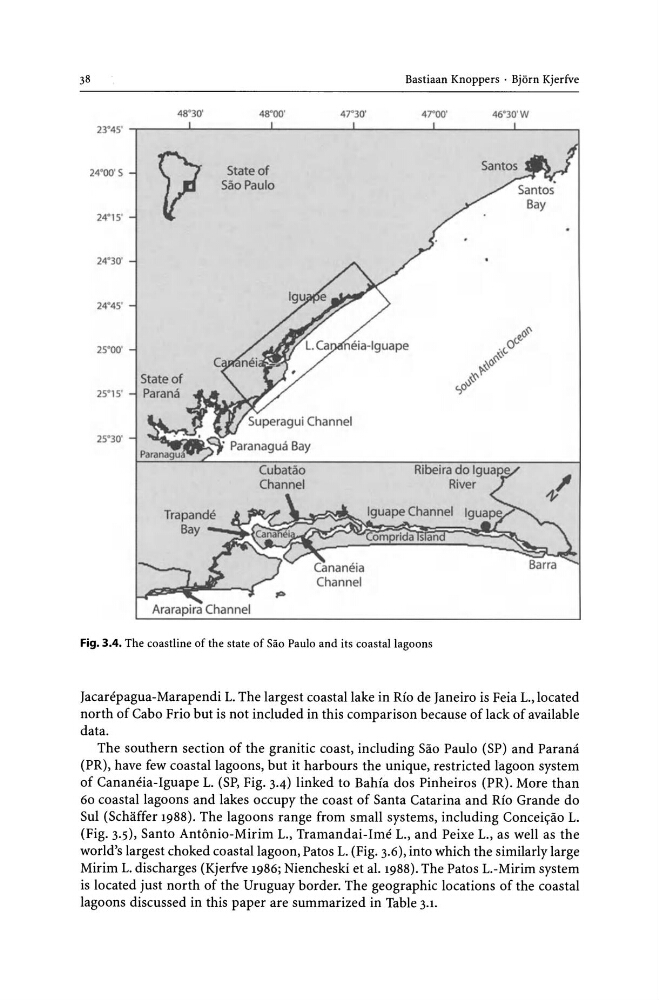
Fig. 3.4. The coastline of the state of Sao Paulo and its coastal lagoons
Jacarepagua-Marapendi 1. The largest coastal lake in Rio de Janeiro is Feia 1., located
north of Cabo Frio but is not included in this comparison because of lack of available
data.
The southern section of the granitic coast, including Sao Paulo (SP) and Parana
(PR), have few coastal lagoons, but it harbours the unique, restricted lagoon system
of Cananeia-Iguape 1. (SP, Fig. 3.4) linked to Bahia dos Pinheiros (PR). More than
60 coastal lagoons and lakes occupy the coast of Santa Catarina and Rio Grande do
SuI (Schaffer 1988). The lagoons range from small systems, including Concei~ao 1.
(Fig. 3.5), Santo Antonio-Mirim 1., Tramandai-Ime 1., and Peixe 1., as well as the
world's largest choked coastal lagoon, Patos 1. (Fig. 3.6), into which the similarly large
Mirim 1. discharges (Kjerfve 1986; Niencheski et al. 1988). The Patos 1.-Mirim system
is located just north of the Uruguay border. The geographic locations of the coastal
lagoons discussed in this paper are summarized in Table 3.1.
Bastiaan Knoppers ' Bjorn Kjerfve
48· 30'
48·00'
47"30'
47"00'
46· 30' W
23· 45'
24· 00' S
?
State of
Sao Paulo
24· 15'
24· 30'
24· 45'
r:P
25· 00'
0"' ' 1;
~'"
~(§'
~
~'S'
25· 15'
'-,0
25· 30'
,/
Trapande
Bay
Fig. 3.4. The coastline of the state of Sao Paulo and its coastal lagoons
Jacarepagua-Marapendi 1. The largest coastal lake in Rio de Janeiro is Feia 1., located
north of Cabo Frio but is not included in this comparison because of lack of available
data.
The southern section of the granitic coast, including Sao Paulo (SP) and Parana
(PR), have few coastal lagoons, but it harbours the unique, restricted lagoon system
of Cananeia-Iguape 1. (SP, Fig. 3.4) linked to Bahia dos Pinheiros (PR). More than
60 coastal lagoons and lakes occupy the coast of Santa Catarina and Rio Grande do
SuI (Schaffer 1988). The lagoons range from small systems, including Concei~ao 1.
(Fig. 3.5), Santo Antonio-Mirim 1., Tramandai-Ime 1., and Peixe 1., as well as the
world's largest choked coastal lagoon, Patos 1. (Fig. 3.6), into which the similarly large
Mirim 1. discharges (Kjerfve 1986; Niencheski et al. 1988). The Patos 1.-Mirim system
is located just north of the Uruguay border. The geographic locations of the coastal
lagoons discussed in this paper are summarized in Table 3.1.