

CHAPTER 3 . Coastal Lagoons of Southeastern Brazil
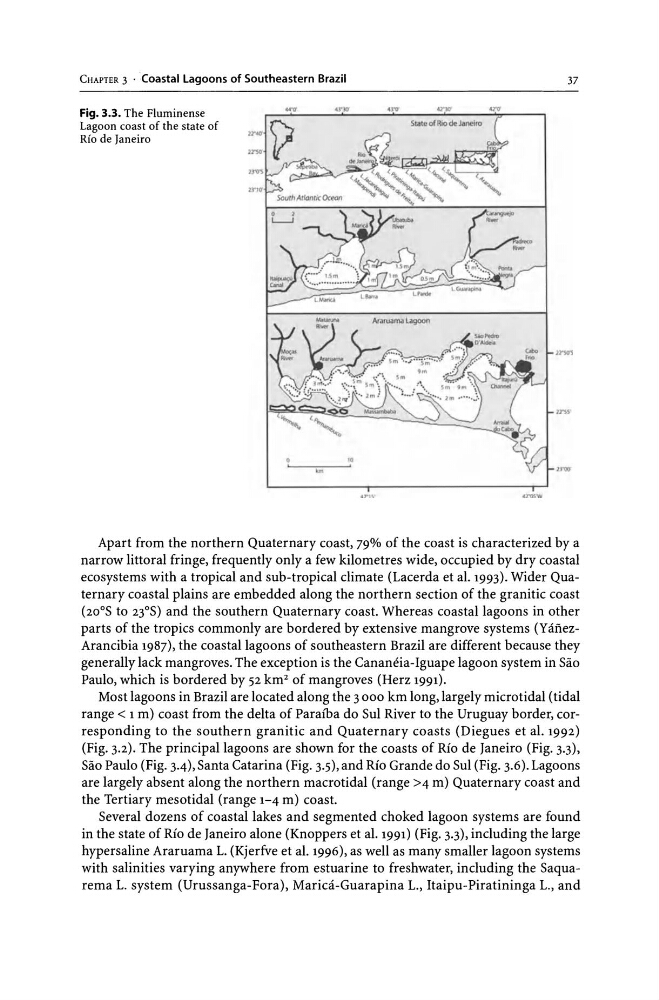
Fig. 3.3. The Fluminense
Lagoon coast of the state of
Rio de Janeiro
""'"
37
,,....,
Apart from the northern Quaternary coast, 79% of the coast is characterized by a
narrow littoral fringe, frequently only a few kilometres wide, occupied by dry coastal
ecosystems with a tropical and sub-tropical climate (Lacerda et al. 1993). Wider Quaternary coastal plains are embedded along the northern section of the granitic coast
(20
0
S to 23°S) and the southern Quaternary coast. Whereas coastal lagoons in other
parts of the tropics commonly are bordered by extensive mangrove systems (YaftezArancibia 1987), the coastal lagoons of southeastern Brazil are different because they
generally lack mangroves. The exception is the Cananeia-Iguape lagoon system in Sao
Paulo, which is bordered by 52 km 2 of mangroves (Herz 1991).
Most lagoons in Brazil are located along the 3 000 km long, largely microtidal (tidal
range < 1 m) coast from the delta of Paraiba do SuI River to the Uruguay border, corresponding to the southern granitic and Quaternary coasts (Diegues et al. 1992)
(Fig. 3.2). The principal lagoons are shown for the coasts of Rio de Janeiro (Fig. 3.3),
Sao Paulo (Fig. 3.4), Santa Catarina (Fig. 3.5), and Rio Grande do SuI (Fig. 3.6). Lagoons
are largely absent along the northern macrotidal (range >4 m) Quaternary coast and
the Tertiary mesotidal (range 1-4 m) coast.
Several dozens of coastal lakes and segmented choked lagoon systems are found
in the state of Rio de Janeiro alone (Knoppers et al. 1991) (Fig. 3.3), including the large
hypersaline Araruama 1. (Kjerfve et al. 1996), as well as many smaller lagoon systems
with salinities varying anywhere from estuarine to freshwater, including the Saquarema 1. system (Urussanga-Fora), Marica-Guarapina 1., Itaipu-Piratininga 1., and
Fig. 3.3. The Fluminense
Lagoon coast of the state of
Rio de Janeiro
""'"
37
,,....,
Apart from the northern Quaternary coast, 79% of the coast is characterized by a
narrow littoral fringe, frequently only a few kilometres wide, occupied by dry coastal
ecosystems with a tropical and sub-tropical climate (Lacerda et al. 1993). Wider Quaternary coastal plains are embedded along the northern section of the granitic coast
(20
0
S to 23°S) and the southern Quaternary coast. Whereas coastal lagoons in other
parts of the tropics commonly are bordered by extensive mangrove systems (YaftezArancibia 1987), the coastal lagoons of southeastern Brazil are different because they
generally lack mangroves. The exception is the Cananeia-Iguape lagoon system in Sao
Paulo, which is bordered by 52 km 2 of mangroves (Herz 1991).
Most lagoons in Brazil are located along the 3 000 km long, largely microtidal (tidal
range < 1 m) coast from the delta of Paraiba do SuI River to the Uruguay border, corresponding to the southern granitic and Quaternary coasts (Diegues et al. 1992)
(Fig. 3.2). The principal lagoons are shown for the coasts of Rio de Janeiro (Fig. 3.3),
Sao Paulo (Fig. 3.4), Santa Catarina (Fig. 3.5), and Rio Grande do SuI (Fig. 3.6). Lagoons
are largely absent along the northern macrotidal (range >4 m) Quaternary coast and
the Tertiary mesotidal (range 1-4 m) coast.
Several dozens of coastal lakes and segmented choked lagoon systems are found
in the state of Rio de Janeiro alone (Knoppers et al. 1991) (Fig. 3.3), including the large
hypersaline Araruama 1. (Kjerfve et al. 1996), as well as many smaller lagoon systems
with salinities varying anywhere from estuarine to freshwater, including the Saquarema 1. system (Urussanga-Fora), Marica-Guarapina 1., Itaipu-Piratininga 1., and