

CHAPTER 9 . Geomorphological and Physical Characteristics of the Bahia Blanca Estuary
207
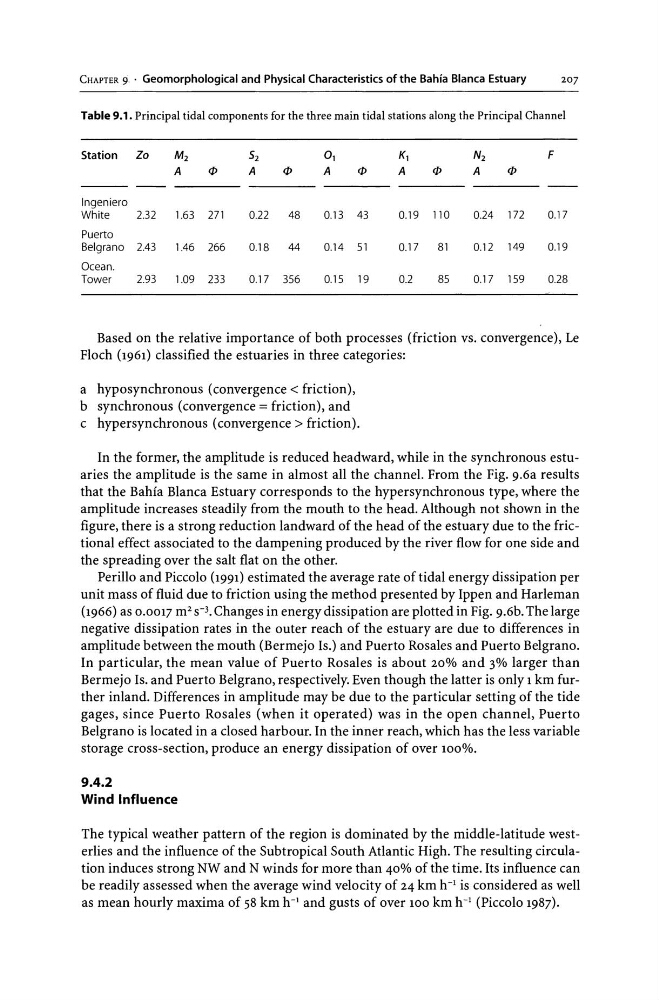
Table 9.1. Principal tidal components for the three main tidal stations along the Principal Channel
Station
Zo
M2
52
0 1
Kl
N2
F
A
cp
A
cp
A
cp
A
cp
A
cp
Ingeniero
White
2.32
1.63 271
0.22
48
0.13 43
0.19 110
0.24 172
0.17
Puerto
Belgrano 2.43
1.46 266
0.18
44
0.14 51
0.17
81
0.12 149
0.19
Ocean.
Tower
2.93
1.09 233
0.17 356
0.15 19
0.2
85
0.17 159
0.28
Based on the relative importance of both processes (friction vs. convergence), Le
Floch (1961) classified the estuaries in three categories:
a hyposynchronous (convergence < friction),
b synchronous (convergence = friction), and
c hypersynchronous (convergence> friction).
In the former, the amplitude is reduced headward, while in the synchronous estuaries the amplitude is the same in almost all the channel. From the Fig. 9.6a results
that the Bahia Blanca Estuary corresponds to the hypersynchronous type, where the
amplitude increases steadily from the mouth to the head. Although not shown in the
figure, there is a strong reduction landward of the head of the estuary due to the frictional effect associated to the dampening produced by the river flow for one side and
the spreading over the salt flat on the other.
Perillo and Piccolo (1991) estimated the average rate of tidal energy dissipation per
unit mass of fluid due to friction using the method presented by Ippen and Harleman
(1966) as 0.0017 m 2 S-3. Changes in energy dissipation are plotted in Fig. 9.6b. The large
negative dissipation rates in the outer reach of the estuary are due to differences in
amplitude between the mouth (Bermejo Is.) and Puerto Rosales and Puerto Belgrano.
In particular, the mean value of Puerto Rosales is about 20% and yJlo larger than
Bermejo Is. and Puerto Belgrano, respectively. Even though the latter is only 1 km further inland. Differences in amplitude may be due to the particular setting of the tide
gages, since Puerto Rosales (when it operated) was in the open channel, Puerto
Belgrano is located in a closed harbour. In the inner reach, which has the less variable
storage cross-section, produce an energy dissipation of over 100%.
9.4.2
Wind Influence
The typical weather pattern of the region is dominated by the middle-latitude westerlies and the influence of the Subtropical South Atlantic High. The resulting circulation induces strong NW and N winds for more than 40% of the time. Its influence can
be readily assessed when the average wind velocity of 24 km h- 1 is considered as well
as mean hourly maxima of 58 km h- 1 and gusts of over 100 km h- 1 (Piccolo 1987).
207
Table 9.1. Principal tidal components for the three main tidal stations along the Principal Channel
Station
Zo
M2
52
0 1
Kl
N2
F
A
cp
A
cp
A
cp
A
cp
A
cp
Ingeniero
White
2.32
1.63 271
0.22
48
0.13 43
0.19 110
0.24 172
0.17
Puerto
Belgrano 2.43
1.46 266
0.18
44
0.14 51
0.17
81
0.12 149
0.19
Ocean.
Tower
2.93
1.09 233
0.17 356
0.15 19
0.2
85
0.17 159
0.28
Based on the relative importance of both processes (friction vs. convergence), Le
Floch (1961) classified the estuaries in three categories:
a hyposynchronous (convergence < friction),
b synchronous (convergence = friction), and
c hypersynchronous (convergence> friction).
In the former, the amplitude is reduced headward, while in the synchronous estuaries the amplitude is the same in almost all the channel. From the Fig. 9.6a results
that the Bahia Blanca Estuary corresponds to the hypersynchronous type, where the
amplitude increases steadily from the mouth to the head. Although not shown in the
figure, there is a strong reduction landward of the head of the estuary due to the frictional effect associated to the dampening produced by the river flow for one side and
the spreading over the salt flat on the other.
Perillo and Piccolo (1991) estimated the average rate of tidal energy dissipation per
unit mass of fluid due to friction using the method presented by Ippen and Harleman
(1966) as 0.0017 m 2 S-3. Changes in energy dissipation are plotted in Fig. 9.6b. The large
negative dissipation rates in the outer reach of the estuary are due to differences in
amplitude between the mouth (Bermejo Is.) and Puerto Rosales and Puerto Belgrano.
In particular, the mean value of Puerto Rosales is about 20% and yJlo larger than
Bermejo Is. and Puerto Belgrano, respectively. Even though the latter is only 1 km further inland. Differences in amplitude may be due to the particular setting of the tide
gages, since Puerto Rosales (when it operated) was in the open channel, Puerto
Belgrano is located in a closed harbour. In the inner reach, which has the less variable
storage cross-section, produce an energy dissipation of over 100%.
9.4.2
Wind Influence
The typical weather pattern of the region is dominated by the middle-latitude westerlies and the influence of the Subtropical South Atlantic High. The resulting circulation induces strong NW and N winds for more than 40% of the time. Its influence can
be readily assessed when the average wind velocity of 24 km h- 1 is considered as well
as mean hourly maxima of 58 km h- 1 and gusts of over 100 km h- 1 (Piccolo 1987).