

206
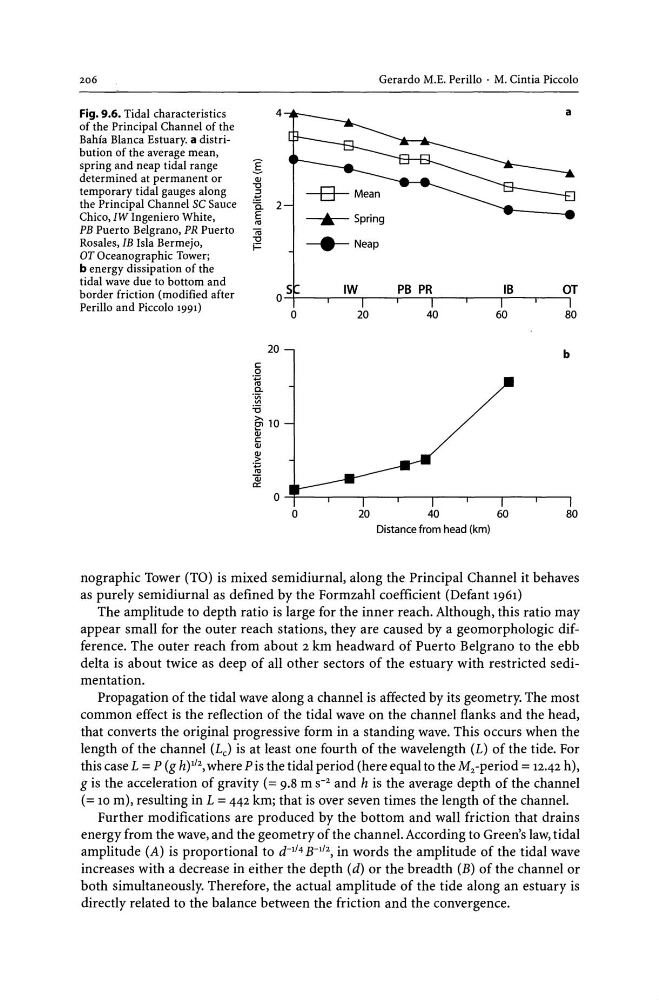
Fig. 9.6. Tidal characteristics
of the Principal Channel of the
Bahia Blanca Estuary. a distribution of the average mean,
spring and neap tidal range
determined at permanent or
temporary tidal gauges along
the Principal Channel SC Sauce
Chico, IW Ingeniero White,
PB Puerto Belgrano, PR Puerto
Rosales, IB Isla Bermejo,
OT Oceanographic Tower;
b energy dissipation of the
tidal wave due to bottom and
border friction (modified after
Perillo and Piccolo 1991)
:g
OJ
'0
.e
4
a. 2
E
'"
ro
'0
1=
oS
0
20
I:
0
'';:;
'" 0.~
'5
e> 10
OJ
I:
OJ
~
'';:;
'"
Qj
0:
0
0
Gerardo M.E. Perillo . M. Cintia Piccolo
a
--B- Mean
----.- Spring
- - . - Neap
IW
20
40
60
80
b
20
40
60
80
Distance from head (km)
no graphic Tower (TO) is mixed semidiurnal, along the Principal Channel it behaves
as purely semidiurnal as defined by the Formzahl coefficient (Defant 1961)
The amplitude to depth ratio is large for the inner reach. Although, this ratio may
appear small for the outer reach stations, they are caused by a geomorphologic difference. The outer reach from about 2 km headward of Puerto Belgrano to the ebb
delta is about twice as deep of all other sectors of the estuary with restricted sedimentation.
Propagation of the tidal wave along a channel is affected by its geometry. The most
common effect is the reflection of the tidal wave on the channel flanks and the head,
that converts the original progressive form in a standing wave. This occurs when the
length of the channel (LJ is at least one fourth of the wavelength (L) of the tide. For
this case L = P (g h)Ii2, where Pis the tidal period (here equal to the M2-period = 12-42 h),
g is the acceleration of gravity (= 9.8 m S-2 and h is the average depth of the channel
(= 10 m), resulting in L = 442 km; that is over seven times the length of the channel.
Further modifications are produced by the bottom and wall friction that drains
energy from the wave, and the geometry of the channel. According to Green's law, tidal
amplitude (A) is proportional to d- 1i4 B- 1 i2, in words the amplitude of the tidal wave
increases with a decrease in either the depth (d) or the breadth (B) of the channel or
both simultaneously. Therefore, the actual amplitude of the tide along an estuary is
directly related to the balance between the friction and the convergence.
Fig. 9.6. Tidal characteristics
of the Principal Channel of the
Bahia Blanca Estuary. a distribution of the average mean,
spring and neap tidal range
determined at permanent or
temporary tidal gauges along
the Principal Channel SC Sauce
Chico, IW Ingeniero White,
PB Puerto Belgrano, PR Puerto
Rosales, IB Isla Bermejo,
OT Oceanographic Tower;
b energy dissipation of the
tidal wave due to bottom and
border friction (modified after
Perillo and Piccolo 1991)
:g
OJ
'0
.e
4
a. 2
E
'"
ro
'0
1=
oS
0
20
I:
0
'';:;
'" 0.~
'5
e> 10
OJ
I:
OJ
~
'';:;
'"
Qj
0:
0
0
Gerardo M.E. Perillo . M. Cintia Piccolo
a
--B- Mean
----.- Spring
- - . - Neap
IW
20
40
60
80
b
20
40
60
80
Distance from head (km)
no graphic Tower (TO) is mixed semidiurnal, along the Principal Channel it behaves
as purely semidiurnal as defined by the Formzahl coefficient (Defant 1961)
The amplitude to depth ratio is large for the inner reach. Although, this ratio may
appear small for the outer reach stations, they are caused by a geomorphologic difference. The outer reach from about 2 km headward of Puerto Belgrano to the ebb
delta is about twice as deep of all other sectors of the estuary with restricted sedimentation.
Propagation of the tidal wave along a channel is affected by its geometry. The most
common effect is the reflection of the tidal wave on the channel flanks and the head,
that converts the original progressive form in a standing wave. This occurs when the
length of the channel (LJ is at least one fourth of the wavelength (L) of the tide. For
this case L = P (g h)Ii2, where Pis the tidal period (here equal to the M2-period = 12-42 h),
g is the acceleration of gravity (= 9.8 m S-2 and h is the average depth of the channel
(= 10 m), resulting in L = 442 km; that is over seven times the length of the channel.
Further modifications are produced by the bottom and wall friction that drains
energy from the wave, and the geometry of the channel. According to Green's law, tidal
amplitude (A) is proportional to d- 1i4 B- 1 i2, in words the amplitude of the tidal wave
increases with a decrease in either the depth (d) or the breadth (B) of the channel or
both simultaneously. Therefore, the actual amplitude of the tide along an estuary is
directly related to the balance between the friction and the convergence.