

176
M.B. Framiiian . M.P. Etala . E.M. Acha . R. A. Guerrero· C.A. Lasta . O.B. Brown
and Wong (1994). With the information available, the effect of the longitudinal winds
on the circulation can not be properly evaluated, but, due to the large cross-section of
the Rio de la Plata, transverse circulation generated by longitudinal winds might be
expected. Onshore winds might produce southward advection of water in the estuary,
as suggested by Guerrero et al. (1997); this mechanism, superposed onto the effect of
upwelling-favourable winds, can explain the presence of the fresh water extension
along the Argentinean coast during spring/summer.
From the analysis of the salinity distribution, a seasonal pattern exists when the
seasons are based on the forcing cycles. Although a dynamical analysis of the circulation and forcing is needed to fully understand the complex processes of the estuarine-shelf interaction, the qualitative force balance described above gives a first order
explanation of the seasonal variability observed.
8.4.3
Vertical Distribution and Stratification
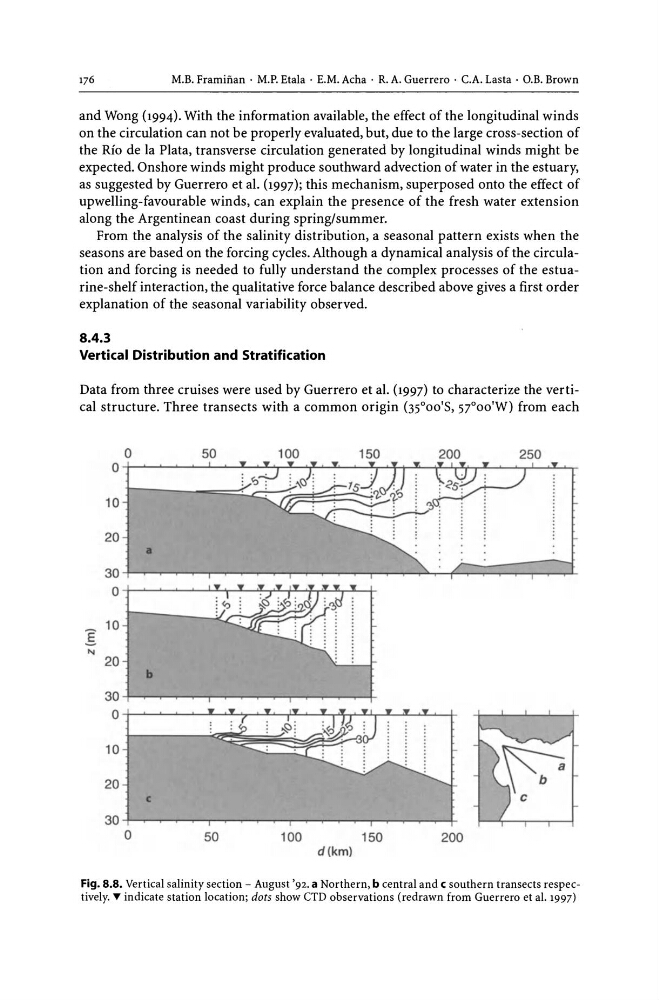
Data from three cruises were used by Guerrero et al. (1997) to characterize the vertical structure. Three transects with a common origin (35°00'5, 57°00'W) from each
I
o
O+-~~~~~-L~~~~~~~~~~~~~~~~~~
50
100
150
200
250
20
a
30+-~~--~~~~-r~~~-.~~~~~--~~~~
o +-~~~~~~~~~~~~-+
10
20
b
30+-~~~~~~~~~~~~-+
O +-~~~~~~~-P~~~~,L~~~
20
c
30+-~~~~~~~~~~~~~~--~~+
o
50
100
150
200
d(km)
Fig. 8.8. Vertical salinity section - August '92. a Northern, b central and c southern transects respectively. T indicate station location; dots show CTD observations (redrawn from Guerrero et al. 1997)
M.B. Framiiian . M.P. Etala . E.M. Acha . R. A. Guerrero· C.A. Lasta . O.B. Brown
and Wong (1994). With the information available, the effect of the longitudinal winds
on the circulation can not be properly evaluated, but, due to the large cross-section of
the Rio de la Plata, transverse circulation generated by longitudinal winds might be
expected. Onshore winds might produce southward advection of water in the estuary,
as suggested by Guerrero et al. (1997); this mechanism, superposed onto the effect of
upwelling-favourable winds, can explain the presence of the fresh water extension
along the Argentinean coast during spring/summer.
From the analysis of the salinity distribution, a seasonal pattern exists when the
seasons are based on the forcing cycles. Although a dynamical analysis of the circulation and forcing is needed to fully understand the complex processes of the estuarine-shelf interaction, the qualitative force balance described above gives a first order
explanation of the seasonal variability observed.
8.4.3
Vertical Distribution and Stratification
Data from three cruises were used by Guerrero et al. (1997) to characterize the vertical structure. Three transects with a common origin (35°00'5, 57°00'W) from each
I
o
O+-~~~~~-L~~~~~~~~~~~~~~~~~~
50
100
150
200
250
20
a
30+-~~--~~~~-r~~~-.~~~~~--~~~~
o +-~~~~~~~~~~~~-+
10
20
b
30+-~~~~~~~~~~~~-+
O +-~~~~~~~-P~~~~,L~~~
20
c
30+-~~~~~~~~~~~~~~--~~+
o
50
100
150
200
d(km)
Fig. 8.8. Vertical salinity section - August '92. a Northern, b central and c southern transects respectively. T indicate station location; dots show CTD observations (redrawn from Guerrero et al. 1997)