

Jorge Lopez Laborde· Gustavo J. Nagy
80
60
,
~
E 40
~
C . .
" 20
0
Co
E
8 0
!'
'u
0
Q; - 20
>
.. "
'C -40
:
'0.
" 0 -60
...J
- 80
140
E"C 120
.. c>
~.E 100
~5 80
~'f;; 60
-0:::
~~ 40
~ ~ 20
1- Velocity
-
Tide
1
~
::J 0
V1U
O~~~~rn~""~~ . . . . ~~~~~~~
o 2 4 6 8 10 1214161820222426283032343638
Sampling hours
160
140
120 E
~
100 ..
"0
80
';;
:.
60
,..
0
40 :0
~
. .
20 -0
;.::
0
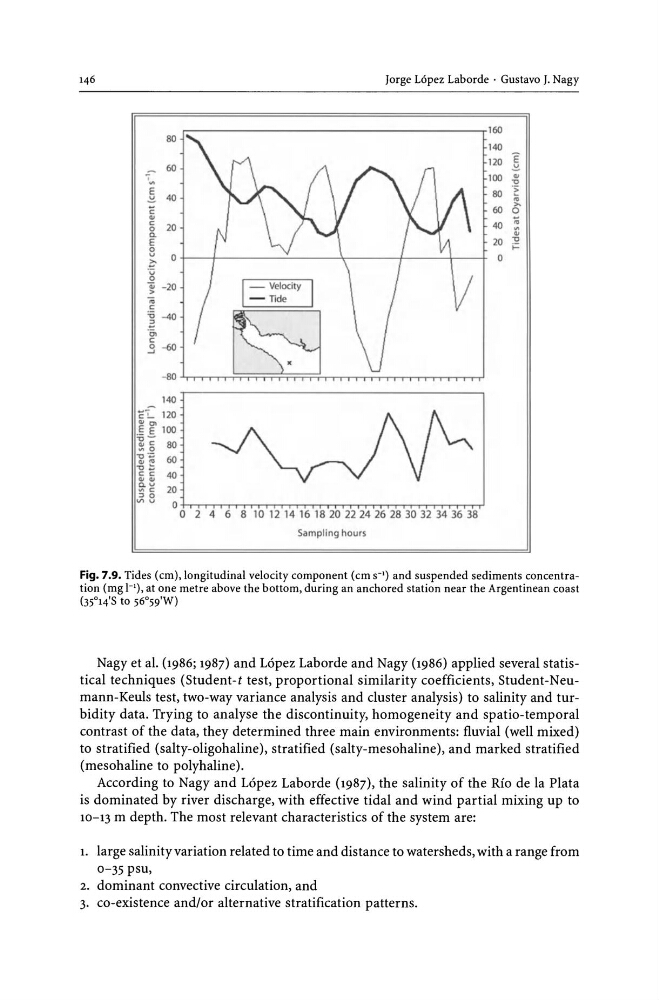
Fig. 7.9. Tides (cm), longitudinal velocity component (cm S-I) and suspended sediments concentration (mg I-I), at one metre above the bottom, during an anchored station near the Argentinean coast
(35°14'5 to 56°59'W)
Nagy et al. (1986; 1987) and Lopez Laborde and Nagy (1986) applied several statistical techniques (Student-t test, proportional similarity coefficients, Student-Neumann-Keuls test, two-way variance analysis and cluster analysis) to salinity and turbidity data. Trying to analyse the discontinuity, homogeneity and spatio-temporal
contrast of the data, they determined three main environments: fluvial (well mixed)
to stratified (salty-oligohaline), stratified (salty-mesohaline), and marked stratified
(mesohaline to polyhaline).
According to Nagy and Lopez Laborde (1987), the salinity of the Rio de la Plata
is dominated by river discharge, with effective tidal and wind partial mixing up to
10-13 m depth. The most relevant characteristics of the system are:
1. large salinity variation related to time and distance to watersheds, with a range from
0-35 psu,
2. dominant convective circulation, and
3. co-existence and/or alternative stratification patterns.
80
60
,
~
E 40
~
C . .
" 20
0
Co
E
8 0
!'
'u
0
Q; - 20
>
.. "
'C -40
:
'0.
" 0 -60
...J
- 80
140
E"C 120
.. c>
~.E 100
~5 80
~'f;; 60
-0:::
~~ 40
~ ~ 20
1- Velocity
-
Tide
1
~
::J 0
V1U
O~~~~rn~""~~ . . . . ~~~~~~~
o 2 4 6 8 10 1214161820222426283032343638
Sampling hours
160
140
120 E
~
100 ..
"0
80
';;
:.
60
,..
0
40 :0
~
. .
20 -0
;.::
0
Fig. 7.9. Tides (cm), longitudinal velocity component (cm S-I) and suspended sediments concentration (mg I-I), at one metre above the bottom, during an anchored station near the Argentinean coast
(35°14'5 to 56°59'W)
Nagy et al. (1986; 1987) and Lopez Laborde and Nagy (1986) applied several statistical techniques (Student-t test, proportional similarity coefficients, Student-Neumann-Keuls test, two-way variance analysis and cluster analysis) to salinity and turbidity data. Trying to analyse the discontinuity, homogeneity and spatio-temporal
contrast of the data, they determined three main environments: fluvial (well mixed)
to stratified (salty-oligohaline), stratified (salty-mesohaline), and marked stratified
(mesohaline to polyhaline).
According to Nagy and Lopez Laborde (1987), the salinity of the Rio de la Plata
is dominated by river discharge, with effective tidal and wind partial mixing up to
10-13 m depth. The most relevant characteristics of the system are:
1. large salinity variation related to time and distance to watersheds, with a range from
0-35 psu,
2. dominant convective circulation, and
3. co-existence and/or alternative stratification patterns.