

106
M. Cintia Piccolo . Gerardo M.E. Perillo
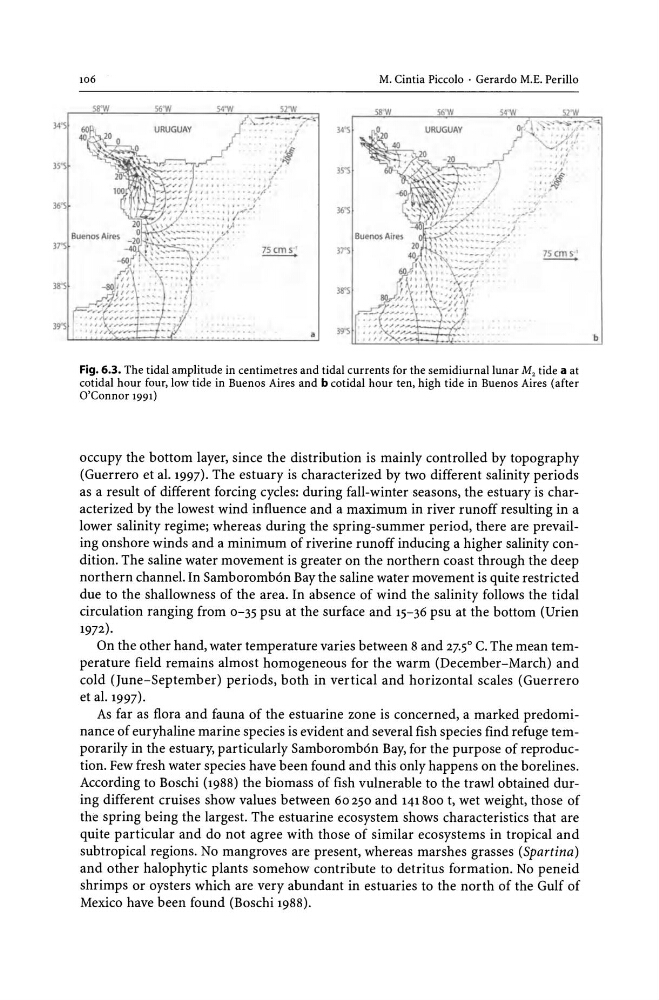
Fig. 6.3. The tidal amplitude in centimetres and tidal currents for the semidiurnallunar M, tide a at
cotidal hour four, low tide in Buenos Aires and b cotidal hour ten, high tide in Buenos Aires (after
O'Connor 1991)
occupy the bottom layer, since the distribution is mainly controlled by topography
(Guerrero et al. 1997). The estuary is characterized by two different salinity periods
as a result of different forcing cycles: during fall-winter seasons, the estuary is characterized by the lowest wind influence and a maximum in river runoff resulting in a
lower salinity regime; whereas during the spring-summer period, there are prevailing onshore winds and a minimum of riverine runoff inducing a higher salinity condition. The saline water movement is greater on the northern coast through the deep
northern channel. In Samboromb6n Bay the saline water movement is quite restricted
due to the shallowness of the area. In absence of wind the salinity follows the tidal
circulation ranging from 0-35 psu at the surface and 15-36 psu at the bottom (Urien
1972).
On the other hand, water temperature varies between 8 and 27.5° C. The mean temperature field remains almost homogeneous for the warm (December-March) and
cold (June-September) periods, both in vertical and horizontal scales (Guerrero
et al. 1997).
As far as flora and fauna of the estuarine zone is concerned, a marked predominance of euryhaline marine species is evident and several fish species find refuge temporarily in the estuary, particularly Samboromb6n Bay, for the purpose of reproduction. Few fresh water species have been found and this only happens on the borelines.
According to Boschi (1988) the biomass of fish vulnerable to the trawl obtained during different cruises show values between 60250 and 141800 t, wet weight, those of
the spring being the largest. The estuarine ecosystem shows characteristics that are
quite particular and do not agree with those of similar ecosystems in tropical and
subtropical regions. No mangroves are present, whereas marshes grasses (Spartina)
and other halophytic plants somehow contribute to detritus formation. No peneid
shrimps or oysters which are very abundant in estuaries to the north of the Gulf of
Mexico have been found (Boschi 1988).
M. Cintia Piccolo . Gerardo M.E. Perillo
Fig. 6.3. The tidal amplitude in centimetres and tidal currents for the semidiurnallunar M, tide a at
cotidal hour four, low tide in Buenos Aires and b cotidal hour ten, high tide in Buenos Aires (after
O'Connor 1991)
occupy the bottom layer, since the distribution is mainly controlled by topography
(Guerrero et al. 1997). The estuary is characterized by two different salinity periods
as a result of different forcing cycles: during fall-winter seasons, the estuary is characterized by the lowest wind influence and a maximum in river runoff resulting in a
lower salinity regime; whereas during the spring-summer period, there are prevailing onshore winds and a minimum of riverine runoff inducing a higher salinity condition. The saline water movement is greater on the northern coast through the deep
northern channel. In Samboromb6n Bay the saline water movement is quite restricted
due to the shallowness of the area. In absence of wind the salinity follows the tidal
circulation ranging from 0-35 psu at the surface and 15-36 psu at the bottom (Urien
1972).
On the other hand, water temperature varies between 8 and 27.5° C. The mean temperature field remains almost homogeneous for the warm (December-March) and
cold (June-September) periods, both in vertical and horizontal scales (Guerrero
et al. 1997).
As far as flora and fauna of the estuarine zone is concerned, a marked predominance of euryhaline marine species is evident and several fish species find refuge temporarily in the estuary, particularly Samboromb6n Bay, for the purpose of reproduction. Few fresh water species have been found and this only happens on the borelines.
According to Boschi (1988) the biomass of fish vulnerable to the trawl obtained during different cruises show values between 60250 and 141800 t, wet weight, those of
the spring being the largest. The estuarine ecosystem shows characteristics that are
quite particular and do not agree with those of similar ecosystems in tropical and
subtropical regions. No mangroves are present, whereas marshes grasses (Spartina)
and other halophytic plants somehow contribute to detritus formation. No peneid
shrimps or oysters which are very abundant in estuaries to the north of the Gulf of
Mexico have been found (Boschi 1988).