

CHAPTER 6 . The Argentina Estuaries: A Review
103
To the south of Colorado River (Fig. 6.1) there are only ten major former fluvial
valleys that discharge in the coastal ocean. All the Patagonian rivers have their origin
in the Andean mountains and they flow across a high plateau with almost no tributaries. During the Holocene these rivers formed broad valleys that give an idea of their
previous high runoff. At the present time, river discharge is low (and in some practically negligible) due to several decades of low precipitation and the building of dams
along their courses.
Based on the hydrographic characteristics of the Argentinian rivers and the
geomorphologic conditions in which they have developed, the main objective of the
present article is to describe them from their geomorphological and physical points
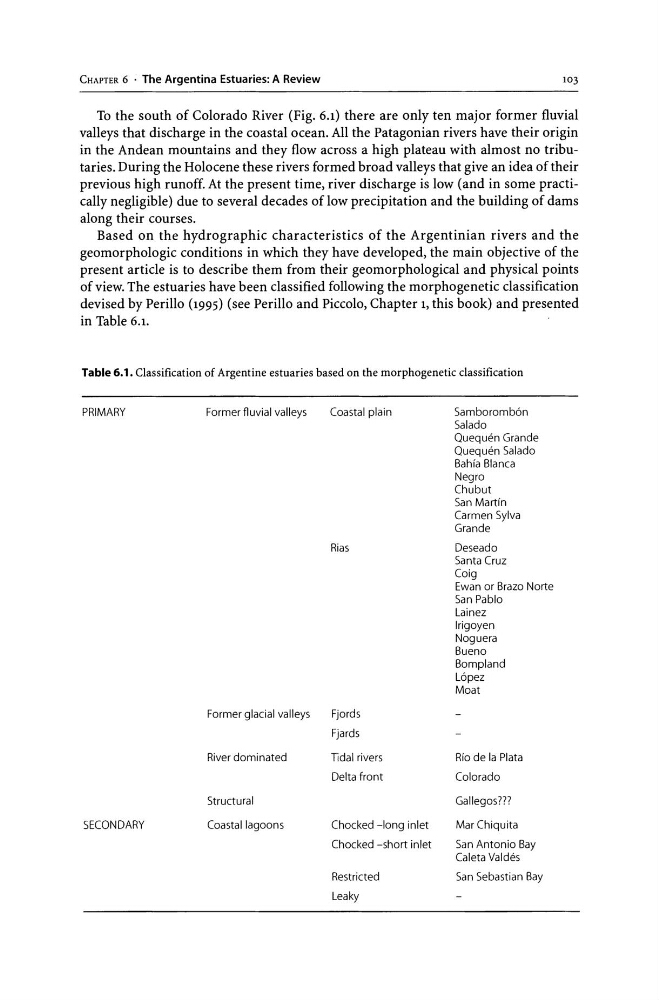
of view. The estuaries have been classified following the morphogenetic classification
devised by Perillo (1995) (see Perillo and Piccolo, Chapter 1, this book) and presented
in Table 6.1.
Table 6.1. Classification of Argentine estuaries based on the morphogenetic classification
PRIMARY
Former fluvial valleys
Coastal plain
Samborombon
Salado
Quequen Grande
Quequen Salado
Bahia Blanca
Negro
Chubut
San Martin
Carmen Sylva
Grande
Rias
Deseado
Santa Cruz
Coig
Ewan or Brazo Norte
San Pablo
Lainez
Irigoyen
Noguera
Bueno
Bompland
Lopez
Moat
Former glacial valleys
Fjords
Fjards
River dominated
Tidal rivers
Rio de la Plata
Delta front
Colorado
Structural
Gallegos???
SECONDARY
Coastal lagoons
Chocked -long inlet
Mar Chiquita
Chocked -short inlet
San Antonio Bay
Caleta Valdes
Restricted
San Sebastian Bay
Leaky
103
To the south of Colorado River (Fig. 6.1) there are only ten major former fluvial
valleys that discharge in the coastal ocean. All the Patagonian rivers have their origin
in the Andean mountains and they flow across a high plateau with almost no tributaries. During the Holocene these rivers formed broad valleys that give an idea of their
previous high runoff. At the present time, river discharge is low (and in some practically negligible) due to several decades of low precipitation and the building of dams
along their courses.
Based on the hydrographic characteristics of the Argentinian rivers and the
geomorphologic conditions in which they have developed, the main objective of the
present article is to describe them from their geomorphological and physical points
of view. The estuaries have been classified following the morphogenetic classification
devised by Perillo (1995) (see Perillo and Piccolo, Chapter 1, this book) and presented
in Table 6.1.
Table 6.1. Classification of Argentine estuaries based on the morphogenetic classification
PRIMARY
Former fluvial valleys
Coastal plain
Samborombon
Salado
Quequen Grande
Quequen Salado
Bahia Blanca
Negro
Chubut
San Martin
Carmen Sylva
Grande
Rias
Deseado
Santa Cruz
Coig
Ewan or Brazo Norte
San Pablo
Lainez
Irigoyen
Noguera
Bueno
Bompland
Lopez
Moat
Former glacial valleys
Fjords
Fjards
River dominated
Tidal rivers
Rio de la Plata
Delta front
Colorado
Structural
Gallegos???
SECONDARY
Coastal lagoons
Chocked -long inlet
Mar Chiquita
Chocked -short inlet
San Antonio Bay
Caleta Valdes
Restricted
San Sebastian Bay
Leaky