

2.2 Nomenclature Types for Substituted Systems
85
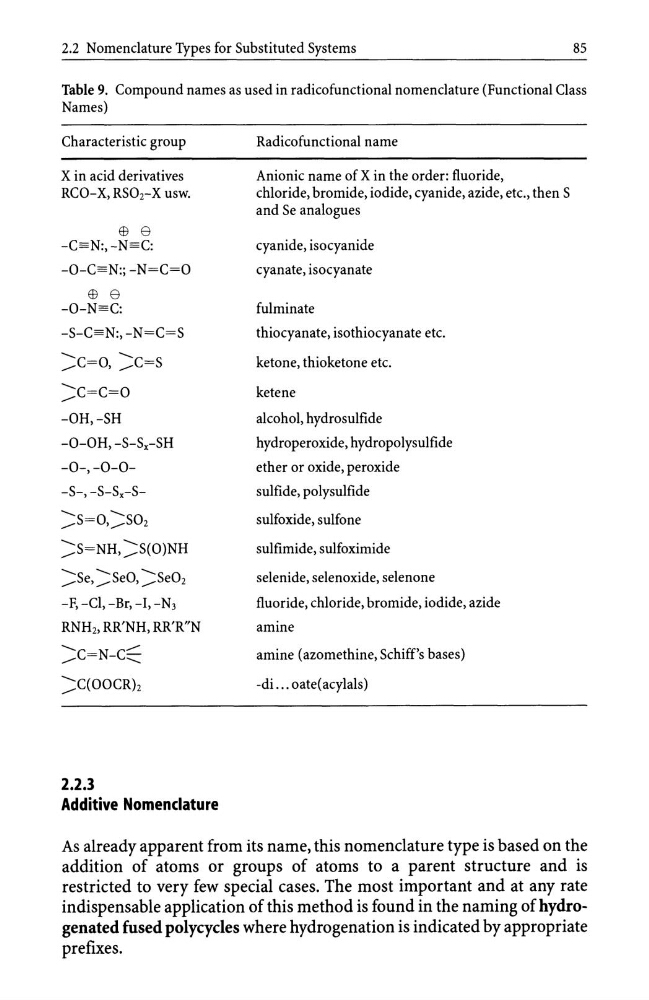
Table 9. Compound names as used in radicofunctional nomenclature (Functional Class
Names)
Characteristic group
X in acid derivatives
RCO-X, RSOrX usw.
Ell 8
-C""N:, -N""C:
-O-C""N:; -N=C=O
Ell 8
-O-N""C:
-S-C""N:,-N=C=S
:::C=O, :::C=S
:::C=C=O
-OH,-SH
-O-OH, -S-ScSH
-0-,-0-0-S-, -S-ScS:::S=0,:::S02
:::S=NH, :::S(O)NH
:::Se, :::SeO, :::Se02
-F, -CI, -Br, -I, -NJ
RNHz, RR'NH, RR'R"N
:::C=N-C:=:
:::C(OOCRh
2.2.3
Additive Nomenclature
Radicofunctional name
Anionic name of X in the order: fluoride,
chloride, bromide, iodide, cyanide, azide, etc., then S
and Se analogues
cyanide, isocyanide
cyanate, isocyanate
fulminate
thiocyanate, isothiocyanate etc.
ketone, thioketone etc.
ketene
alcohol, hydro sulfide
hydro peroxide, hydropolysulfide
ether or oxide, peroxide
sulfide, polysulfide
sulfoxide, sulfone
sulfimide, sulfoximide
selenide, selenoxide, selenone
fluoride, chloride, bromide, iodide, azide
amine
amine (azomethine, Schiff's bases)
-di ... oate( acylals)
As already apparent from its name, this nomenclature type is based on the
addition of atoms or groups of atoms to a parent structure and is
restricted to very few special cases. The most important and at any rate
indispensable application of this method is found in the naming of hydrogenated fused polycycles where hydrogenation is indicated by appropriate
prefixes.
85
Table 9. Compound names as used in radicofunctional nomenclature (Functional Class
Names)
Characteristic group
X in acid derivatives
RCO-X, RSOrX usw.
Ell 8
-C""N:, -N""C:
-O-C""N:; -N=C=O
Ell 8
-O-N""C:
-S-C""N:,-N=C=S
:::C=O, :::C=S
:::C=C=O
-OH,-SH
-O-OH, -S-ScSH
-0-,-0-0-S-, -S-ScS:::S=0,:::S02
:::S=NH, :::S(O)NH
:::Se, :::SeO, :::Se02
-F, -CI, -Br, -I, -NJ
RNHz, RR'NH, RR'R"N
:::C=N-C:=:
:::C(OOCRh
2.2.3
Additive Nomenclature
Radicofunctional name
Anionic name of X in the order: fluoride,
chloride, bromide, iodide, cyanide, azide, etc., then S
and Se analogues
cyanide, isocyanide
cyanate, isocyanate
fulminate
thiocyanate, isothiocyanate etc.
ketone, thioketone etc.
ketene
alcohol, hydro sulfide
hydro peroxide, hydropolysulfide
ether or oxide, peroxide
sulfide, polysulfide
sulfoxide, sulfone
sulfimide, sulfoximide
selenide, selenoxide, selenone
fluoride, chloride, bromide, iodide, azide
amine
amine (azomethine, Schiff's bases)
-di ... oate( acylals)
As already apparent from its name, this nomenclature type is based on the
addition of atoms or groups of atoms to a parent structure and is
restricted to very few special cases. The most important and at any rate
indispensable application of this method is found in the naming of hydrogenated fused polycycles where hydrogenation is indicated by appropriate
prefixes.