

84
2 Substituted Systems
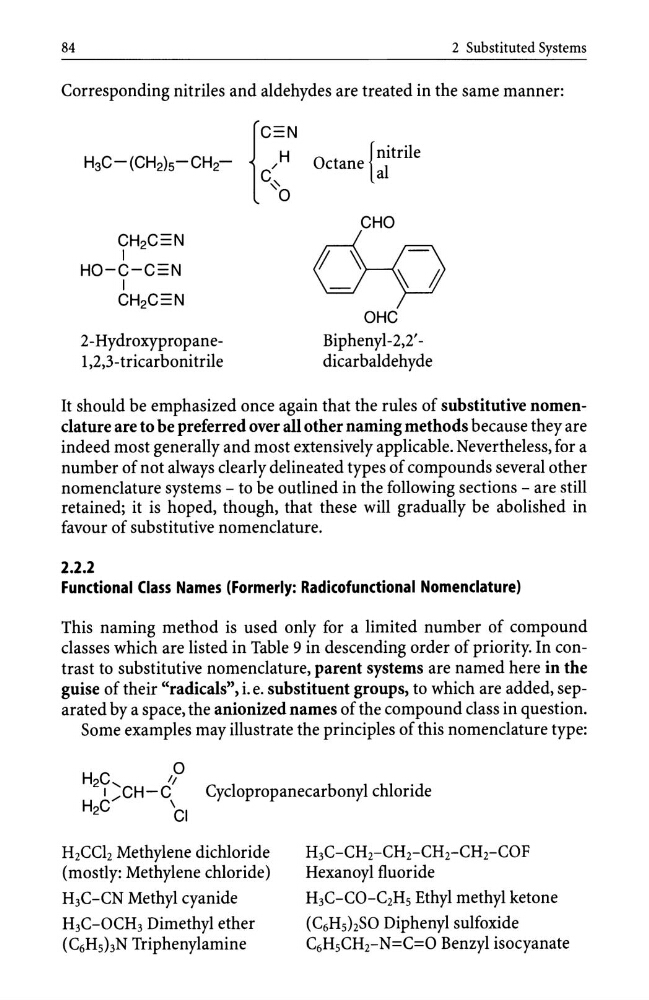
Corresponding nitriles and aldehydes are treated in the same manner:
2-Hydroxypropane1,2,3-tricarbonitrile
O
{ nitrile
ctane al
CHO
< ) ) >
OHC
Biphenyl-2,2'dicarbaldehyde
It should be emphasized once again that the rules of substitutive nomenclature are to be preferred over all other naming methods because they are
indeed most generally and most extensively applicable. Nevertheless, for a
number of not always clearly delineated types of compounds several other
nomenclature systems - to be outlined in the following sections - are still
retained; it is hoped, though, that these will gradually be abolished in
favour of substitutive nomenclature.
2.2.2
Functional Class Names (Formerly: Radicofunctional Nomenclature)
This naming method is used only for a limited number of compound
classes which are listed in Table 9 in descending order of priority. In contrast to substitutive nomenclature, parent systems are named here in the
guise of their "radicals", i. e. substituent groups, to which are added, separated by a space, the anionized names of the compound class in question.
Some examples may illustrate the principles of this nomenclature type:
o
H2C,
II
I/CH-C
Cyclopropanecarbonyl chloride
H2C
CI
H2CCl2 Methylene dichloride
(mostly: Methylene chloride)
H3C-CN Methyl cyanide
H3C-OCH3 Dimethyl ether
(C6HShN Triphenylamine
H3C-CHz-CHz-CHz-CHz-COF
Hexanoyl fluoride
H3C-CO-C2Hs Ethyl methyl ketone
(C6HshSO Diphenyl sulfoxide
C6HsCHz-N=C=O Benzyl isocyanate
2 Substituted Systems
Corresponding nitriles and aldehydes are treated in the same manner:
2-Hydroxypropane1,2,3-tricarbonitrile
O
{ nitrile
ctane al
CHO
< ) ) >
OHC
Biphenyl-2,2'dicarbaldehyde
It should be emphasized once again that the rules of substitutive nomenclature are to be preferred over all other naming methods because they are
indeed most generally and most extensively applicable. Nevertheless, for a
number of not always clearly delineated types of compounds several other
nomenclature systems - to be outlined in the following sections - are still
retained; it is hoped, though, that these will gradually be abolished in
favour of substitutive nomenclature.
2.2.2
Functional Class Names (Formerly: Radicofunctional Nomenclature)
This naming method is used only for a limited number of compound
classes which are listed in Table 9 in descending order of priority. In contrast to substitutive nomenclature, parent systems are named here in the
guise of their "radicals", i. e. substituent groups, to which are added, separated by a space, the anionized names of the compound class in question.
Some examples may illustrate the principles of this nomenclature type:
o
H2C,
II
I/CH-C
Cyclopropanecarbonyl chloride
H2C
CI
H2CCl2 Methylene dichloride
(mostly: Methylene chloride)
H3C-CN Methyl cyanide
H3C-OCH3 Dimethyl ether
(C6HShN Triphenylamine
H3C-CHz-CHz-CHz-CHz-COF
Hexanoyl fluoride
H3C-CO-C2Hs Ethyl methyl ketone
(C6HshSO Diphenyl sulfoxide
C6HsCHz-N=C=O Benzyl isocyanate