

1.2 Cyclic Systems
ss
Table S. Symbols for indicating ring size and saturation degree of heterocycles within
the Hantzsch-Widman system. (A: 0, S, Se, Te, Bi, Hg; B: N, Si, Ge, Sn, Pb; C: B, F, Cl, Br, I,
P,As, Sb)
Ring size
Unsaturated a
Saturated b
Ring size
Unsaturated a Saturated b
3
irene'
irane d
7
epine
epane
4
ete
etane d
8
ocine
ocane
S
ole
olane d
9
onine
onane
6A
ine
ane
10
ecine
ecane
6B
ine
inane
6C
inine
inane
a If at least one double bond and the maximum number of non-cumulated double
bonds are present.
b When no double bonds are present or possible.
, For rings containing (only) nitrogen the traditional ending "irine" can be used.
d For nitrogen-containing rings the traditional endings "iridine", "etidine", and "olidine" are still prefered.
The terminal "e" of the above terms is more or less optional (see for example Chern.
Abstr.) and could conveniently be dispensed with.
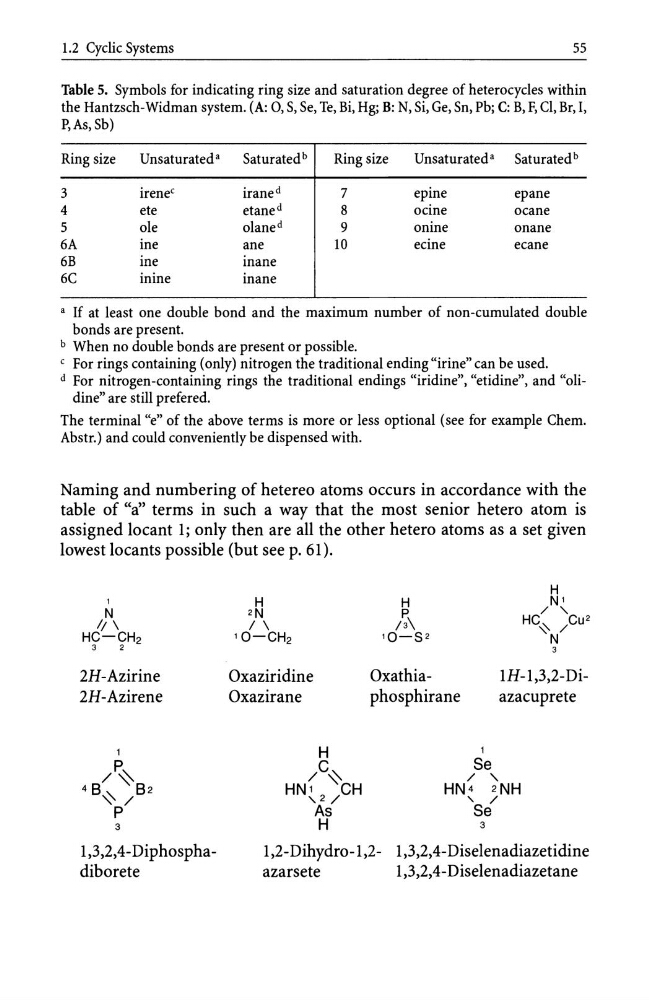
Naming and numbering of hetereo atoms occurs in accordance with the
table of "a" terms in such a way that the most senior hetero atom is
assigned locant 1; only then are all the other hetero atoms as a set given
lowest locants possible (but see p. 61).
1
N
II \
HC-CH2
3
2
2H-Azirine
2H-Azirene
1,3,2,4-Diphosphadiborete
H
2N
I \
10-CH2
Oxaziridine
Oxazirane
H
/C~
HN1 2"CH
" /
As
H
H
H
Nl
P.
/ "13\
HC~ /CU 2
10-8 2
~N
IH-l,3,2-Diphosphirane
azacuprete
1
Se
/
"HN4 2NH
, /
Se
3
1,2-Dihydro-l,2- 1,3,2,4-Diselenadiazetidine
azarsete
1,3,2,4-Diselenadiazetane
ss
Table S. Symbols for indicating ring size and saturation degree of heterocycles within
the Hantzsch-Widman system. (A: 0, S, Se, Te, Bi, Hg; B: N, Si, Ge, Sn, Pb; C: B, F, Cl, Br, I,
P,As, Sb)
Ring size
Unsaturated a
Saturated b
Ring size
Unsaturated a Saturated b
3
irene'
irane d
7
epine
epane
4
ete
etane d
8
ocine
ocane
S
ole
olane d
9
onine
onane
6A
ine
ane
10
ecine
ecane
6B
ine
inane
6C
inine
inane
a If at least one double bond and the maximum number of non-cumulated double
bonds are present.
b When no double bonds are present or possible.
, For rings containing (only) nitrogen the traditional ending "irine" can be used.
d For nitrogen-containing rings the traditional endings "iridine", "etidine", and "olidine" are still prefered.
The terminal "e" of the above terms is more or less optional (see for example Chern.
Abstr.) and could conveniently be dispensed with.
Naming and numbering of hetereo atoms occurs in accordance with the
table of "a" terms in such a way that the most senior hetero atom is
assigned locant 1; only then are all the other hetero atoms as a set given
lowest locants possible (but see p. 61).
1
N
II \
HC-CH2
3
2
2H-Azirine
2H-Azirene
1,3,2,4-Diphosphadiborete
H
2N
I \
10-CH2
Oxaziridine
Oxazirane
H
/C~
HN1 2"CH
" /
As
H
H
H
Nl
P.
/ "13\
HC~ /CU 2
10-8 2
~N
IH-l,3,2-Diphosphirane
azacuprete
1
Se
/
"HN4 2NH
, /
Se
3
1,2-Dihydro-l,2- 1,3,2,4-Diselenadiazetidine
azarsete
1,3,2,4-Diselenadiazetane