

54
1 Parent Structures
H
H2
C,
C 14 0
H 2 C/11'B/ 'C/ 1 'CU
I 12 H 21 CIG
9
e 7 52 3
H2Ge........ /S ........ /. P,,- /0
C I C//\ C
H2 Me Hph PhH2
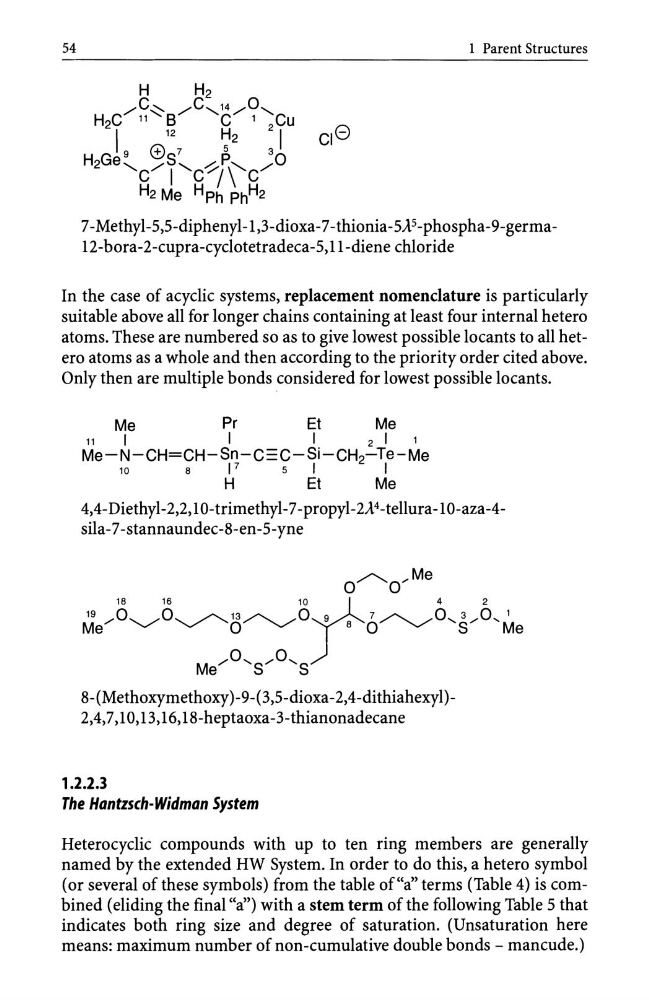
7-Methyl-S,S-diphenyl-l,3-dioxa-7-thionia-S,\5-phospha-9-germa12-bora-2-cupra-cyclotetradeca-S,11-diene chloride
In the case of acyclic systems, replacement nomenclature is particularly
suitable above all for longer chains containing at least four internal hetero
atoms. These are numbered so as to give lowest possible locants to all hetero atoms as a whole and then according to the priority order cited above.
Only then are multiple bonds considered for lowest possible locants.
Me
Pr
Et
Me
11
I
I
I
2 I
1
Me-N-CH=CH-Sn-C:=C-Si-CH 2 -Te-Me
10
8
17
5
I
I
H
Et
Me
4,4-Diethyl-2,2, 1 0-trimethyl-7 -propyl-2,\4-tellura -1 O-aza -4sila-7 -stannaundec-8-en-S-yne
O~O . . . . Me
18
16
10
r
4
2
19 ,O~0~13~0 9
7~0,3 ..... 0 . . . . 1
Me
0
8 0 S
Me
o 0
Me' 's"'" 's
8-(Methoxymethoxy)-9-(3,S-dioxa-2,4-dithiahexyl)2,4,7,10,13,16,18-heptaoxa-3-thianonadecane
1.2.2.3
The Hantzsch-Widman System
Heterocyclic compounds with up to ten ring members are generally
named by the extended HW System. In order to do this, a hetero symbol
(or several of these symbols) from the table of "a" terms (Table 4) is combined (eliding the final "a") with a stem term of the following Table 5 that
indicates both ring size and degree of saturation. (Unsaturation here
means: maximum number of non-cumulative double bonds - mancude.)
1 Parent Structures
H
H2
C,
C 14 0
H 2 C/11'B/ 'C/ 1 'CU
I 12 H 21 CIG
9
e 7 52 3
H2Ge........ /S ........ /. P,,- /0
C I C//\ C
H2 Me Hph PhH2
7-Methyl-S,S-diphenyl-l,3-dioxa-7-thionia-S,\5-phospha-9-germa12-bora-2-cupra-cyclotetradeca-S,11-diene chloride
In the case of acyclic systems, replacement nomenclature is particularly
suitable above all for longer chains containing at least four internal hetero
atoms. These are numbered so as to give lowest possible locants to all hetero atoms as a whole and then according to the priority order cited above.
Only then are multiple bonds considered for lowest possible locants.
Me
Pr
Et
Me
11
I
I
I
2 I
1
Me-N-CH=CH-Sn-C:=C-Si-CH 2 -Te-Me
10
8
17
5
I
I
H
Et
Me
4,4-Diethyl-2,2, 1 0-trimethyl-7 -propyl-2,\4-tellura -1 O-aza -4sila-7 -stannaundec-8-en-S-yne
O~O . . . . Me
18
16
10
r
4
2
19 ,O~0~13~0 9
7~0,3 ..... 0 . . . . 1
Me
0
8 0 S
Me
o 0
Me' 's"'" 's
8-(Methoxymethoxy)-9-(3,S-dioxa-2,4-dithiahexyl)2,4,7,10,13,16,18-heptaoxa-3-thianonadecane
1.2.2.3
The Hantzsch-Widman System
Heterocyclic compounds with up to ten ring members are generally
named by the extended HW System. In order to do this, a hetero symbol
(or several of these symbols) from the table of "a" terms (Table 4) is combined (eliding the final "a") with a stem term of the following Table 5 that
indicates both ring size and degree of saturation. (Unsaturation here
means: maximum number of non-cumulative double bonds - mancude.)