

2.2 Nomenclature Types for Substituted Systems
105
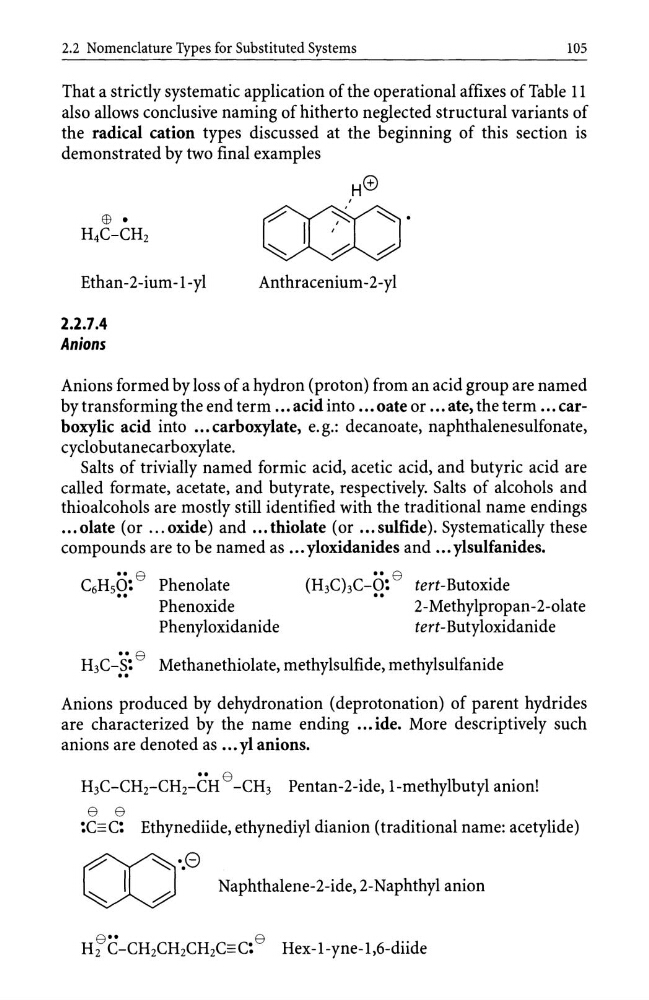
That a strictly systematic application of the operational affixes of Table 11
also allows conclusive naming of hitherto neglected structural variants of
the radical cation types discussed at the beginning of this section is
demonstrated by two final examples
Ethan-2-ium-l-yl
Anthracenium -2-yl
2.2.7.4
Anions
Anions formed by loss of a hydron (proton) from an acid group are named
by transforming the end term ... acid into ... oate or ... ate, the term ... carboxylic acid into ... carboxylate, e. g.: decanoate, naphthalenesulfonate,
cyclobutanecarboxylate.
Salts of trivially named formic acid, acetic acid, and butyric acid are
called formate, acetate, and butyrate, respectively. Salts of alcohols and
thioalcohols are mostly still identified with the traditional name endings
... olate (or ... oxide) and ... thiolate (or ... sulfide). Systematically these
compounds are to be named as ... yloxidanides and .•. ylsulfanides .
.. e
C6HSg:
Phenolate
Phenoxide
Phenyloxidanide
.• e
(H3Chc-g: tert-Butoxide
2-Methylpropan -2-olate
tert-Butyloxidanide
.• e
H3C-.~:
Methanethiolate, methylsulfide, methylsulfanide
Anions produced by dehydronation (deprotonation) of parent hydrides
are characterized by the name ending ... ide. More descriptively such
anions are denoted as ... yl anions.
.. e
H3C-CHr CHr CH -CH3 Pentan-2-ide, I-methylbutyl anion!
e e
:C=C: Ethynediide, ethynediyl dianion (traditional name: acetylide)
00
,-,::··8
~ I ~
Naphthalene-2-ide, 2-Naphthyl anion
H~C-CH2CH2CH2C=C: e Hex-l-yne-l,6-diide
105
That a strictly systematic application of the operational affixes of Table 11
also allows conclusive naming of hitherto neglected structural variants of
the radical cation types discussed at the beginning of this section is
demonstrated by two final examples
Ethan-2-ium-l-yl
Anthracenium -2-yl
2.2.7.4
Anions
Anions formed by loss of a hydron (proton) from an acid group are named
by transforming the end term ... acid into ... oate or ... ate, the term ... carboxylic acid into ... carboxylate, e. g.: decanoate, naphthalenesulfonate,
cyclobutanecarboxylate.
Salts of trivially named formic acid, acetic acid, and butyric acid are
called formate, acetate, and butyrate, respectively. Salts of alcohols and
thioalcohols are mostly still identified with the traditional name endings
... olate (or ... oxide) and ... thiolate (or ... sulfide). Systematically these
compounds are to be named as ... yloxidanides and .•. ylsulfanides .
.. e
C6HSg:
Phenolate
Phenoxide
Phenyloxidanide
.• e
(H3Chc-g: tert-Butoxide
2-Methylpropan -2-olate
tert-Butyloxidanide
.• e
H3C-.~:
Methanethiolate, methylsulfide, methylsulfanide
Anions produced by dehydronation (deprotonation) of parent hydrides
are characterized by the name ending ... ide. More descriptively such
anions are denoted as ... yl anions.
.. e
H3C-CHr CHr CH -CH3 Pentan-2-ide, I-methylbutyl anion!
e e
:C=C: Ethynediide, ethynediyl dianion (traditional name: acetylide)
00
,-,::··8
~ I ~
Naphthalene-2-ide, 2-Naphthyl anion
H~C-CH2CH2CH2C=C: e Hex-l-yne-l,6-diide