

104
2 Substituted Systems
2.2.7.3
Radical Cations (Cation Radicals)
Formation of these species can be envisaged as resulting from a) removal
of an electron from a neutral structure, b) addition of a hydron (or another
positively charged group) to a radical, c) addition of a hydron to, accompagnied by removal of a hydrogen atom from, a neutral compound, and d)
concomitant abstraction of a hydride ion and a hydrogen atom from a
neutral structure (often after a formal dihydrogenation step). Since no discrete morphemes denoting subtraction (or addition) of single electrons
have so far been awarded official status, operations c) and d) are generally applied. This translates into appending composite suffixes, such as
... iumyl and ... yliumyl (derivable from Table 11) to the parent name with
inclusion, if necessary, of the respective locants. Since here again, in
general, and for resonance-prone lt systems in particular, only arbitrarily
chosen (plausible) resonance forms can be named precisely, the more
descriptive denotations radical cation (or cation radical) - in Chern.
Abstr. format: radical ion(I +) - are frequently utilized.
[CH4t B Methaniumyl
[C14HlOl
-EEl
Methane radical cation
Methane radical ion(l +)
Anthraceniumyl etc.
H
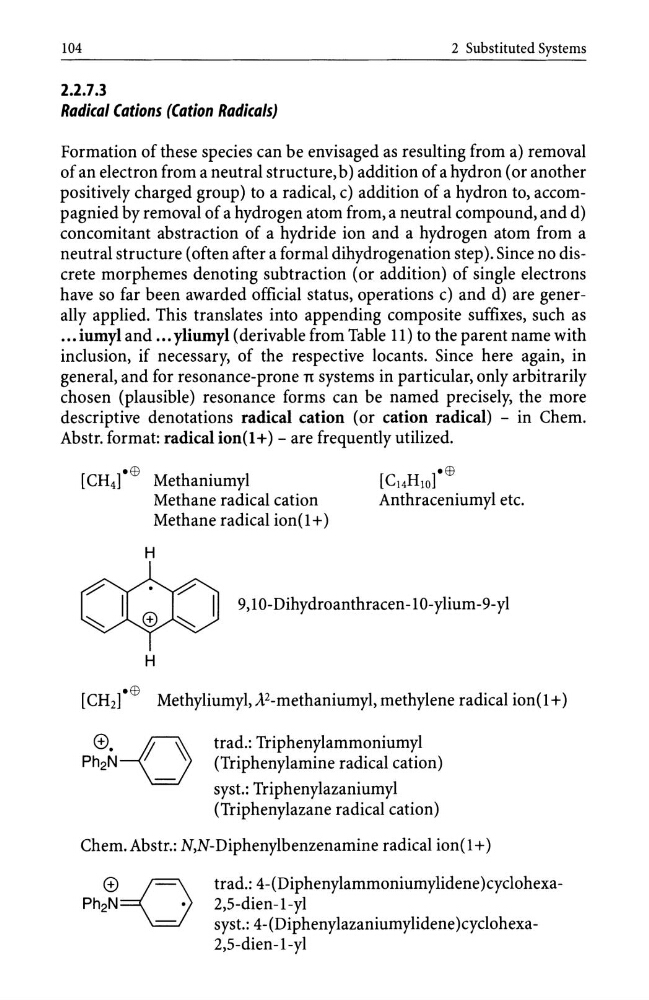
9,10-Dihydroanthracen-10-ylium-9-yl
H
[CH2f EEl Methyliumyl, "V-methaniumyl, methylene radical ion( 1 +)
trad.: Triphenylammoniumyl
(Triphenylamine radical cation)
syst.: Triphenylazaniumyl
(Triphenylazane radical cation)
Chern. Abstr.: N,N- Diphenylbenzenamine radical ion( 1 +)
trad.: 4-(Diphenylammoniumylidene )cyclohexa2,5-dien-1-yl
syst.: 4-(Diphenylazaniumylidene )cyclohexa2,5-dien-1-yl
2 Substituted Systems
2.2.7.3
Radical Cations (Cation Radicals)
Formation of these species can be envisaged as resulting from a) removal
of an electron from a neutral structure, b) addition of a hydron (or another
positively charged group) to a radical, c) addition of a hydron to, accompagnied by removal of a hydrogen atom from, a neutral compound, and d)
concomitant abstraction of a hydride ion and a hydrogen atom from a
neutral structure (often after a formal dihydrogenation step). Since no discrete morphemes denoting subtraction (or addition) of single electrons
have so far been awarded official status, operations c) and d) are generally applied. This translates into appending composite suffixes, such as
... iumyl and ... yliumyl (derivable from Table 11) to the parent name with
inclusion, if necessary, of the respective locants. Since here again, in
general, and for resonance-prone lt systems in particular, only arbitrarily
chosen (plausible) resonance forms can be named precisely, the more
descriptive denotations radical cation (or cation radical) - in Chern.
Abstr. format: radical ion(I +) - are frequently utilized.
[CH4t B Methaniumyl
[C14HlOl
-EEl
Methane radical cation
Methane radical ion(l +)
Anthraceniumyl etc.
H
9,10-Dihydroanthracen-10-ylium-9-yl
H
[CH2f EEl Methyliumyl, "V-methaniumyl, methylene radical ion( 1 +)
trad.: Triphenylammoniumyl
(Triphenylamine radical cation)
syst.: Triphenylazaniumyl
(Triphenylazane radical cation)
Chern. Abstr.: N,N- Diphenylbenzenamine radical ion( 1 +)
trad.: 4-(Diphenylammoniumylidene )cyclohexa2,5-dien-1-yl
syst.: 4-(Diphenylazaniumylidene )cyclohexa2,5-dien-1-yl