

Level 1 – Case 12
86
X
C NH
L L
OCO
DBU
Y
G
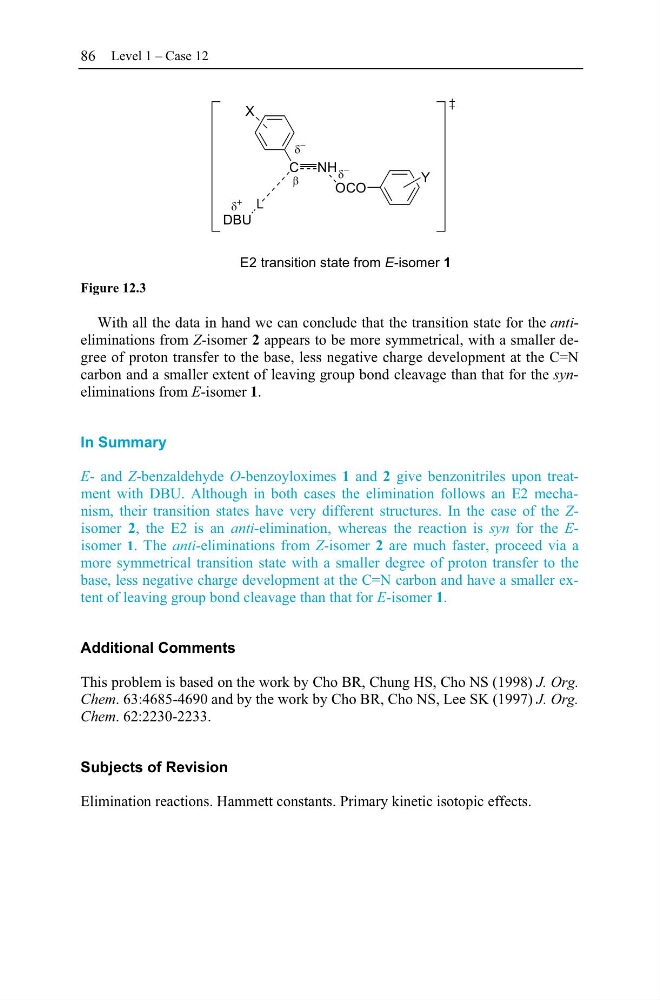
E2 transition state from E-isomer E E
1
G
G
E
Figure 12.3
With all the data in hand we can conclude that the transition state for the antieliminations from Z-isomer Z Z
2 appears to be more symmetrical, with a smaller degree of proton transfer to the base, less negative charge development at the C=N
carbon and a smaller extent of leaving group bond cleavage than that for the syneliminations from E-isomer 1.
In Summary
E- and Z-benzaldehyde O-benzoyloximes 1 and 2 give benzonitriles upon treatment with DBU. Although in both cases the elimination follows an E2 mechanism, their transition states have very different structures. In the case of the Zisomer 2, the E2 is an anti-elimination, whereas the reaction is syn for the Eisomer 1. The anti-eliminations from Z-isomer 2 are much faster, proceed via a
more symmetrical transition state with a smaller degree of proton transfer to the
base, less negative charge development at the C=N carbon and have a smaller extent of leaving group bond cleavage than that for E-isomer 1.
Additional Comments
This problem is based on the work by Cho BR, Chung HS, Cho NS (1998) J. Org.
Chem. 63:4685-4690 and by the work by Cho BR, Cho NS, Lee SK (1997) J. Org.
Chem. 62:2230-2233.
Subjects of Revision
Elimination reactions. Hammett constants. Primary kinetic isotopic effects.
86
X
C NH
L L
OCO
DBU
Y
G
E2 transition state from E-isomer E E
1
G
G
E
Figure 12.3
With all the data in hand we can conclude that the transition state for the antieliminations from Z-isomer Z Z
2 appears to be more symmetrical, with a smaller degree of proton transfer to the base, less negative charge development at the C=N
carbon and a smaller extent of leaving group bond cleavage than that for the syneliminations from E-isomer 1.
In Summary
E- and Z-benzaldehyde O-benzoyloximes 1 and 2 give benzonitriles upon treatment with DBU. Although in both cases the elimination follows an E2 mechanism, their transition states have very different structures. In the case of the Zisomer 2, the E2 is an anti-elimination, whereas the reaction is syn for the Eisomer 1. The anti-eliminations from Z-isomer 2 are much faster, proceed via a
more symmetrical transition state with a smaller degree of proton transfer to the
base, less negative charge development at the C=N carbon and have a smaller extent of leaving group bond cleavage than that for E-isomer 1.
Additional Comments
This problem is based on the work by Cho BR, Chung HS, Cho NS (1998) J. Org.
Chem. 63:4685-4690 and by the work by Cho BR, Cho NS, Lee SK (1997) J. Org.
Chem. 62:2230-2233.
Subjects of Revision
Elimination reactions. Hammett constants. Primary kinetic isotopic effects.