

Elimination Reactions of Benzaldehyde O-Benzoyloximes 85
Alternatively, the extent of the C E -H bond breaking will be determined by the
Hammett constant Uand the k H
k k /k
H H D
k k values. The first are related to the extent of
charge development at the E-carbon and the second indicate the degree of proton
transfer to the base in the transition state. Next we will comment on all these parameters together, in order to find information about the structure of the transition
state for both elimination processes.
Z-oxime 2: anti E2 elimination
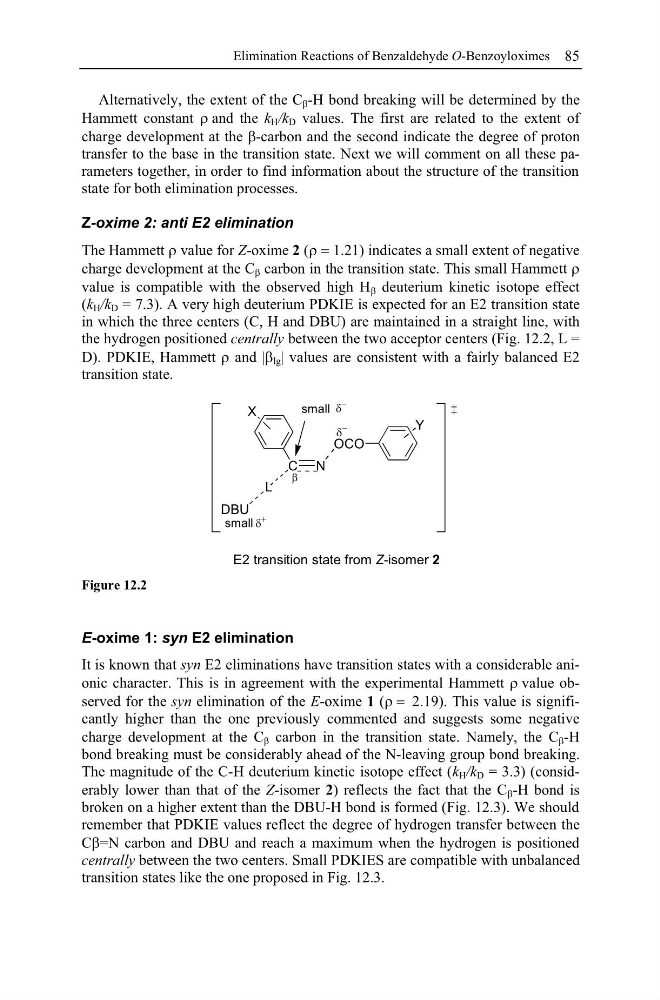
The Hammett U value for Z-oxime Z Z
2 (U 1.21) indicates a small extent of negative
charge development at the C E carbon in the transition state. This small Hammett U
value is compatible with the observed high H E deuterium kinetic isotope effect
(k H
k k /k
H H D
k k = 7.3). A very high deuterium PDKIE is expected for an E2 transition state
in which the three centers (C, H and DBU) are maintained in a straight line, with
the hydrogen positioned centrally between the two acceptor centers (Fig. 12.2, L =
D). PDKIE, Hammett U and |E lg | values are consistent with a fairly balanced E2
transition state.
Y Y Y
X
C N
L L
OCO
DBU
E2 transition state from Z-isomer Z Z
2
G
G
E
small G
small
Figure 12.2
E-oxime 1: syn E2 elimination
It is known that syn E2 eliminations have transition states with a considerable anionic character. This is in agreement with the experimental Hammett Uvalue observed for the syn elimination of the E-oxime 1 (U 2.19). This value is significantly higher than the one previously commented and suggests some negative
charge development at the C E carbon in the transition state. Namely, the C E -H
bond breaking must be considerably ahead of the N-leaving group bond breaking.
The magnitude of the C-H deuterium kinetic isotope effect (k H
k k /k
H H D
k k = 3.3) (considerably lower than that of the Z-isomer Z Z
2) reflects the fact that the C E -H bond is
broken on a higher extent than the DBU-H bond is formed (Fig. 12.3). We should
remember that PDKIE values reflect the degree of hydrogen transfer between the
CE=N carbon and DBU and reach a maximum when the hydrogen is positioned
centrally between the two centers. Small PDKIES are compatible with unbalanced
transition states like the one proposed in Fig. 12.3.
Alternatively, the extent of the C E -H bond breaking will be determined by the
Hammett constant Uand the k H
k k /k
H H D
k k values. The first are related to the extent of
charge development at the E-carbon and the second indicate the degree of proton
transfer to the base in the transition state. Next we will comment on all these parameters together, in order to find information about the structure of the transition
state for both elimination processes.
Z-oxime 2: anti E2 elimination
The Hammett U value for Z-oxime Z Z
2 (U 1.21) indicates a small extent of negative
charge development at the C E carbon in the transition state. This small Hammett U
value is compatible with the observed high H E deuterium kinetic isotope effect
(k H
k k /k
H H D
k k = 7.3). A very high deuterium PDKIE is expected for an E2 transition state
in which the three centers (C, H and DBU) are maintained in a straight line, with
the hydrogen positioned centrally between the two acceptor centers (Fig. 12.2, L =
D). PDKIE, Hammett U and |E lg | values are consistent with a fairly balanced E2
transition state.
Y Y Y
X
C N
L L
OCO
DBU
E2 transition state from Z-isomer Z Z
2
G
G
E
small G
small
Figure 12.2
E-oxime 1: syn E2 elimination
It is known that syn E2 eliminations have transition states with a considerable anionic character. This is in agreement with the experimental Hammett Uvalue observed for the syn elimination of the E-oxime 1 (U 2.19). This value is significantly higher than the one previously commented and suggests some negative
charge development at the C E carbon in the transition state. Namely, the C E -H
bond breaking must be considerably ahead of the N-leaving group bond breaking.
The magnitude of the C-H deuterium kinetic isotope effect (k H
k k /k
H H D
k k = 3.3) (considerably lower than that of the Z-isomer Z Z
2) reflects the fact that the C E -H bond is
broken on a higher extent than the DBU-H bond is formed (Fig. 12.3). We should
remember that PDKIE values reflect the degree of hydrogen transfer between the
CE=N carbon and DBU and reach a maximum when the hydrogen is positioned
centrally between the two centers. Small PDKIES are compatible with unbalanced
transition states like the one proposed in Fig. 12.3.