

The Hydrolysis of p-Substituted Styrene Oxides 75
Another essential aspect is the discussion of the electronic effects. The Hammett U values for D- and E-addition of OH
– (–0.9 and +0.2, respectively) are very
–
low in magnitude and opposite in sign. This results in the observed insensitivity of
the reaction rates to the substituents in the aromatic ring (k OH
k k 1.02u10
–4 M
–1 s
–1 in
the case of the p-NO 2 -styrene and k OH
k k 1.62u10
–4 M
–1 s
–1 in the case of p-Mestyrene). However, despite its low magnitude, U D is indicating some charge development near the ring in the transition state.
Furthermore, the effect of the substituents in position para of the ring seems to
be determinant in the control of the regiochemistry of the reaction. The experimental results with K
18
OH/H 2
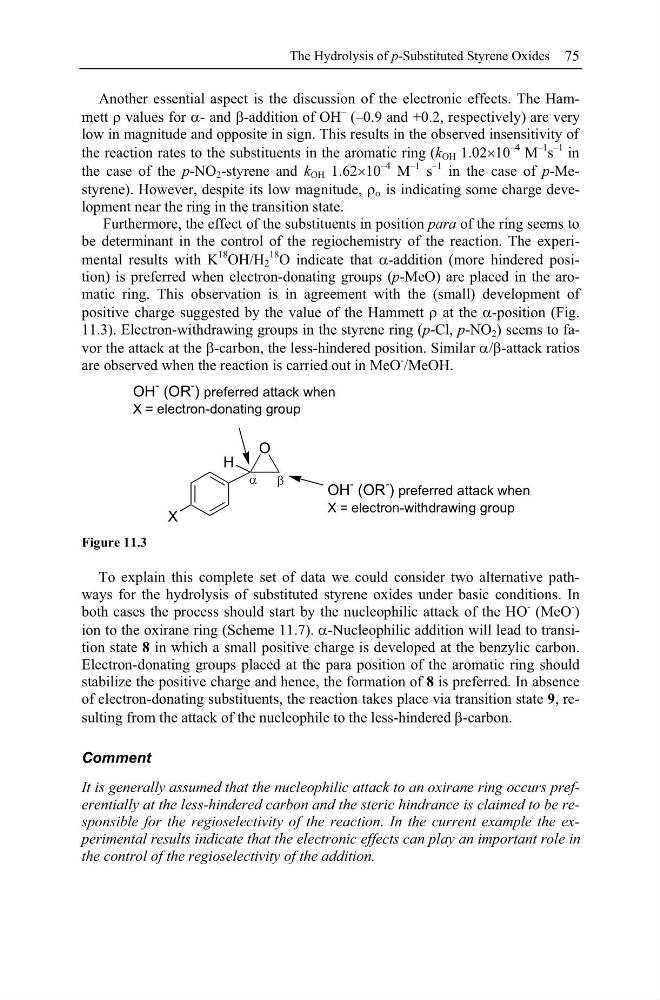
18 O indicate that D-addition (more hindered position) is preferred when electron-donating groups (p
( ( -MeO) are placed in the aromatic ring. This observation is in agreement with the (small) development of
positive charge suggested by the value of the Hammett U at the D-position (Fig.
11.3). Electron-withdrawing groups in the styrene ring (p ( ( -Cl, p-NO 2 ) seems to favor the attack at the E-carbon, the less-hindered position. Similar D/E-attack ratios
are observed when the reaction is carried out in MeO
- /MeOH.
O
H
X
D
E
OH
- (OR
-
) preferred attack when
X = electron-donating group
OH
- (OR
-
) preferred attack when
X = electron-withdrawing group
Figure 11.3
To explain this complete set of data we could consider two alternative pathways for the hydrolysis of substituted styrene oxides under basic conditions. In
both cases the process should start by the nucleophilic attack of the HO
- (MeO
- )
ion to the oxirane ring (Scheme 11.7). D-Nucleophilic addition will lead to transition state 8 in which a small positive charge is developed at the benzylic carbon.
Electron-donating groups placed at the para position of the aromatic ring should
stabilize the positive charge and hence, the formation of 8 is preferred. In absence
of electron-donating substituents, the reaction takes place via transition state 9, resulting from the attack of the nucleophile to the less-hindered E-carbon.
Comment
It is generally assumed that the nucleophilic attack to an oxirane ring occurs preferentially at the less-hindered carbon and the steric hindrance is claimed to be responsible for the regioselectivity of the reaction. In the current example the experimental results indicate that the electronic effects can play an important role in
the control of the regioselectivity of the addition.
Another essential aspect is the discussion of the electronic effects. The Hammett U values for D- and E-addition of OH
– (–0.9 and +0.2, respectively) are very
–
low in magnitude and opposite in sign. This results in the observed insensitivity of
the reaction rates to the substituents in the aromatic ring (k OH
k k 1.02u10
–4 M
–1 s
–1 in
the case of the p-NO 2 -styrene and k OH
k k 1.62u10
–4 M
–1 s
–1 in the case of p-Mestyrene). However, despite its low magnitude, U D is indicating some charge development near the ring in the transition state.
Furthermore, the effect of the substituents in position para of the ring seems to
be determinant in the control of the regiochemistry of the reaction. The experimental results with K
18
OH/H 2
18 O indicate that D-addition (more hindered position) is preferred when electron-donating groups (p
( ( -MeO) are placed in the aromatic ring. This observation is in agreement with the (small) development of
positive charge suggested by the value of the Hammett U at the D-position (Fig.
11.3). Electron-withdrawing groups in the styrene ring (p ( ( -Cl, p-NO 2 ) seems to favor the attack at the E-carbon, the less-hindered position. Similar D/E-attack ratios
are observed when the reaction is carried out in MeO
- /MeOH.
O
H
X
D
E
OH
- (OR
-
) preferred attack when
X = electron-donating group
OH
- (OR
-
) preferred attack when
X = electron-withdrawing group
Figure 11.3
To explain this complete set of data we could consider two alternative pathways for the hydrolysis of substituted styrene oxides under basic conditions. In
both cases the process should start by the nucleophilic attack of the HO
- (MeO
- )
ion to the oxirane ring (Scheme 11.7). D-Nucleophilic addition will lead to transition state 8 in which a small positive charge is developed at the benzylic carbon.
Electron-donating groups placed at the para position of the aromatic ring should
stabilize the positive charge and hence, the formation of 8 is preferred. In absence
of electron-donating substituents, the reaction takes place via transition state 9, resulting from the attack of the nucleophile to the less-hindered E-carbon.
Comment
It is generally assumed that the nucleophilic attack to an oxirane ring occurs preferentially at the less-hindered carbon and the steric hindrance is claimed to be responsible for the regioselectivity of the reaction. In the current example the experimental results indicate that the electronic effects can play an important role in
the control of the regioselectivity of the addition.