

Level 1 – Case 11
74
H 2 O
ArCH CH 2 OH
OH
CH 2 OH
Ar
H
ROH
Ar
OR
CH 2 OH
H
O
Ar
H
H
H +
O
Ar
H
Ar = p-MeOC 6 H 5 , p-MeC 6 H 5 ,
C 6 H 5 , p-ClC 6 H 5 , p-NO 2 C 6 H 5
inversion
racemization
6
path b
path a
5
Scheme 11.5
Base (OH
) Catalysis
The experimental data obtained in the OH
–
-catalyzed hydrolyses of styrene oxides
are completely different from the ones previously commented. First, the reaction
products result from the incorporation of the nucleophile (OH
–
) to both, the D and
the E positions of the oxirane ring, as it has been demonstrated in the reaction with
K
18 OH/H 2
18
O. Second, a change in the nucleophile (solvolysis in MeO
– /MeOH)
–
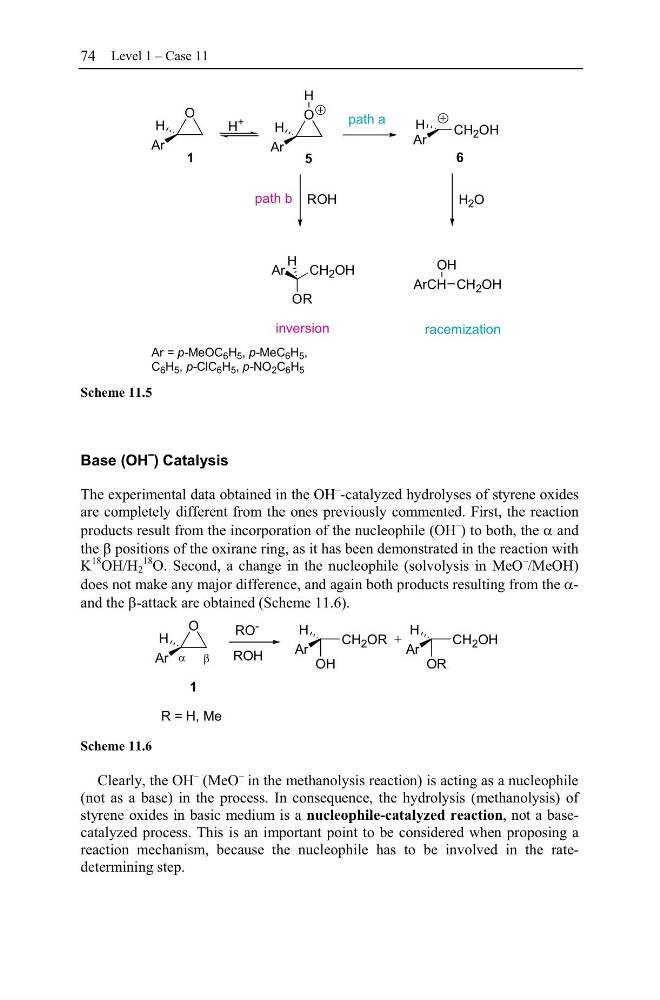
does not make any major difference, and again both products resulting from the Dand the E-attack are obtained (Scheme 11.6).
O
Ar
H
CH 2 OH
Ar
H
OR
CH 2 OR
Ar
H
OH
D
E
RO -
ROH
1
R = H, Me
Scheme 11.6
Clearly, the OH
– (MeO
–
– in the methanolysis reaction) is acting as a nucleophile
–
(not as a base) in the process. In consequence, the hydrolysis (methanolysis) of
styrene oxides in basic medium is a nucleophile-catalyzed reaction, not a basecatalyzed process. This is an important point to be considered when proposing a
reaction mechanism, because the nucleophile has to be involved in the ratedetermining step.
74
H 2 O
ArCH CH 2 OH
OH
CH 2 OH
Ar
H
ROH
Ar
OR
CH 2 OH
H
O
Ar
H
H
H +
O
Ar
H
Ar = p-MeOC 6 H 5 , p-MeC 6 H 5 ,
C 6 H 5 , p-ClC 6 H 5 , p-NO 2 C 6 H 5
inversion
racemization
6
path b
path a
5
Scheme 11.5
Base (OH
) Catalysis
The experimental data obtained in the OH
–
-catalyzed hydrolyses of styrene oxides
are completely different from the ones previously commented. First, the reaction
products result from the incorporation of the nucleophile (OH
–
) to both, the D and
the E positions of the oxirane ring, as it has been demonstrated in the reaction with
K
18 OH/H 2
18
O. Second, a change in the nucleophile (solvolysis in MeO
– /MeOH)
–
does not make any major difference, and again both products resulting from the Dand the E-attack are obtained (Scheme 11.6).
O
Ar
H
CH 2 OH
Ar
H
OR
CH 2 OR
Ar
H
OH
D
E
RO -
ROH
1
R = H, Me
Scheme 11.6
Clearly, the OH
– (MeO
–
– in the methanolysis reaction) is acting as a nucleophile
–
(not as a base) in the process. In consequence, the hydrolysis (methanolysis) of
styrene oxides in basic medium is a nucleophile-catalyzed reaction, not a basecatalyzed process. This is an important point to be considered when proposing a
reaction mechanism, because the nucleophile has to be involved in the ratedetermining step.